News
Here, we regularly share articles about metal forging, including how the process works, news and updates from top forging companies, and trends in the industry. Whether you’re a professional, an enthusiast, or a business looking to stay informed, our column gives useful knowledge, practical tips, and industry insights to help you stay connected and up to date in the world of metal forging.
13-24 of 126 results

Aluminum Alloy Cold Forging Technology Explained
Jun 25, 2026
4
Aluminum alloy cold forging is a room-temperature forming process that uses high pressure to shape aluminum billets into precise, near-net parts without heating. It offers high dimensional accuracy, excellent surface quality, improved strength through work hardening, low material waste, and energy efficiency, making it ideal for mass production. Widely used in aerospace, automotive, military, and electronics industries, it works with alloys such as 6061 and 7075. Despite high equipment demands and limits on complex shapes, it remains a cost-effective and sustainable manufacturing method.

Guide to Surface Roughness for Forged Parts
Jun 22, 2026
3
This article explains surface roughness standards for forged parts, including key parameters (Ra, Rz), industry and international requirements, and their impact on performance and cost. It summarizes influencing factors such as material properties, forging parameters, processing, and environment, and reviews measurement methods and process control strategies for achieving stable surface quality.

Forged Valve Components: Everything You Need to Know
Jun 18, 2026
2
Forged valve components are essential elements in industrial pipeline systems, widely used in oil and gas, petrochemical, and power generation industries. Manufactured through high-temperature and high-pressure forging processes, these components feature dense internal structures, excellent mechanical strength, and superior resistance to fatigue, corrosion, and extreme operating conditions. Compared with cast parts, forged components offer improved reliability, longer service life, and better sealing performance, making them ideal for high-pressure and high-temperature applications.

Guide to Forging Classification, Processes & Equipment
Jun 15, 2026
18
This article provides a comprehensive overview of forging technology, covering its fundamental principles, historical development, classification by temperature and equipment, major forging methods, and key industrial applications. It explains how forging improves metal properties through plastic deformation, grain refinement, and defect elimination, while highlighting the differences between hot, warm, and cold forging as well as open die, closed die, and ring rolling processes. The article also introduces essential forging equipment and modern advancements such as precision and automated forging, offering a clear understanding of how this essential manufacturing process supports modern high-performance metal component production.

Material Selection and Optimization in Forging Design
Jun 09, 2026
22
This article presents a concise overview of forging design, focusing on material selection, geometric design, heat treatment, and quality control. It explains how steel type, structural features, and process parameters influence strength, toughness, and manufacturability. The guide also highlights key optimization strategies and testing methods used to ensure reliable, high-performance forged components in demanding industrial applications.

Forged Rings vs. Seamless Rolled Rings: A Selection Guide
Jun 08, 2026
31
This article provides a systematic comparison between forged rings and seamless rolled rings, two widely used ring manufacturing solutions in industrial applications. It explains their differences in manufacturing processes, microstructural characteristics, mechanical performance, dimensional accuracy, and machining behavior, while also highlighting their respective advantages in cost efficiency, material utilization, and production scalability. By analyzing key application scenarios such as wind power, aerospace, heavy machinery, and chemical equipment, the article clarifies how each process performs under different engineering requirements.

What is Metal Forging Scale & How to Deal with It
Jun 06, 2026
91
Forging scale is an iron oxide layer formed on steel during high-temperature forging, characterized by its brittle, black, flaky surface. While it is an unavoidable by-product of thermal metal processing, it significantly affects welding quality, surface precision, and tool wear if not properly managed. This article explains its formation mechanism, distinguishes it from rust, and explores its dual nature as both a processing challenge and an aesthetic element. It further details methods to reduce scale formation, including temperature control and flux use, and provides a comprehensive overview of chemical and mechanical descaling techniques such as acid pickling and abrasive blasting.

Understanding Grain Flow in Forged Components
Jun 05, 2026
78
This article explains the concept of metal grain flow in forging and its critical role in determining the mechanical performance of industrial components. It explores how plastic deformation during forging aligns and refines grain structures, improving strength, fatigue resistance, and impact toughness. The article also compares forging with machining and casting, highlighting the advantages of continuous grain flow in enhancing reliability and service life. In addition, it discusses grain flow requirements for different forged parts and outlines key process controls such as temperature management, multi-stage forging, and near-net-shape forming.

Multi-Directional Forging for Complex Components
Jun 04, 2026
21
Multi-directional forging (MDF) is an advanced metal forming technology that applies pressure from multiple directions to produce complex, flash-free components in a single stroke. Combining extrusion and die forging, MDF improves material utilization, enhances mechanical properties, and efficiently forms difficult-to-machine materials such as stainless steel, high-temperature alloys, and titanium. This technology offers optimized metal flow, high production efficiency, and adaptability to intricate shapes, making it ideal for aerospace, energy, heavy machinery, and hydraulic systems. Key aspects include forming principles, parting methods, die design, and typical industrial applications.

A Comparison of Press Forging and Hammer Forging
Jun 01, 2026
14
This article compares press forging and hammer forging, two key metal forming processes in manufacturing. It explains their working principles, differences in forming method, precision, internal structure, efficiency, and cost, as well as their respective advantages and limitations. Press forging offers high accuracy and uniform quality for large-scale production, while hammer forging provides strong toughness, fast forming, and lower equipment cost. The article also outlines selection criteria and typical applications in industries such as aerospace, automotive, oil and gas, and tooling, helping readers choose the appropriate forging method based on performance and production requirements.
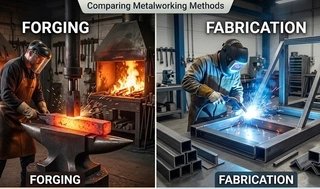
Forging vs. Fabrication: Two Core Metal Processing Methods
May 29, 2026
16
Forging and fabrication are two core metal forming methods. Forging reshapes solid metal under heat and pressure to improve strength and durability. It produces dense, high-performance parts for heavy-duty use. Fabrication cuts, bends, and assembles metal into structures. It offers flexibility, fast production, and cost efficiency. Forged parts are stronger, while fabricated structures are more versatile and scalable.
Complete Guide to Copper Alloy Hot Forging
May 25, 2026
20
In modern industrial manufacturing, copper alloys and hot forging technology are two closely connected and indispensable elements. Copper alloys are widely used in industries such as electrical power, construction, transportation, marine engineering, and machinery manufacturing because of their...
Total 126 Records, 12 records per page