How to Choose Between Forged Pistons and Cast Pistons
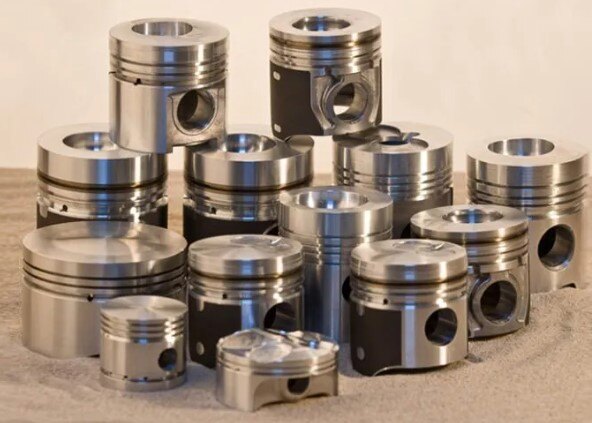
In engine modification, the piston is a component that is often discussed but rarely deeply understood. When many car owners consider increasing power, the first things that come to mind are turbochargers, exhaust systems, or ECU tuning, while they overlook the piston, a component located at the very core of the engine.
The choice of forged piston or cast piston directly determines how much power an engine can withstand, how high a boost level it can handle, and whether it can maintain stable operation under extreme conditions. Choosing the wrong piston may result in limited power and increased fuel consumption in mild cases, or engine knocking, cylinder scoring, or even complete engine failure in severe cases.
At present, pistons on the market are mainly divided into two categories: forged pistons and cast pistons. These two types differ significantly in manufacturing processes, material properties, structural design, and application scenarios. Understanding these differences is a prerequisite for making the correct choice.
Cast pistons are currently the most common type of piston, and almost all original factory engines use cast pistons. Their manufacturing process involves heating aluminum alloy to a molten state, then pouring it into a pre-made mold. After cooling and solidification, the piston is removed, followed by necessary machining.
The advantage of this process is high production efficiency and low cost, making it suitable for large-scale mass production. A casting production line can produce hundreds or even thousands of pistons per day. Therefore, cast pistons are relatively inexpensive. The total cost of replacing a set of cast pistons for a typical passenger car is usually only a few hundred to over a thousand yuan.
However, the casting process also has inherent defects. When the metal solidifies in the mold, the crystal grain growth direction is random and cannot be controlled. During cooling, the surface and interior of the metal cool at different rates, which can easily lead to micro-porosity and shrinkage defects. These microscopic defects do not appear during normal use, but under high load, high speed, or high boost conditions, they may become the origin of cracks.
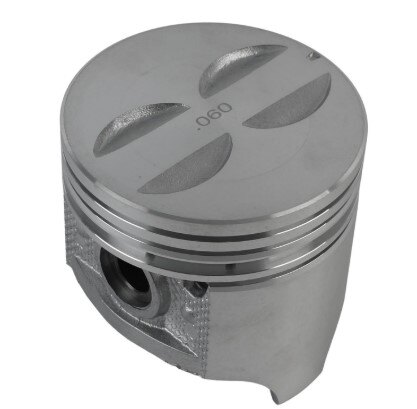
The starting point of forged pistons is a solid aluminum alloy billet, not molten metal. This billet is first heated to a plastic state (usually 400–500°C), and then compressed and formed in a mold using a press with thousands of tons of force.
During this process, the internal grain structure of the metal undergoes a fundamental change. Originally randomly arranged grains are forced to rearrange along the direction of force, forming a so-called “grain flow” (Grain Flow). This directional grain structure makes the material’s strength more uniform in all directions, and its internal density is much higher than that of cast materials.
To use a simple analogy: a cast piston is like an artificial board made by pressing sawdust and glue together; although usable, its internal structure is discontinuous and non-uniform. A forged piston is like furniture made from a single piece of solid wood, with a continuous and consistent structure, naturally resulting in higher strength.
After forging, the piston must undergo precision CNC machining, including piston ring grooves, piston pin holes, valve relief cuts, and skirt profiling. These processes require extremely high precision, typically with tolerances controlled within 0.01 mm. After that, heat treatment is performed to further optimize mechanical properties. Some high-end forged pistons also undergo surface coating treatments, such as graphite or molybdenum disulfide coatings on the piston skirt, to reduce friction and wear.
The entire forging and machining process is complex and time-consuming. Therefore, the cost of forged pistons is usually more than three times that of cast pistons. The price per piston can range from several hundred to over a thousand yuan.
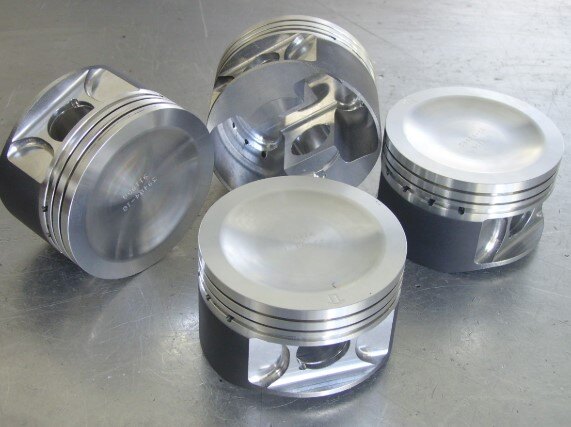
Piston materials are usually aluminum-silicon alloys because aluminum is lightweight and has good thermal conductivity, while silicon significantly reduces thermal expansion. However, cast pistons and forged pistons differ significantly in silicon content.
To control thermal expansion and ensure stable clearance between piston and cylinder wall during cold starts, cast pistons typically use high-silicon hypereutectic aluminum alloys, with silicon content generally between 17%–26%. This material has good fluidity during casting, making it easy to fill complex mold shapes. After forming, it has a low thermal expansion coefficient, allowing small clearance between piston and cylinder wall.
The direct advantage of small clearance is quieter engine operation. There is no obvious piston knocking noise during cold start, blow-by is reduced, and it is beneficial for oil consumption and emissions. This is one of the reasons why original factory engines widely use cast pistons.
However, the disadvantage of high-silicon alloys is greater brittleness. Silicon forms hard particles in the aluminum alloy. The higher the silicon content, the harder and more brittle the material becomes. In cases of knocking or abnormal combustion, the piston ring bridge (the thin wall section connecting piston ring grooves) of cast pistons is prone to cracking, and in severe cases, even the piston crown may break.
Forged pistons typically use aluminum alloys with lower silicon content (generally 8%–12%), and some even use nearly silicon-free 2xxx series aerospace aluminum alloys. Low silicon content gives the material better ductility and toughness, allowing slight deformation under impact without breaking.
This characteristic is especially important for high-boost engines. When mild knocking occurs, forged pistons can “withstand” the impact, while cast pistons may already crack. In addition, forged pistons have higher material density, and under the same strength requirement, they can be made lighter, reducing reciprocating mass in the engine.
The cost of low-silicon materials is a higher thermal expansion coefficient. Therefore, forged pistons require larger clearance between piston and cylinder when cold. This leads to a temporary “piston knocking sound” during cold start, which is normal. Once the engine temperature rises and the piston expands, the clearance decreases and the noise disappears.
Cast piston design primarily focuses on daily comfort and economy. The piston crown is usually thinner to reduce weight and optimize combustion chamber shape; the piston skirt is longer, with a larger contact area with the cylinder wall, helping stability and noise reduction; the piston ring bridge is thinner to reduce weight and friction.
These designs perform well under original factory conditions, but under high load conditions, the weak piston ring bridge and crown structure become bottlenecks. When cylinder pressure exceeds design limits, the ring bridge may crack due to excessive bending stress, and the piston crown may suffer thermal stress concentration leading to melting or perforation.
Forged pistons are designed for high-load conditions. The piston ring bridge is significantly thicker, allowing it to withstand higher combustion pressure; the piston pin boss area is reinforced to handle greater connecting rod force; the piston crown can be custom-designed according to combustion chamber requirements, such as deeper valve reliefs or modified compression surfaces.
Because forged pistons have greater strength margin, designers can optimize other performance aspects while maintaining strength. For example, unnecessary material can be removed through precise calculation, allowing forged pistons to be lighter than cast pistons while being stronger. The reduced reciprocating mass allows faster engine response and more sensitive throttle behavior.
However, the reinforced structure of forged pistons also means larger installation clearance is required, and higher precision is needed in cylinder machining and assembly. Improper clearance control may cause seizure if too small, or increased oil consumption and noise if too large.
Differences in manufacturing processes and materials directly determine performance differences in real-world use. The following compares several key aspects to help with decision-making.
In terms of strength, forged pistons have clear advantages. Due to their dense and directional grain structure, their tensile strength, fatigue strength, and impact toughness are significantly higher than cast pistons. Under the same material grade, forged parts typically have 30%–50% higher mechanical performance.
In terms of durability, forged pistons show less performance degradation under long-term high-temperature cycles. Cast pistons become brittle after prolonged high-temperature operation, and microscopic pores may expand into cracks. Forged pistons have better thermal stability and can maintain structural integrity even during continuous high-load track driving.
High RPM means the piston performs thousands of reciprocating movements per minute, generating huge inertial forces. Due to uneven density and possible internal defects, cast pistons are more prone to fatigue failure under high-frequency alternating stress. Forged pistons have better material consistency and fewer internal defects, allowing them to withstand such stress for longer periods.
In high-boost applications, cylinder pressure may exceed twice the original factory level. Cast pistons are typically designed for 80–120 bar, while forged pistons can withstand over 150 bar. For high-power tuning projects, forged pistons are almost a necessity.
Forged pistons are usually 10%–20% lighter than cast pistons of the same size. Although each piston only reduces tens of grams, the total reduction across four pistons and piston pins significantly improves engine dynamic response. Lower reciprocating mass allows the crankshaft to accelerate faster, shortening the time needed to reach high RPM and improving driving responsiveness.
However, reducing piston weight changes the balance of the crankshaft-connecting rod-piston system. If other components are not adjusted accordingly, vibration may occur at high RPM. Therefore, forged piston upgrades usually require dynamic balancing correction.
Knocking is one of the most dangerous phenomena in engine modification. During knocking, unburned air-fuel mixture self-ignites under high pressure, producing strong pressure waves that impact the piston crown. Cast pistons, due to their brittleness, are prone to cracking under repeated knocking. Forged pistons have better toughness and can absorb impact energy, providing a greater safety margin.
In addition, forged pistons generally have better thermal conductivity, allowing faster heat transfer from the piston crown to the cylinder wall, reducing piston temperature and thermal load.
Initial Investment: A set of cast pistons for a four-cylinder engine typically costs 500–1500 yuan, including standard piston rings and pins. A comparable set of forged pistons may cost 300–800 yuan per piston, with total cost reaching 3000–8000 yuan, which is three to five times that of cast pistons. However, this is only part cost. Installation requirements for forged pistons are higher, usually requiring precision cylinder honing. If cylinder walls are worn, boring may also be required. These machining costs may add another 1000–3000 yuan.
Long-Term Value: For stock or lightly modified vehicles, cast pistons offer better cost-effectiveness, with service life reaching 200,000–300,000 km under normal use, fully meeting daily requirements. However, for high-boost or high-power modifications, the risk cost of using cast pistons may far exceed the purchase cost of forged pistons. Once failure occurs, debris may damage cylinder walls, valves, or even punch through the engine block, leading to repair costs of tens of thousands of yuan. In this case, forged pistons act as insurance, preventing greater potential losses.
If your vehicle is mainly used for daily commuting, with power levels close to or slightly above stock (within 30% increase), a mild driving style, and no frequent high-RPM use, then cast pistons are fully sufficient. They are quiet, economical, and reliable, with low maintenance cost.
Engine engineers already design factory engines for most usage scenarios. Cast piston clearance, material selection, and structural design are optimized for daily use. Without clear requirements, there is no need to blindly upgrade to forged pistons.
If you plan any of the following modifications, forged pistons should be considered:
- Turbocharger or supercharger upgrade with boost increase exceeding 50%
- Naturally aspirated engine with significantly higher RPM (e.g., from 7000 to 9000+ RPM)
- Nitrous oxide (NOS) system use
- Frequent track driving or drag racing
- Wheel horsepower exceeding stock by more than 100%
In these scenarios, the safety margin of cast pistons is already exhausted, and continued use carries high risk. Forged pistons, combined with reinforced connecting rods, crankshaft, and upgraded bearings, form the foundation of a reliable high-performance engine.
The choice between forged and cast pistons is essentially a balance between performance, cost, and application.
Cast pistons are suitable for users seeking economy, comfort, and daily reliability. They are inexpensive, quiet in operation, and easy to maintain, performing well in stock and mild modification ranges.
Forged pistons are suitable for users pursuing extreme performance, high boost, high RPM, or track driving. They offer high strength, low weight, and strong heat resistance, forming the foundation of a reliable high-power engine, but require higher initial investment and more professional installation and maintenance.
The final decision should be based on your power goals, driving habits, budget range, and overall modification plan, rather than a single parameter. If you are unsure of your needs, it is recommended to consult an experienced engine tuning technician to develop a reasonable plan based on your specific vehicle and usage scenario. Remember, there is no universal “one-step solution” in engine modification. The best choice is always the one that suits your needs.