Powder Forging Process, Benefits & Applications
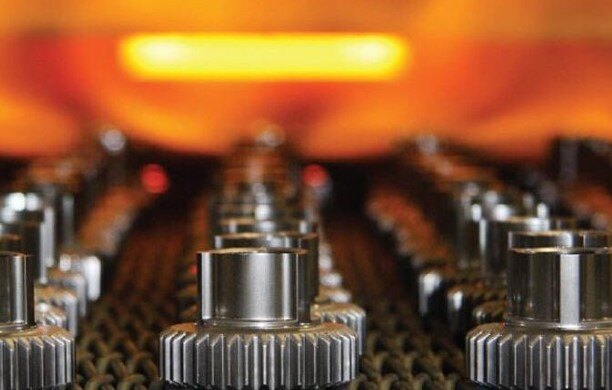
In the field of mechanical manufacturing, achieving high-strength, high-precision, and cost-effective production of components has always been a central concern for manufacturers. With the ever-increasing demands of the automotive, aerospace, and industrial machinery sectors, traditional manufacturing methods often face trade-offs between material utilization, mechanical performance, and production efficiency. Powder forging technology has emerged in response to these challenges as a cutting-edge manufacturing solution. By integrating powder metallurgy with precision forging, this technique utilizes a sequence of pressing, sintering, and forging to produce metal parts with densities approaching those of wrought steel, while preserving complex geometric precision.
Compared to conventional forging, powder forging significantly reduces material waste. Compared to standard powder metallurgy, it markedly enhances mechanical properties such as tensile strength, fatigue resistance, and impact toughness. This article provides a comprehensive overview of powder forging, including its process principles, core advantages, performance comparisons, alternative solutions, and typical material applications, enabling readers to gain a thorough understanding of this modern manufacturing technology.
Powder forging is an advanced metal forming process that combines the flexibility of powder metallurgy with the strengthening advantages of precision forging. The core principle involves first compressing metal powder into a preform that closely resembles the final part shape. This preform then undergoes high-temperature sintering to establish initial metallurgical bonds between the powder particles. Finally, forging at elevated temperatures densifies the material further, closing residual porosity and enhancing the microstructure.
This multi-step process allows parts to achieve densities close to or equal to wrought steel. The internal structure is highly uniform and isotropic, enabling mechanical performance comparable to, or even exceeding, that of conventional alloy steel. Powder forging is particularly valuable in producing components that require both high strength and dimensional precision, making it a preferred method in automotive, aerospace, and precision machinery applications.
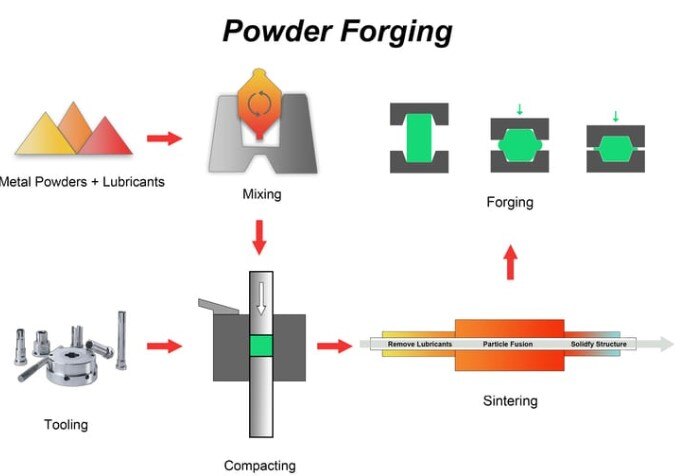
The powder forging process can be divided into three key stages:
- Compaction: Metal powders are placed into molds and compressed under high pressure to form preforms with a specific density and shape. This step establishes the initial geometry of the part and ensures high material utilization.
- Sintering: The compacted preform is heated in a controlled atmosphere furnace, causing particles to bond metallurgically. This step increases strength while maintaining the preform’s dimensional stability.
- Forging: While the part remains at a high temperature (typically above 1800°F), it is transferred to forging dies where final shaping occurs. At elevated temperatures, the material exhibits excellent plasticity, allowing internal pores to collapse under pressure, further densifying the part and improving mechanical properties.
The primary goal of powder forging is to maximize the density and mechanical performance of components. After forging, parts typically achieve over 98% of theoretical maximum density, with internal porosity reduced by more than 99%. High density directly enhances mechanical properties, including tensile strength, fatigue resistance, and impact toughness, giving powder-forged components a clear advantage over standard powder metallurgy products.
Moreover, because the powder metallurgy stage produces near-net shapes, subsequent forging primarily focuses on densification and mechanical strengthening. This allows powder forging to balance complex geometric requirements with high-performance demands, making it suitable for critical structural components such as connecting rods, gears, and aerospace structural parts.
Powder forging has gained recognition in industrial manufacturing due to its unique combination of advantages in forming precision, mechanical performance, material design, production efficiency, and cost control.
Powder forging ensures high forming accuracy by using molds throughout both compaction and forging stages. Parts produced are extremely close to final dimensions, often requiring minimal secondary machining. Material utilization can exceed 95%, significantly reducing raw material waste.
Sintering and forging are conducted in protective atmospheres to minimize surface oxidation, further improving dimensional accuracy and extending die life. Unlike traditional forging, which requires cutting from billets and generates substantial scrap, powder forging efficiently preserves material and energy, offering a clear economic and environmental advantage.
Powder-forged parts exhibit high density, uniform internal structures, and minimal porosity, resulting in superior mechanical properties. Fatigue resistance is particularly enhanced, as low internal porosity prevents stress concentrations under cyclic loading.
This makes powder-forged components ideal for applications requiring high fatigue strength. For example, automotive engine connecting rods endure repeated tensile and compressive loads during operation. Powder-forged connecting rods maintain stable performance under these conditions, contributing to engine durability and reliability.
Other components, such as gears, cams, and high-stress aerospace fittings, also benefit from the combination of high density, isotropic microstructure, and reduced defect concentration.
Powder forging allows flexible material design. By combining different metal powders, manufacturers can tailor alloy compositions to meet specific performance requirements, such as enhanced corrosion resistance, high-temperature strength, or wear resistance. This flexibility enables optimal cost-performance balance, particularly in high-value applications.
From a production standpoint, powder forging is suitable for large-scale automated manufacturing. The use of precision molds and streamlined process steps reduces cycle times and increases throughput compared to traditional multi-step machining or forging methods. This makes powder forging an attractive option for mass production of high-strength, complex components.
High material utilization reduces intermediate process and scrap disposal costs. Parts near their final shape require minimal secondary machining, making powder forging particularly advantageous for complex components such as gears, cams, and connecting rods.
Reduced machining also minimizes the risk of surface defects introduced by cutting, further improving component quality and reliability. Overall, powder forging provides a cost-efficient solution without compromising mechanical performance.
To fully appreciate the advantages of powder forging, it is essential to understand its two foundational techniques: powder metallurgy and forging. Each process has its unique strengths and limitations, which powder forging effectively integrates.
Powder metallurgy involves compacting metal powders in molds, followed by sintering at high temperatures to bond particles into a solid part. Advantages include high production efficiency, precise dimensional control, and minimal post-processing. By blending different metal powders, manufacturers can create custom alloys with specific mechanical or chemical properties.
Powder metallurgy is widely used for complex parts such as gears, sprockets, pistons, bushings, and connecting rods. However, typical densities range from 85% to 92% of theoretical density, with residual porosity limiting performance in high-stress or fatigue-critical applications.
Forging is a traditional method where metal is heated to a plastic state and shaped under high pressure using hammers or presses. Forging aligns internal grain structures along the direction of force, creating a continuous, uniform crystalline structure that enhances strength, toughness, and durability.
Forging methods include open-die, closed-die, and press forging. Forged steel components are dense and pore-free, offering excellent wear resistance, high-stress tolerance, and impact strength. Forging is commonly used in aerospace, automotive, and heavy machinery applications, particularly for high-stress or high-temperature components such as aircraft structural parts, crankshafts, and structural steel members.
Powder forging combines the near-net-shape forming capability of powder metallurgy with the mechanical strengthening benefits of forging. It allows the production of complex components with minimal waste while achieving mechanical properties comparable to or exceeding those of conventionally forged steel. This hybrid process makes powder forging particularly effective for high-strength, geometrically complex components, offering both precision and durability.
While powder forging combines the benefits of powder metallurgy and forging, engineers often face the choice between using powder-forged or conventionally forged steel parts for the same application.
Powder-forged components achieve high density, but residual microscopic porosity may remain, slightly reducing fatigue resistance compared to high-quality forged steel under extreme loading. Forged steel, with aligned continuous grains and no porosity, excels in wear resistance, high-stress capacity, and impact toughness.
Forged steel components generally exhibit longer service life under heavy load, high-impact, or high-temperature conditions. Powder-forged components perform well under normal conditions but may require more frequent replacement in extreme environments. Critical applications, such as automotive crankshafts or aircraft landing gear, benefit from forged steel’s superior reliability.
Powder forging often involves lower initial investment due to high production efficiency, minimal scrap, and near-net shape formation. Forging requires higher labor and energy inputs and generates more material waste. However, considering total lifecycle costs, forged steel may provide lower long-term expenses due to extended durability and reduced replacement frequency. Companies must weigh upfront costs against long-term performance.
Powder forging is ideal for high-strength, high-precision components, including engine parts, drivetrain components, chassis components, and automatic transmission parts. Automotive connecting rods are a prime example: powder forging reduces raw material weight while minimizing secondary machining.
Other applications include aerospace components, biomedical devices, and electrical contacts. Powder-forged parts can withstand high stresses, making them suitable for structural aerospace components. In automotive manufacturing, powder forging produces gears, cams, and transmission components. In general mechanical engineering, it enables the production of complex high-strength parts that leverage the combined advantages of powder metallurgy and precision forging.
Powder forging successfully integrates the forming benefits of powder metallurgy with the strengthening advantages of forging. By combining pressing, sintering, and forging, it produces high-density, high-strength, high-precision metal parts with material utilization exceeding 95%, offering clear advantages in cost efficiency and production throughput.
Compared to traditional forging, powder forging excels in producing complex-shaped parts and reducing initial costs. However, under extreme high-stress or high-impact conditions, its durability remains slightly lower than premium forged steel. Ultra-high-temperature sintering offers a compromise, achieving performance close to powder forging without significant additional equipment investment, providing more options for small and medium-sized enterprises. With its combination of precision, efficiency, and performance, powder forging is poised to play a key role in modern high-performance manufacturing, especially for automotive, aerospace, and high-precision industrial applications.