Overview of Inconel Forgings for Engineers and Buyers
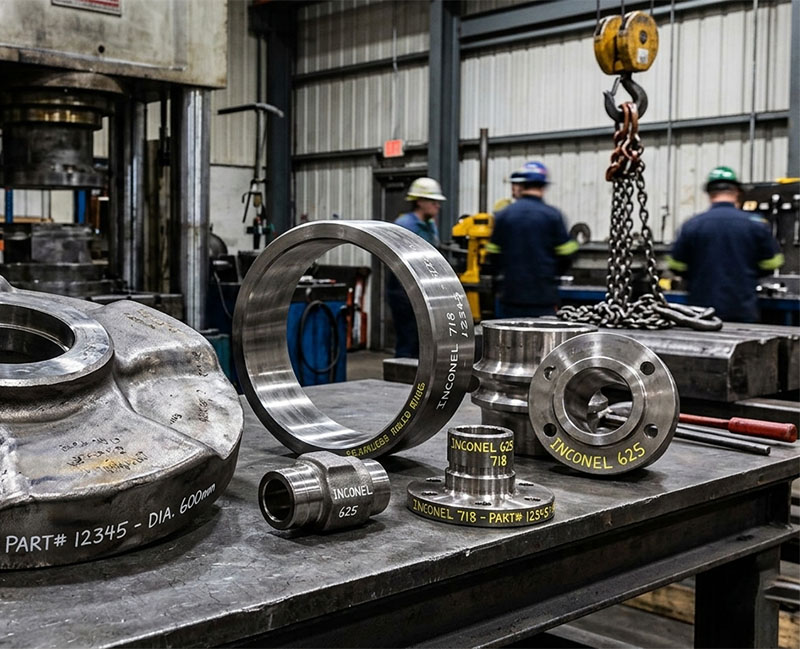
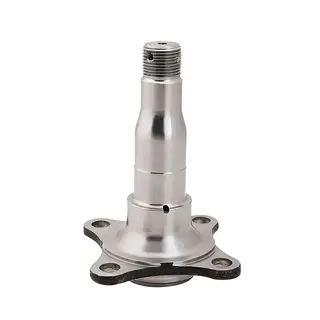
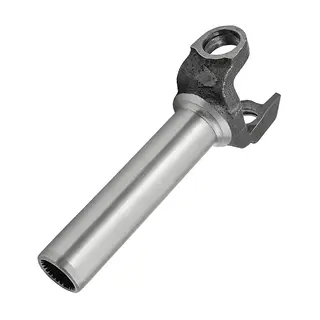
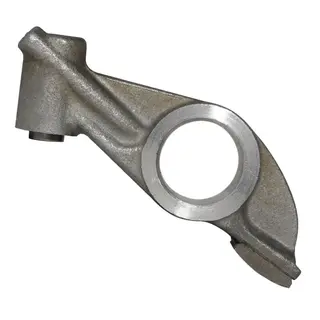
Inconel forgings refer to metal components made from Inconel (nickel-chromium alloys) using forging processes. Inconel is a type of high-temperature alloy with nickel as the base, and it includes chromium, iron, and other metal elements. It is characterized by excellent high-temperature resistance, corrosion resistance, and oxidation resistance. During the forging process, Inconel billets are heated to specific temperatures and shaped under hammers or presses, producing final forgings with dense structures and superior mechanical properties.
This manufacturing method significantly improves the internal structure of the metal, giving the finished product higher strength and reliability compared to casting or machining. Currently, more than 20 Inconel grades are available on the market, each with a unique composition and performance profile suitable for different industrial applications.
In extreme working environments, ordinary steels and aluminum alloys often cannot meet the requirements. High temperatures can cause steel to soften and deform, corrosive gases can rapidly erode aluminum surfaces, and high-pressure environments can induce cracking and material failure. Such failures not only damage equipment but also pose serious safety hazards and production losses. Inconel alloys fundamentally address these problems:
- High-temperature resistance: Inconel maintains structural stability and mechanical strength even in environments exceeding 1000°C. Inconel 718, for instance, can still operate normally at temperatures up to 700°C, making it an ideal choice for high-temperature components in aerospace engines.
- Corrosion resistance: Inconel resists various corrosive media, including chloride-induced corrosion, stress corrosion cracking, high-purity water corrosion, and alkaline corrosion. In marine environments exposed to salt spray or in chemical industries with strong acids and alkalis, Inconel significantly outperforms stainless steel.
- Oxidation resistance: The high chromium and nickel content forms a dense oxide layer on the material surface, preventing further oxidation and extending component life.
- Fatigue and creep resistance: Forged Inconel components can withstand cyclic loads and long-term stresses without developing fatigue cracks or creep deformation.
Different Inconel grades achieve their unique properties by adjusting the ratios of nickel, chromium, and other elements. Understanding these differences helps select the most suitable material for specific applications.
- Composition: ~72% Ni, 14–17% Cr, 6–10% Fe
- Main Properties: Stable high-temperature oxidation resistance, excellent resistance to chloride-induced corrosion and stress corrosion cracking, good machinability
- Typical Applications: Heat-treatment furnace components, chemical reactors, food processing equipment, high-purity water systems in nuclear facilities
- Composition: Inconel 600 base with ~1.4% aluminum
- Main Properties: Higher high-temperature strength and improved oxidation resistance compared to 600; aluminum addition enhances stability at extreme temperatures
- Typical Applications: High-temperature furnace tubes, radiant tubes, heat-treatment fixtures, catalytic regeneration systems in petrochemical industries
- Composition: ~58% Ni, 20–23% Cr, 8–10% Mo, 3.15–4.15% Nb
- Main Properties: Outstanding corrosion resistance, especially against pitting and crevice corrosion in seawater; good weldability and low-temperature toughness
- Typical Applications: Submarine components, offshore oil platform equipment, seawater heat exchangers, chemical process pipelines, marine propulsion systems
- Composition: 50–55% Ni, 17–21% Cr, Nb-Mo strengthened, with Ti-Al precipitation-hardening elements
- Main Properties: Extremely high tensile strength, excellent fatigue resistance and creep resistance; maintains stable mechanical properties from -253°C to 700°C
- Typical Applications: Aircraft engine turbine blades, discs, combustion chamber casings, rocket engine components, spacecraft structural components, gas turbine fasteners
Turning Inconel alloys into high-performance forgings requires a series of strict process steps. Each step directly impacts the quality and performance of the final product.
Manufacturing high-quality Inconel forgings starts with raw material selection. Engineers determine the appropriate Inconel grade based on the final component’s operating environment, then cut ingots or bars into billets of required dimensions.
Because Inconel is hard, cutting requires specialized circular saws or band saws, and the cutting cycle is relatively short. For large aerospace components, ingots are typically machined into uniform circular billets to ensure precise control of the internal structure during subsequent forging.
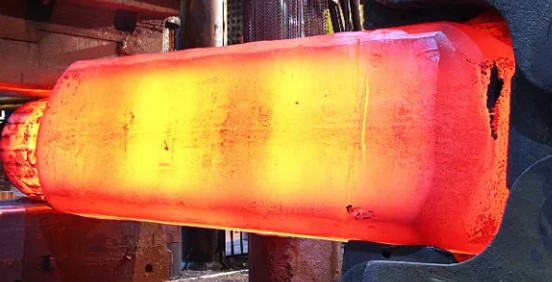
After surface cleaning, billets are heated in a furnace to the forging temperature range. While steel forging typically occurs at 850–1150°C and aluminum alloys around 500°C, precise temperature control is critical. Proper heating ensures good plasticity for forming while avoiding overheating that causes grain coarsening.
The heated billets are quickly transferred to dies for shaping. Depending on the component complexity, different forging methods are employed:
- Open-die forging: Suitable for large, simple shapes such as shafts and discs. Dies are simple, metal flow is unrestricted, and small-batch production is feasible.
- Closed-die forging: Used for complex geometries like turbine blades and precision housings. Metal flows within the closed cavity, achieving accurate dimensions and smooth surfaces.
- Roll forging: Mainly for long shaft components, reducing cross-sections and extending length, such as propeller shafts and pump shafts.
In practice, multiple forging steps—pre-forging, intermediate forging, and finishing forging—are used. Pre-forging roughly shapes the part, intermediate dies control metal flow, and finishing dies achieve precise dimensions. Reheating may be required to maintain optimal forging temperatures. Auxiliary processes include trimming (forming clean edges), spreading (expanding metal distribution), and rough forging (reducing wall thickness), ensuring proper material distribution and optimal internal structure.
Closed-die forging produces excess edge material called flash. Flash trimming uses specialized trimming presses and custom dies to remove it precisely without damaging the forging body. This step ensures dimensional accuracy, smooth edge contours, and prepares the component for subsequent machining and heat treatment. Accurate trimming reduces material waste and maintains batch consistency.
Heat treatment optimizes the mechanical properties of Inconel forgings and includes:
- Solution treatment: Heating to high temperature (~980–1200°C) and rapid cooling dissolves alloy elements, producing a uniform supersaturated solid solution, relieving forging stress, and improving ductility and toughness.
- Aging/precipitation hardening: Holding at lower temperature (~720°C) precipitates strengthening phases from the matrix, significantly increasing strength and hardness. This step is critical for precipitation-hardened alloys like Inconel 718.
- Annealing: Improves machinability, reduces hardness, and relieves internal stresses.
Precise control of heating temperature, hold time, and cooling rate achieves the required mechanical properties for different applications.
Finished product inspection includes multiple dimensions:
- Dimensional inspection: Using CMM and other equipment to verify geometric dimensions and tolerances
- Visual inspection: Detecting cracks, folds, and surface defects
- Metallographic analysis: Evaluating grain size, phase ratios, and inclusions
- Non-destructive testing: Ultrasonic, radiographic, or penetrant methods detect internal defects
- Performance testing: Sample tests for tensile, impact, and hardness properties
All inspection data are recorded in a traceability system to ensure batch traceability. If necessary, protective coatings are applied, and specialized packaging prevents mechanical damage during transportation.
- Aerospace Industry: Jet engines demand the highest performance from Inconel forgings, operating above 1000°C with rapid pressure fluctuations. Inconel 718 is widely used for turbine blades, discs, and combustion chamber casings, offering excellent fatigue resistance for cyclic loads during takeoff, cruise, and landing. Exhaust systems, fasteners, seals, and heat exchangers also rely on Inconel. In space applications, it is used in rocket engine thrust chambers, turbopumps, and spacecraft structural connections, where low-temperature toughness is essential.
- Petrochemical Industry: Refining and chemical equipment face corrosive media and wide temperature variations. Inconel forgings produce reactors, heat exchangers, boilers, valves, and piping systems, resisting hydrogen sulfide, chlorides, and other corrosives. Offshore tools, wellheads, and manifolds rely on Inconel 625 for superior seawater corrosion resistance.
- Energy Sector: Gas turbine components, high-temperature/high-pressure nuclear systems, supercritical boilers, and geothermal equipment use Inconel forgings for high-temperature corrosion and fatigue resistance.
- Marine Engineering & Shipbuilding: Inconel 625 forgings excel in seawater applications, including submarine hulls, propeller shafts, desalination units, marine instruments, and subsea pipelines. Forging ensures fatigue strength against waves, vibration, and cyclic stress, while smooth surfaces reduce fouling and maintenance.
- Automotive Industry: High-performance and racing vehicles use Inconel forgings for exhaust systems, turbocharger components, exhaust valves, and high-temperature fasteners, offering corrosion resistance, weight reduction, and improved efficiency.
- Food & Pharmaceutical Industry: Inconel 600 and 601, with superior corrosion resistance and hygienic properties, are used in food processing equipment, pharmaceutical reactors, and high-temperature sterilization units to ensure safety and regulatory compliance.
Inconel forgings are significantly more expensive than ordinary carbon steel or aluminum forgings due to:
- High raw material cost: Nickel, chromium, and other alloying elements are expensive, and Inconel production is complex
- Processing difficulty: Hard material increases wear on forging equipment and dies, and energy consumption is high
- Strict process requirements: Precise temperature control, complex heat treatment, and rigorous quality inspections
Although initial investment is higher, Inconel forgings are often more economical over their lifecycle:
- Extended service life: Can last several times longer than ordinary materials in corrosive or high-temperature environments
- Reduced maintenance costs: Less frequent downtime, lower labor and replacement costs
- Failure prevention: Avoids production interruptions, safety incidents, and environmental hazards
- Weight reduction benefits: High strength allows smaller cross-section components, saving energy
- Recyclability: Inconel scrap has high recovery value, supporting sustainability
For core components of critical equipment, the safety and reliability benefits of Inconel forgings are invaluable.
Facing numerous Inconel grades and suppliers, making the right choice is key to ensuring performance and optimizing cost.
- Temperature range: Maximum operating temperature and fluctuation, distinguishing continuous vs. intermittent high temperatures
- Corrosive media: Identify chemical types, concentration, and contact mode (gas, liquid, or solid)
- Mechanical loads: Assess stress types (tension, compression, bending, torsion) and load characteristics (static, dynamic, impact)
- Pressure conditions: Understand operating pressure range and fluctuations
- High-temperature strength priority → Inconel 718 or similar precipitation-hardened alloy
- Seawater corrosion resistance priority → Inconel 625
- High-temperature oxidation resistance priority → Inconel 601
- Balanced performance → Inconel 600
- Material traceability and certification
- Forging and heat treatment equipment specifications
- Quality systems and industry-specific certifications (aerospace, nuclear, etc.)
- Proven supply experience and technical support
Inconel forgings represent a major achievement in modern metallurgy, providing reliable solutions for industrial applications in extreme environments through advanced alloy design and forging technology. From aerospace engines to deep-sea equipment, chemical plants to energy systems, Inconel forgings play an irreplaceable role in ensuring equipment safety, extending service life, and reducing lifecycle costs.
For engineers and procurement decision-makers, understanding Inconel’s material characteristics, manufacturing processes, and application requirements helps make optimal material choices. Although initial costs are high, considering reliability, durability, and maintenance cost advantages, Inconel forgings are a wise investment for critical applications.
As industrial technology moves toward higher temperatures, harsher conditions, and longer service life, the application scope of Inconel forgings will continue to expand, and their technological significance will become increasingly prominent.