Precision Forging in Industrial Valves Manufacturing
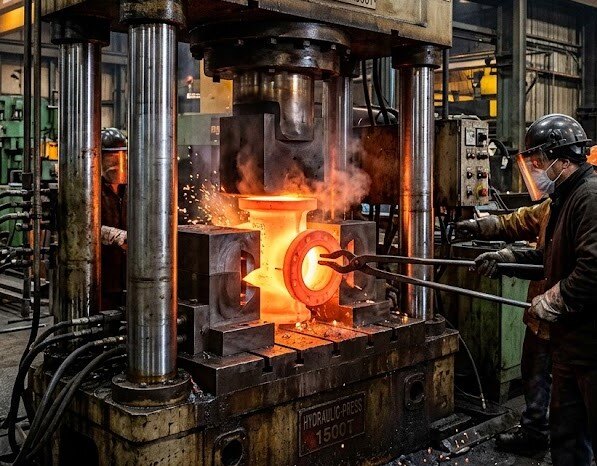
Precision forging is an advanced metal forming process. It applies pressure to a heated metal billet through dies, causing the metal to undergo plastic deformation in the solid state, thereby producing components that are close to their final shape. Compared with traditional forging, the most significant feature of precision forging is higher dimensional accuracy, smaller machining allowance, and better product consistency.
In the field of industrial valve manufacturing, precision forging has become a mainstream technology for producing key components such as valve bodies, valve bonnets, and valve stems. Through optimized die design, controlled material flow, and precise regulation of deformation processes, precision forging enables parts to be closer to final dimensions while also obtaining a more stable grain flow structure. This process is usually combined with CNC machining, controlled heat treatment, and strict inspection to ensure consistent quality across different production batches.
The typical tolerance range of precision forging can generally reach ±0.3 mm to ±1.0 mm, depending on part size and structural complexity. For valve manufacturers, this means fewer subsequent machining operations, shorter delivery cycles, and more stable mass production capability.
Precision forging is not a single technology, but a comprehensive system that includes multiple process routes. According to forming temperature and die characteristics, it can be mainly divided into the following types:
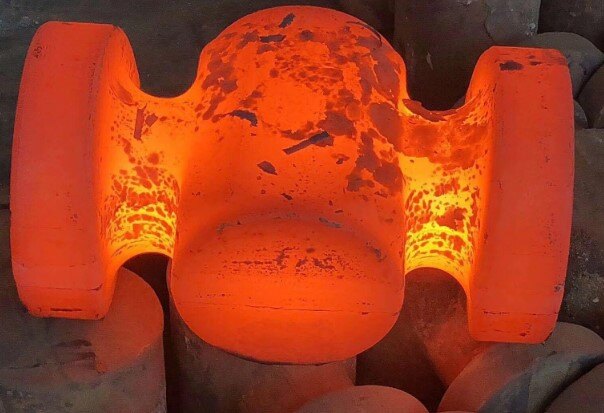
Hot die forging is currently the most commonly used precision forging method in industrial valve manufacturing. In this process, the metal billet is heated above the recrystallization temperature (usually about 75% of its melting point), allowing it to obtain good plasticity, and then formed in precision-machined dies.
Hot die forging can produce complex geometric shapes while refining the grain structure of the material, thereby improving the strength and toughness of the parts. For common valve materials such as carbon steel, stainless steel, and alloy steel, hot die forging can achieve good forming results and stable mechanical properties.
Isothermal forging is a more advanced precision forging process in which the billet and the die are maintained at the same or similar temperature during the forging process. This temperature control method significantly reduces thermal gradients, improves the uniformity of material flow, and allows the parts to achieve better mechanical properties and higher dimensional accuracy.
Isothermal forging is particularly suitable for valve components with complex shapes and high performance requirements, such as high-pressure ball valve bodies and globe valve bonnets.
Cold precision forging is performed at room temperature or near room temperature. It uses the work hardening of materials to increase strength. This process can achieve very high dimensional accuracy and surface finish quality, often requiring no or only minimal subsequent machining.
Cold precision forging is suitable for relatively simple and small valve components, such as valve stems and sealing rings. Because it does not require heating, it also has the advantages of low energy consumption and high production efficiency.
Precision forging is not a single operation but a systematic engineering process composed of multiple key steps. Each step plays an important role in the final dimensional accuracy and material performance of the product.
Precision forging has strict requirements for raw materials. First, the chemical composition of the material must be strictly controlled to ensure it meets design specifications. Common valve forging materials include carbon steels (such as AISI 1020 and 1045), alloy steels (such as 4140 and 42CrMo4), and carburizing steels (such as 20MnCr5 and 8620). These materials have good load-bearing capacity, toughness, and heat treatment response, and are suitable for valve bodies, valve bonnets, flanges, and structural components.
In addition to chemical composition, the size and surface condition of the billet must also be strictly controlled to ensure uniform deformation during forging.
The billet is heated to a specific temperature range so that it has good plasticity while maintaining a stable microstructure. Temperature control is the core of this step. Excessively high temperature can lead to grain coarsening and reduced mechanical properties, while insufficient temperature can reduce plasticity and increase the risk of cracking.
For different steel grades, the heating temperature is usually between 1050°C and 1250°C. Modern forging plants generally use gas furnaces or induction heating equipment combined with precise temperature monitoring systems to ensure stability and repeatability of the heating process.
After heating, the billet is transferred to forging equipment and plastically deformed under the guidance of precision dies. The dies control the flow of metal so that the material fills the cavity evenly and dimensional deviation is minimized.
During this process, the grain flow of the metal aligns along the contour of the part, forming a continuous and stable internal structure while reducing residual stress. Closed-die forging is commonly used in valve manufacturing. It fully encloses the metal with precision dies, allowing near-net-shape forming, higher material utilization, and better dimensional consistency.
After forging, the parts undergo trimming, shot blasting, and dimensional inspection. Trimming removes excess flash, while shot blasting cleans surface scale and introduces compressive stress on the surface, improving fatigue resistance. Dimensional inspection ensures that each product meets tolerance requirements. These treatments prepare the components for subsequent heat treatment or CNC machining.
Heat treatment plays an important role in precision forging. Common processes include quenching and tempering, normalizing, and stress-relief annealing. These treatments further improve material properties and enhance dimensional stability, ensuring consistent machining accuracy in later CNC processes.
For example, high-pressure valve components often use quenching and high-temperature tempering to achieve a good balance of strength and toughness. Stress-relief annealing is used for precision-machined parts to eliminate residual stress and prevent deformation during machining.
Although precision forging produces parts close to final shape, CNC machining is still required in most cases to meet final dimensional accuracy, surface quality, and functional requirements. The combination of precision forging and CNC machining achieves a balance between efficiency and precision.
Final products must undergo strict non-destructive testing, pressure testing, and dimensional inspection to ensure compliance with international standards such as API, ASTM, ASME, and ISO.
After understanding the process flow of precision forging, we can examine the practical advantages it brings to industrial valve manufacturing. For both manufacturers and buyers, the value of precision forging is reflected not only in individual processes but in comprehensive improvements in performance, efficiency, and lifecycle cost.
One of the most important advantages of precision forging is the significant improvement in the structural integrity of internal valve components. During forging, the material undergoes plastic deformation under high temperature and pressure, resulting in a denser internal structure. This effectively eliminates internal voids, cracks, and fatigue-related weaknesses.
Compared with cast parts, which often contain porosity, shrinkage, and uneven density, forged components maintain stable performance over long-term use. This makes precision forging especially important for industries such as power generation, petrochemicals, oil and gas, and pharmaceuticals, where valve failure is not acceptable.
Modern valve structures are increasingly complex, requiring higher dimensional accuracy and sealing performance. Precision forging, through high-precision die design and controlled processes, ensures high consistency in shape and size, significantly reducing machining requirements.
Typical dimensional accuracy can reach ±0.1 mm to ±1.0 mm, much better than conventional forging. Smaller machining allowance means less material waste, shorter processing time, and lower manufacturing cost. For mass production OEM valve manufacturers, this consistency brings significant economic benefits.
Precision forging optimizes material flow paths, allowing grain structures to align along the shape of the part. This produces a strong, tough, and fatigue-resistant structure. In high-pressure applications such as refining systems, reactors, offshore platforms, and pipeline systems, valves must withstand long-term high stress and complex loading conditions.
Precision forging improves material density and significantly enhances the load-bearing capacity of key components such as valve bodies and stems, reducing the risk of cracking or failure under cyclic loading.
The core function of valves is flow control and leakage prevention. Precision forging reduces internal defects and improves material uniformity, resulting in more stable stress distribution and tighter sealing surfaces. This improves flow control accuracy and significantly reduces leakage risks caused by wear or structural inconsistency.
In high-pressure or corrosive environments, even minor leakage can cause serious safety hazards or economic losses. The stability of forged structures effectively minimizes such risks.
Due to high consistency and reduced machining allowance, precision forged parts require fewer secondary operations, improving production efficiency and shortening delivery time. This is particularly important for large-volume, time-sensitive valve manufacturing.
From a lifecycle perspective, forged valves typically have longer service life, lower replacement frequency, and more stable operation, significantly reducing total lifecycle cost. This is especially valuable for systems requiring continuous operation.
Traditional forging usually uses open dies or simple forming methods, resulting in lower dimensional accuracy and larger machining allowance. Although it has lower equipment investment and faster production cycles, it is inferior in consistency, material utilization, and long-term cost.
Precision forging uses precision dies and strict process control to achieve tighter tolerances and reduced waste. Although initial tooling costs are higher, it is more economical in high-precision, large-scale applications.
Casting involves pouring molten metal into molds. During solidification, defects such as porosity, shrinkage, and inclusions may form, leading to non-dense structures and lower mechanical strength. Cast valves often require thicker walls to compensate for these weaknesses, increasing weight and material consumption.
Precision forging, on the other hand, deforms metal in the solid state, avoiding phase-change-related defects. The resulting structure is denser and more uniform, allowing higher pressure resistance at the same wall thickness. This makes it more suitable for high-pressure and high-reliability valve applications.
As an advanced manufacturing process, precision forging plays an irreplaceable role in industrial valve production. It improves dimensional accuracy, optimizes material properties, reduces machining allowance, and enhances product consistency, bringing significant technological and economic benefits to the valve industry.
For valve buyers, understanding the technical characteristics of precision forging helps make more informed procurement decisions. For manufacturers, continuous investment in precision forging technology is essential for improving competitiveness and meeting high-end market demands.
In industries such as oil and gas, power generation, chemical engineering, and pharmaceuticals, where safety and reliability are critical, precision forged valves have become key components ensuring stable and safe operation of industrial systems due to their dense internal structure, excellent mechanical performance, and reliable service behavior.