Aluminum Forging vs. Aluminum Casting: Differences & Selection
Aluminum is currently one of the most widely used lightweight metals in the industrial field. From aircraft fuselages to automotive wheels, from electronic device enclosures to architectural doors and windows, its presence can be seen everywhere. There are two main processing routes for producing aluminum parts: forging and casting.
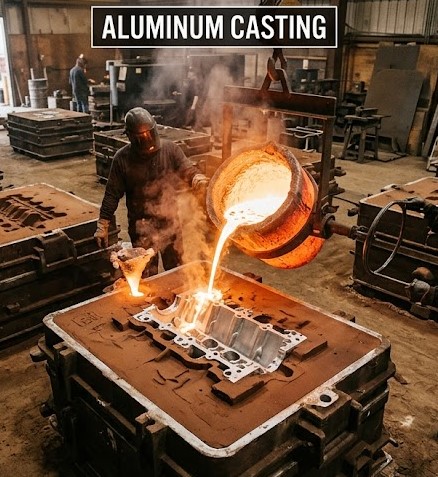
Aluminum casting involves heating solid aluminum above its melting point (approximately 660°C) until it completely melts into a liquid, and then pouring it into a pre-prepared mold cavity. The molten aluminum flows and fills the mold, then cools and solidifies to form a part that conforms to the mold shape. Common aluminum casting processes include high-pressure die casting, sand casting, precision casting (also known as lost-wax casting), and permanent mold casting.
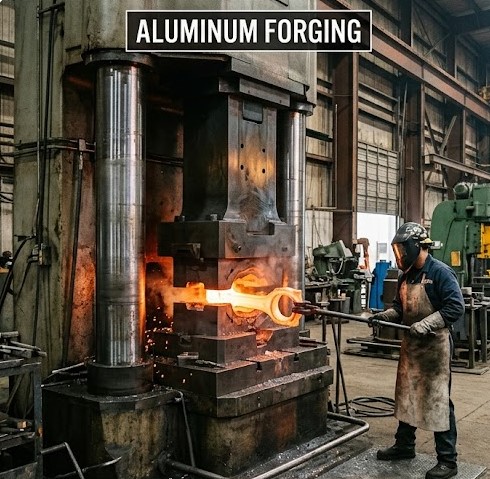
Aluminum forging is completely different. In the forging process, aluminum remains in a solid state, only heated to a certain temperature (hot forging usually ranges from 300–500°C) to increase its plasticity. Then, through forging equipment, enormous pressure or impact force is applied to the aluminum billet, causing plastic deformation, gradually filling the mold cavity and achieving the desired shape. Throughout the process, aluminum does not enter a liquid state; it is reshaped while remaining solid.
The fundamental difference between these two processes lies in the material state: casting undergoes a "solid → liquid → solid" phase change, while forging remains solid at all times and achieves shaping solely through mechanical deformation.
The fundamental difference between the two processes is not only reflected in the production workflow but also more profoundly in the internal structure of the material. It is these microscopic features, invisible to the naked eye, that determine the performance and lifespan of aluminum parts in practical use.
There is a fundamental difference in microstructure between aluminum castings and aluminum forgings, which directly determines their performance.
In the casting process, molten aluminum gradually cools from the outside to the inside of the mold. The atoms in the liquid metal have no fixed arrangement, and during solidification, grains grow randomly in all directions, forming an irregular equiaxed crystal structure. This randomly arranged grain structure results in relatively uniform performance in all directions but lacks a directional advantage.
In the forging process, the grain structure is actively optimized. When the solid aluminum billet is deformed under pressure, the original cast grains are elongated and broken, then dynamically recrystallized under the combined effect of deformation heat and mechanical heat. The new grains align along the deformation direction, forming a directional fibrous structure. This streamlined grain structure significantly enhances mechanical properties in specific directions.
The greatest quality challenge in casting is porosity. During mold filling, molten aluminum may entrap gas to form bubbles; if volume shrinkage during solidification is not adequately compensated, shrinkage cavities can also form. In addition, oxide inclusions introduced during melting or debris falling from the mold can become internal defects. These pores and inclusions disrupt the continuity of the metal matrix, acting as stress concentrators and crack initiation sites.
Forging has a natural advantage in defect control. During solid-state deformation, the enormous triaxial compressive stress compresses existing micro-pores, effectively welding internal voids. Even if certain inclusions exist in the raw material, they are dispersed or deformed during repeated forging, reducing their harmful effects. Therefore, the internal density of forgings is significantly higher than that of castings, with porosity usually controlled below 0.5%, while castings often reach 2–5% or even higher.
Differences in internal structure directly translate into measurable performance gaps. Standardized mechanical tests can quantify the performance of aluminum forgings and castings under actual load conditions.
In room-temperature tensile tests, aluminum forgings and castings of the same alloy show significant differences in performance. Taking the commonly used 6061 aluminum alloy as an example:
Forgings typically have tensile strength of 290–310 MPa and yield strength of 240–280 MPa.
Castings generally have tensile strength in the 200–260 MPa range and yield strength of 150–220 MPa.
This means that under the same cross-sectional area, a forging can withstand 30–50% higher load than a casting without plastic deformation. For structural components that must bear high stress, this difference is decisive.
Fatigue life under cyclic loads is a key reliability indicator. The fatigue limit of forged aluminum (the maximum stress that does not cause failure after 10^7 cycles) is usually 40–60% higher than that of cast aluminum. The reason is that pores and inclusions in the casting act as crack initiation sites, accelerating crack nucleation and propagation under alternating stress. The dense and directional structure of forged aluminum forces cracks to follow a more tortuous path, consuming more energy and delaying failure.
Under impact or sudden overload, forgings exhibit better toughness reserves. Charpy impact tests show that the impact energy absorption of aluminum forgings is usually over 50% higher than that of castings. This means that forgings are more likely to absorb energy through plastic deformation rather than fracturing suddenly when subjected to unexpected impact or overload.
Advantages of Casting: Casting has an irreplaceable advantage in shape complexity. The flowability of molten aluminum allows it to fill extremely detailed mold cavities, producing thin-walled structures (wall thickness as low as 1–2 mm), complex internal cavities (such as engine cylinder water jackets), and parts with bosses, ribs, and curved surfaces. Casting can achieve "near-net-shape" production, meaning parts can often be used with minimal or even no post-machining.
Precision Features of Forging: Forging is not as capable as casting in geometric complexity, but it offers advantages in dimensional accuracy and surface quality. Tolerances of precision forged parts can be controlled within ±0.3–0.5 mm, with surface roughness Ra 3.2–6.3 μm, which meets assembly requirements in many applications. Forgings also have better dimensional stability because they do not experience shrinkage during solidification. However, forgings usually require subsequent machining for precision holes, threads, and mating surfaces. This means the total cost of forged parts includes both forging and machining expenses.
Performance advantages must be weighed against manufacturing costs. In actual production, factors such as mold investment, batch size, and material utilization, together with technical indicators, determine process selection.
The cost of casting molds varies by process. Sand casting uses disposable molds, with very low per-piece mold cost but low efficiency; high-pressure die casting molds must withstand repeated high temperature and pressure, typically made of high-quality hot-work tool steel, with a medium-complexity mold costing 100–300k RMB; precision casting wax molds are relatively cheap, but subsequent ceramic shell production adds process costs.
Forging molds must withstand higher mechanical loads, usually made of higher-strength, tougher materials, and require higher machining accuracy. Therefore, for the same complexity, initial investment for forging molds is usually higher than casting molds, possibly ranging from 150–500k RMB.
In small batches (<1,000 pieces), casting generally has a cost advantage because mold costs can be amortized over fewer units, and post-processing is minimal.
In medium-to-large batches (>5,000 pieces), forging becomes more cost-effective. Although single-piece material utilization may be slightly lower (forging requires flash allowance), machining costs are stable, and performance advantages may allow smaller sections to bear the same load. For safety-critical parts, savings from reduced heat treatment, X-ray inspection, and quality control further enhance forging’s competitiveness.
Scrap from forging, such as flash and oxide scale, can be 100% recycled and remelted. Casting scrap, including runners, risers, and defective parts, also has high recyclability. However, casting requires complete melting, consuming significantly more energy than forging, which only needs heating to the recrystallization temperature. Over the component’s lifecycle, forged parts last longer and require less maintenance, making them more sustainable.
- Aerospace: Fuselage frames, wing beams, landing gear brackets, engine mounts, and other primary load-bearing structural components are almost entirely forged. These parts endure cyclic loads and require extremely high fatigue life and reliability, making forging indispensable.
- Automotive Safety Components: Steering knuckles, control arms, connecting rods, wheel hubs, and chassis components, as well as engine rods and crankshafts, extensively use forged aluminum alloys. Forged wheels offer higher impact toughness and fatigue life than cast wheels, making them standard for high-performance vehicles.
- High-Pressure Fluid Components: Hydraulic bodies, pump housings, and high-pressure pipe fittings benefit from forging to avoid porosity-induced leakage risks.
- Military Equipment: Armored vehicle structural components, weapon system supports, and portable bridge components require optimal balance between weight reduction and reliability; forging is the preferred process.
- Engine Blocks and Transmission Housings: These parts are extremely complex, with cooling channels, oil passages, and mounting bosses that can only be economically produced via casting. Modern engine blocks commonly use high-pressure or low-pressure casting.
- Electronic Heat Sinks and Housings: Casting allows the formation of complex cooling fins for CPU heat sinks, LED housings, and motor enclosures. These parts have moderate strength requirements but demand high thermal dissipation and electromagnetic shielding.
- General Structural Parts: Doors, windows, brackets, and non-critical structural components benefit from the cost advantage of casting.
- Artworks and Decorative Items: Casting can reproduce intricate surface textures, producing sculptures, lamps, and furniture accessories.
In engineering projects, choosing forging or casting should follow a systematic evaluation:
- Define Performance Requirements: If the part experiences cyclic, impact, or high-pressure loads with severe consequences upon failure, prioritize forging. If the part mainly experiences static or low stress with controllable failure consequences, casting can be considered.
- Analyze Geometric Complexity: Closed internal cavities, ultra-thin walls, or complex curved surfaces may only allow casting. Relatively simple shapes with solids and holes can use either process.
- Evaluate Production Volume: Small batches (<1,000 units) favor casting due to low mold investment. Large batches (>10,000 units) favor forging, where per-piece cost benefits become significant.
- Calculate Lifecycle Cost: Consider not only the manufacturing cost but also maintenance, replacement, and downtime costs due to performance differences. For critical equipment, the reliability premium of forgings often exceeds their cost premium.
- Consider Supply Chain Reality: Assess supplier location, capacity, and quality stability. Some special alloys or oversized parts may only be feasible with specific processes due to equipment limitations.
Aluminum forging and casting represent two entirely different process routes, each with irreplaceable applications. Casting wins in shape freedom and cost efficiency, while forging excels in dense structure and reliable performance. Understanding the fundamental differences and establishing a scientific material selection process is essential for engineers.
For applications that pursue extreme performance, reliability, and safety, the value of aluminum forging has long been verified in aerospace and high-end automotive industries. With larger equipment and digital process control, the application boundaries of forging continue to expand, gradually replacing traditional casting solutions in more fields.