Impression Die Forging: A Forging Process for Mass Production
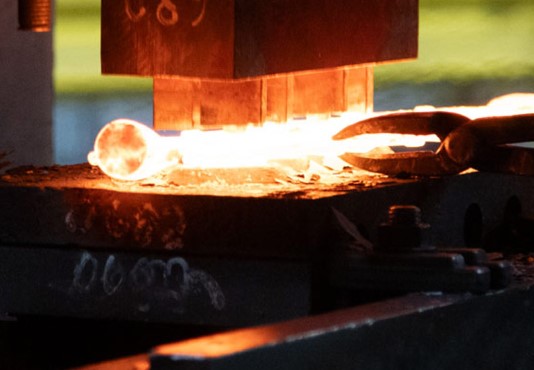
Impression die forging, also known as closed-die forging, is a precision metal forming process in which heated metal billets are placed into specifically designed dies and shaped under substantial pressure. The key principle of this process is the use of pre-machined die cavities, which directly determine the final geometry of the forged part. This method enables manufacturers to produce high-strength components in large volumes with excellent mechanical properties, consistent dimensions, and complex shapes that would be challenging or inefficient to achieve with casting or machining alone.
During impression die forging, metal billets, commonly steel, aluminum, or titanium alloys, are first heated to a precise temperature that renders them plastic and malleable without reaching the melting point. Once at the correct temperature, the billet is positioned in the lower die, and the upper die applies force to drive the metal into the die cavity. This ensures complete filling of the mold and replication of the die geometry. Following the forging step, excess material, known as flash, is removed, and the part undergoes subsequent operations such as cooling, heat treatment, and machining to achieve the required final dimensions, tolerances, and mechanical properties.
The impression die forging process involves several interrelated steps that are critical to achieving the desired part quality and performance:
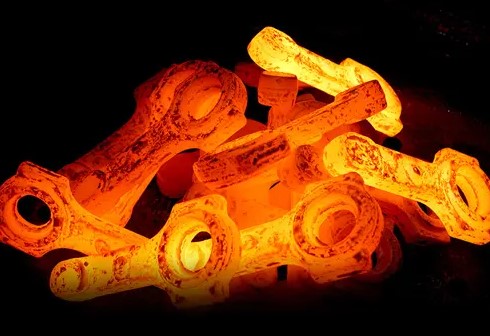
The raw metal is first cut into billets of appropriate size and shape. The billets are then heated in a furnace to the forging temperature specific to the material. Steel typically requires temperatures above 1000°C, while aluminum alloys and other non-ferrous metals are forged at significantly lower temperatures due to their lower melting points. Precise temperature control is essential because underheating can result in incomplete die filling and cracks, whereas overheating can degrade the metal's microstructure and cause surface defects.
After heating, the billet is carefully positioned in the lower die cavity. When the dies close, immense pressure is applied via a hydraulic press, mechanical press, or drop hammer, forcing the metal to flow and fill the die cavity completely. Complex components often require multiple forging stages, including rough forging to establish the general shape, intermediate forging for dimensional refinement, and finishing dies for precision and near-net shape production. The pressure and deformation process promotes a continuous flow of metal, improving the alignment of grain structure along the component geometry, which significantly enhances mechanical properties.
During forging, metal is squeezed out along the die parting line, forming flash. Flash plays a critical role in the forging process. It acts as a pressure chamber that helps direct metal flow into the die cavity. Its rapid cooling compared to the metal inside the die creates resistance, which prevents further metal loss and ensures the cavity is completely filled. Proper flash formation is essential for maintaining the part’s integrity and for avoiding defects such as underfilling or cold shuts.
Once forging is complete, the flash is removed through trimming, which can be performed manually or using automated trimming presses. The trimmed flash is typically recycled and reused in subsequent billets. The forged component then undergoes additional processes, including cooling, cleaning, heat treatment to enhance hardness and strength, and final machining to achieve precise tolerances. These post-forging operations ensure that the final part meets strict dimensional, mechanical, and surface quality requirements.
Impression die forging is widely used across industries due to its multiple advantages, which include:
The forging process aligns the metal grains along the contour of the part, producing an optimized microstructure. This continuous grain flow enhances fatigue strength, impact resistance, and overall durability, often exceeding the performance of cast or machined components. Studies indicate that parts produced by impression die forging can achieve approximately 20% higher strength compared to other forging methods. This strength advantage is particularly important in critical applications such as aerospace landing gear, where components are subjected to extreme stresses and must maintain reliable performance under dynamic and cyclic loads.
Precision-machined dies enable the production of parts with highly consistent shapes and dimensions. Impression die forging can achieve near-net-shape components, minimizing subsequent machining requirements. This not only reduces production time and costs but also ensures repeatable performance in high-precision applications. Industries such as medical devices, aerospace, and high-performance automotive components rely on the dimensional consistency that impression die forging provides to meet stringent tolerances.
Because impression die forging produces parts close to their final shape, material waste is minimized compared to subtractive manufacturing methods, where large portions of the raw material are removed during machining. This higher material utilization reduces production costs and energy consumption, aligning with sustainable manufacturing practices. Additionally, the process is well-suited for large-scale production, offering high throughput and predictable production cycles, which further enhances cost-effectiveness.
Impression die forging can produce intricate three-dimensional shapes, including thin-walled ribs, slender rods, holes, grooves, raised features, and even asymmetrical designs. This capability makes it possible to manufacture complex components such as gears, flanges, brackets, and structural supports that are difficult to produce efficiently through other methods. Advanced die design, coupled with controlled metal flow, allows the creation of sophisticated geometries while maintaining structural integrity and strength.
The process is compatible with a wide variety of metals, including carbon steel, alloy steel, stainless steel, aluminum alloys, titanium alloys, and copper alloys. The choice of material depends on the component’s mechanical requirements, environmental conditions, corrosion resistance, and specific application. For instance, titanium alloys are favored in aerospace for their combination of lightweight and high strength, while stainless steel is common in chemical and medical applications for its corrosion resistance.
The success of impression die forging depends heavily on the design and engineering of the dies. Several technical factors play a critical role in determining part quality, die life, and process efficiency:
Flash is an essential part of the forging process. Its design directly affects the final quality of the part. Metal begins to flow laterally before the dies are fully closed, and if resistance is insufficient, vertical sections of the die may not fill completely, resulting in incomplete or defective parts. Dies must therefore incorporate features to control flash formation, ensuring uniform cavity filling while allowing necessary lateral metal flow. Proper flash design also affects trimming ease, material recovery, and die maintenance.
Fillet radii in die cavities are crucial for reducing stress concentrations and minimizing forging forces. Larger fillets reduce the likelihood of hot cracking and metal tearing during forging. Vertical surfaces require appropriate draft angles to facilitate part ejection, reduce friction, and minimize die wear. Incorrect fillet or draft design can lead to increased die maintenance, accelerated wear, and potential component defects.
As part height increases, die cavity depth increases, making complete filling more challenging due to the need for additional vertical deformation. Forging taller or more complex parts requires higher press or hammer forces to control flash and ensure proper metal flow. Equipment limitations, such as maximum stroke or tonnage, often define the practical limits of part size and geometry. Designers often reduce overall part height or redistribute material to optimize die filling and reduce production costs.
Flash not only affects the forming process but also subsequent operations and overall cost. Excessive flash increases trimming requirements, raises energy consumption, and accelerates die wear. While flash material can be recycled, it still requires additional heating and forming energy. Proper flash management is therefore essential for cost efficiency and die longevity.
Impression die forging is critical to producing components in industries where performance, reliability, and safety are paramount:
The automotive sector relies heavily on impression die forging for high-stress components such as crankshafts, connecting rods, gears, turbocharger housings, steering knuckles, and axles. These parts must endure high torque, temperature fluctuations, and cyclic loading. With the ongoing growth of electric vehicle platforms, the demand for forged automotive components continues to rise; industry reports indicate a 27% increase in forging demand in 2024.
Aerospace components demand extremely high performance. Forged parts include landing gear elements, turbine discs, blades, and wing structures. In 2024, approximately 56% of aerospace structural parts were manufactured using impression die forging, with titanium usage in turbine blades and engine discs growing by 24%. The process ensures components are both lightweight and strong, meeting stringent safety and performance requirements under extreme operating conditions.
Forged components in the railway industry include relays, track switches, and vehicle suspension systems. These parts must withstand heavy loads, constant vibration, and impact forces, ensuring safe and reliable train operation over long service periods.
Tractors, harvesters, and other agricultural machinery operate in harsh, demanding environments. Forged components deliver the durability needed to withstand extreme mechanical stress, ensuring consistent and reliable equipment performance.
In defense applications, impression die forging is used to produce high-precision weapon components and vehicle parts that meet strict tolerances. Barrels, ammunition, missile components, and suspension, steering, and drivetrain parts benefit from the process’s ability to produce durable, high-performance components with complex geometries.
Impression die forging is a mature and highly efficient metal forming process that enables the mass production of high-strength, high-precision, and complex components. Its core advantages include superior mechanical properties, high dimensional consistency, excellent material utilization, and the ability to form intricate geometries. The success of the process hinges on careful die design, with particular attention to flash management, fillet radii, and draft angles. Widely used across automotive, aerospace, rail, agricultural, defense, oil and gas, and medical industries, impression die forging remains indispensable for producing components where performance, reliability, and safety are critical.
Through precise control of metal flow, temperature, and die geometry, impression die forging continues to deliver components that meet the most demanding engineering requirements while optimizing cost, material usage, and production efficiency.