Warm Forging Process in Precision Manufacturing
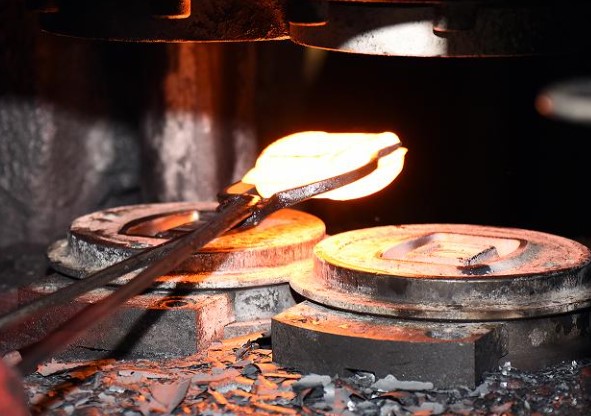
In modern manufacturing, the selection of forging processes directly influences product quality, production efficiency, and cost control. Warm forging, as a precision forming technology positioned between cold forging and hot forging, has gained widespread application in fields such as automotive components and general machinery due to its unique technological advantages. This article provides an in-depth analysis of the principles, characteristics, application scope, and temperature selection of warm forging, helping readers gain a comprehensive understanding of this important metal forming technology.
Warm forging refers to a die forging process performed below or near the recrystallization temperature of metals and above room temperature, making it a bridge process between cold forging and hot forging.
The temperature ranges are generally defined as follows. For ferrous metals, warm forging is typically controlled between 200°C and 850°C, while for non-ferrous metals, the temperature range is usually between room temperature and 350°C. During practical operations, special attention must be paid to avoiding the “blue brittleness zone,” a temperature range where certain steels experience a sharp reduction in plasticity, which may lead to cracking during forging.
The recrystallization temperature of steel is approximately 750°C. When the forging temperature exceeds 700°C, dynamic recovery of metal deformation occurs, significantly reducing forming resistance. Practical experience shows that forging within the 700–850°C range produces less scale formation and mild decarburization, resulting in minimal dimensional variation and superior product quality and precision. In contrast, when the temperature exceeds 950°C, although forming force is further reduced, oxidation scale formation and surface decarburization become more severe, leading to larger dimensional deviations and poorer surface quality.
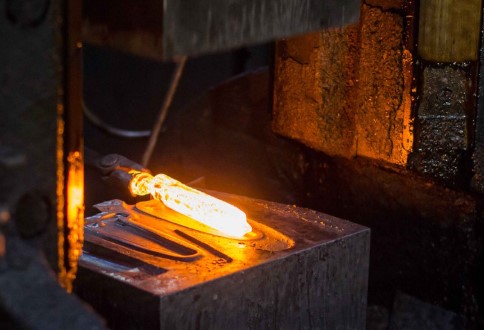
Warm forging occupies an important position in precision manufacturing because it combines the advantages of both cold forging and hot forging while avoiding their major limitations.
Compared with cold forging, preheating the billet during warm forging significantly reduces deformation resistance and forming difficulty. This allows larger deformation amounts and reduces the number of processing steps, mold costs, and equipment tonnage requirements. Manufacturers can use medium-tonnage equipment to form complex forgings, making this process particularly attractive for small and medium-sized enterprises.
Since the heating temperature in warm forging is lower than that in hot forging, the chemical reaction between metal and air is greatly reduced. Consequently, oxidation and decarburization are minimal, dimensional tolerance grades are higher, and surface roughness is lower. These characteristics reduce the workload of subsequent machining processes, thereby lowering material consumption and processing costs.
Warm forging dies operate at relatively lower and more stable temperatures, experiencing reduced thermal stress and wear rates compared with hot forging dies. When combined with advanced die materials and surface treatment technologies, die life can reach tens of thousands of cycles or more. For example, using high-performance alloy steels such as Y4 and HD steel as die materials, together with prestressed die structures and composite PVD surface treatment technologies, can extend die life to over 35,000 pieces, far exceeding the service life of hot forging dies.
Warm forging is especially suitable for materials that are difficult to form under cold conditions, including stainless steel, alloy steel, bearing steel, and tool steel with severe work hardening or high deformation resistance; aluminum and copper alloys with poor plasticity and high cracking tendency during cold deformation; and highly reactive metals such as titanium, molybdenum, and chromium, which are prone to severe oxidation and gas absorption during hot forming.
The best way to understand warm forging is to compare it systematically with cold forging and hot forging.
Cold forging is performed at room temperature and offers the highest dimensional accuracy and best surface quality, but the deformation resistance is extremely high, imposing strict requirements on equipment and die strength. For small precision forgings with simple shapes made of low-carbon or low-alloy steel, cold forging is an economical solution. However, when producing medium-complexity precision forgings made of medium-carbon steel, cold forging often encounters forming difficulties or becomes excessively costly. In such cases, warm forging becomes an ideal alternative. By moderately heating the material, warm forging reduces deformation resistance while maintaining high dimensional accuracy and improving die service life compared with cold forging.
Hot forging is performed above the recrystallization temperature, typically between 800°C and 1250°C for steel. At high temperatures, atomic mobility increases, plasticity improves significantly, and deformation resistance decreases sharply, enabling large deformation forming suitable for highly complex components. However, hot forging also has obvious drawbacks. High temperatures lead to severe scale formation and decarburization, resulting in rough surfaces and low dimensional accuracy, which require extensive subsequent machining. Moreover, hot forging dies are exposed to intense thermal shock and high-temperature wear, leading to thermal fatigue, softening, and shorter service life, usually ranging from several thousand to tens of thousands of cycles.
Warm forging is usually performed below 800°C, effectively controlling oxidation while reducing energy consumption to about one-third to one-half of that required for hot forging. Die life is typically three to five times longer than that of hot forging dies and can reach tens of thousands or even hundreds of thousands of cycles. Although forming force in warm forging is higher than in hot forging and plasticity is slightly lower, warm forging achieves a better balance among precision, cost, and efficiency for components of moderate complexity.
Metals forged at high temperatures undergo complete recrystallization, eliminating casting defects, refining grain structure, and forming uniform metal flow lines, resulting in excellent and stable mechanical properties. Since warm forging does not reach recrystallization temperature, part of the work-hardening structure may remain after deformation, and substructures may exist in the microstructure, leading to slightly lower performance than hot forging. However, post-forging heat treatment can be used for optimization. Notably, warm-extruded steel products show mechanical properties comparable to cold-extruded products when processed at 200–400°C, while at 400–800°C, their strength can reach 1.1–1.5 times that of annealed products.
The application of warm forging is closely related to material properties, workpiece size, and geometric complexity.
- High-Deformation-Resistance Materials: These include stainless steel, alloy steel, bearing steel, and tool steel that exhibit severe work hardening during cold forging. Such materials possess extremely high deformation resistance at room temperature, requiring ultra-high-tonnage equipment if cold forging is used. Warm forging enables effective forming using medium-tonnage equipment.
- Materials Prone to Cracking During Cold Forming: Aluminum alloys such as LC4, copper alloys such as HPb59-1, and titanium alloys have poor plasticity during cold deformation and are prone to cracking. Warm forging improves plasticity by increasing temperature, thereby reducing cracking risk.
- Highly Reactive Metals: Metals such as titanium, molybdenum, and chromium are difficult to machine in cold states and tend to suffer severe oxidation and hydrogen absorption during hot forming, which can degrade material properties. Warm forging allows forming within temperature ranges that avoid intense oxidation, ensuring product quality.
- Complex-Shaped Components: Warm forging is a better choice when parts have complex geometries that are unsuitable for cold forging. It is also suitable for large deformation ratios or workpieces exceeding the capacity of existing cold forging equipment.
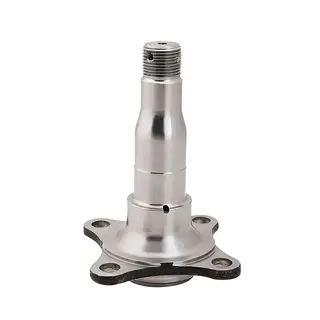
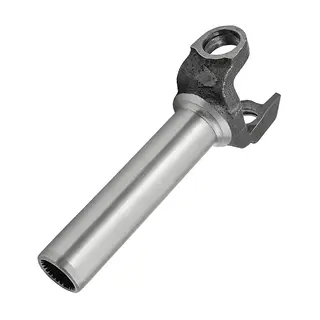
- Typical Industrial Products: Warm forging is widely used in automotive and general machinery industries. Typical products include constant velocity joint sleeves, large-module gears, bearing rings, bolts, and automobile half shafts. These components require relatively high precision and surface quality, while having moderate geometric complexity, making them well suited for warm forging.
Selecting an appropriate forging temperature is critical to process success.
- Flow Stress Characteristics: Generally, temperatures with lower flow stress should be chosen or temperature zones with high flow stress should be avoided. For metals with blue brittleness zones, forging must avoid these temperature ranges to prevent plasticity deterioration and cracking.
- Oxidation Control: Oxidation of steel intensifies when temperatures exceed 800°C; therefore, warm forging temperatures are typically kept below this threshold. Rapid heating methods or solid lubricant coatings on billet surfaces can further suppress oxidation during heating.
- Performance Balance: As forging temperature increases, toughness and plasticity improve while strength decreases. Under certain conditions, increasing deformation degree enhances strength but reduces plasticity. Therefore, an optimal balance between temperature and deformation degree must be achieved according to final product performance requirements.
- Material Characteristics: Different materials have different recrystallization temperatures, phase transformation points, and brittleness zones. For example, the warm forging temperature for medium- and low-carbon steel is approximately 300–700°C, while that for aluminum alloys is about 100–300°C. Optimal temperature ranges must be determined based on specific metallurgical properties.
- Production Continuity: Temperature selection should also consider heating equipment capability, production rhythm, and process stability to facilitate continuous production.
As a precision, efficient, and economical metal forming process, warm forging plays an increasingly important role in modern manufacturing. By forging within the intermediate temperature zone between room temperature and recrystallization temperature, warm forging successfully combines the high precision of cold forging with the low deformation resistance of hot forging while avoiding their major drawbacks.
For manufacturing enterprises, understanding the characteristics and application scope of warm forging, selecting proper forging temperatures, and designing reasonable molds and process flows are key to improving product quality and reducing production costs. With continuous advances in material science, mold technology, and automation control, warm forging technology will play an even greater role in high-end manufacturing fields such as automotive and aerospace industries, driving manufacturing toward higher precision, greater efficiency, and lower energy consumption.