Alloy Steel Forgings: Principles, Advantages & Use Cases
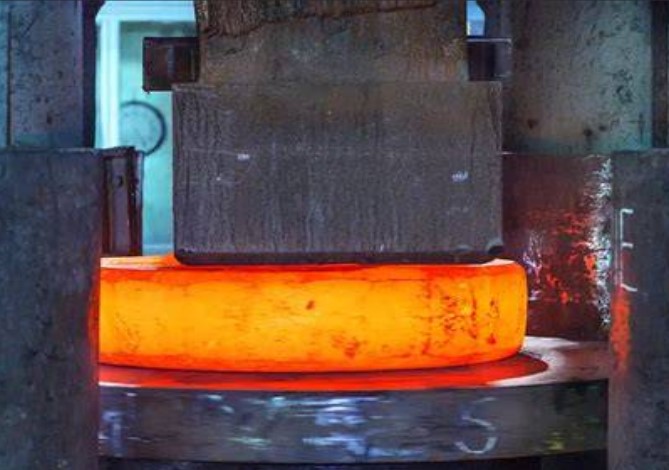
Alloy steel forgings are metal parts manufactured through plastic deformation processes. In simple terms, this involves heating alloy steel material to a specific temperature, then applying pressure through forging machinery to cause the metal billet to undergo plastic deformation, ultimately obtaining products with predetermined shapes, dimensions, and mechanical properties. Unlike ordinary casting or machining, the alloy steel forging process uses repeated impact or extrusion from hammers or presses to make the internal structure of the metal more compact, significantly improving performance. Parts or billets produced in this way possess excellent mechanical properties and are indispensable key components in modern industry.
To understand the advantages of alloy steel forgings, it is necessary first to understand several core principles of the forging process:
- Relationship Between Temperature and Plasticity: When metal is heated to a specific temperature, its internal crystal structure becomes easy to deform, giving it excellent plasticity. In this state, the metal behaves like dough, able to change shape under external force without breaking.
- Grain Refinement and Performance Improvement: During forging, metal grains are compressed and stretched, becoming refined and reorganized. Changes in this microstructure directly enhance the material's mechanical properties, including strength, toughness, and hardness.
- Elimination of Internal Defects: The pressure applied during forging can effectively expel internal pores and impurities, making the material denser. Additionally, forging helps relieve internal stresses in the metal, reducing or eliminating stresses caused by casting, welding, or other processes, thereby enhancing material stability and reliability.
- Precision Forming Capability: Through different forging processes and die designs, the shape and dimensions of metal parts can be precisely adjusted to meet the manufacturing requirements of various complex components. This flexibility allows the forging process to accommodate diverse industrial needs.
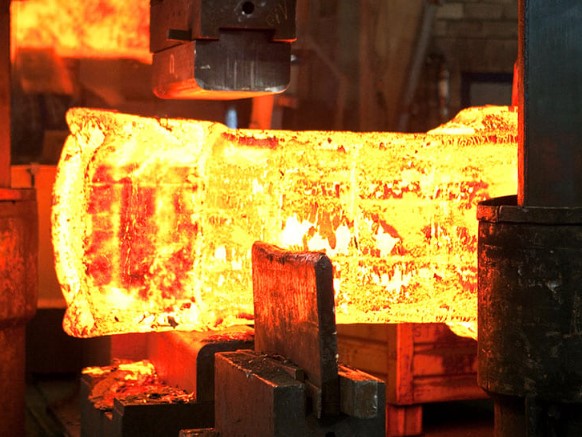
Alloy steel is a type of steel in which specific alloying elements (such as chromium, nickel, molybdenum, vanadium, etc.) are added to carbon steel to selectively improve material properties. Depending on the content of alloying elements and intended use, alloy steel can be divided into three main categories:
- Low Alloy Steel: Alloy element content between 1% and 5%. This steel has relatively low cost but shows significant performance improvement over ordinary carbon steel. It is widely used in stud export production and seamless rolled ring forgings. Large-diameter flanges also commonly use this alloy to achieve specific mechanical properties.
- Medium Alloy Steel: Moderate alloy element content, balancing performance and cost, suitable for various industrial scenarios.
- High Alloy Steel: Higher alloy element content, up to 50%. The most common high-alloy steel is stainless steel, with chromium content as high as 12%. Chromium forms a thin oxide layer on the steel surface, called a passive layer, providing long-term corrosion protection. This type of alloy steel is relatively expensive and mainly used in automobiles and industrial equipment requiring strict corrosion resistance.
The performance of alloy steel is customized primarily by adding different alloying elements:
- Chromium (Cr): Increases hardness, wear resistance, and corrosion resistance. When content exceeds 12%, it can form stainless steel.
- Nickel (Ni): Strongly increases material strength while maintaining very high toughness.
- Molybdenum (Mo): Improves high-temperature strength and creep resistance, often used with chromium to enhance corrosion resistance.
- Manganese (Mn): Improves hardenability and strength, and enhances heat treatment response.
- Vanadium (V): Refines grains and improves strength and toughness.
- Aluminum (Al): Refines grains, stabilizes nitrogen in steel, and significantly improves impact toughness and corrosion resistance, especially when combined with molybdenum, copper, silicon, or chromium.
- Copper (Cu): Improves atmospheric corrosion resistance, particularly with phosphorus, and also increases steel strength and yield ratio without negatively affecting weldability.
- Silicon (Si): Used as a deoxidizer and also improves strength and elastic limit.
- Titanium (Ti) and Boron (B): Trace additions significantly enhance specific properties such as hardenability and grain control.
This add the element according to the missing property design philosophy allows alloy steel to accurately meet diverse usage scenarios.
After understanding the basic composition and classification of alloy steel forgings, a key question arises: why does the industry favor this material so much? The answer lies in its unique comprehensive performance advantages. Compared with traditional casting processes and ordinary carbon steel, alloy steel forgings achieve significant breakthroughs in mechanical properties, internal quality, and applicability, making them the preferred choice for high-end equipment manufacturing.
- Elimination of internal defects: effectively removes common casting defects such as shrinkage cavities, porosity, and voids.
- Denser structure: pressure expels impurities and gases, resulting in a more compact material.
- Superior mechanical properties: grain structure gives higher wear resistance, toughness, and strength than cast steel.
- Higher impact strength: capable of withstanding greater impact loads.
- Customizable performance: toughness, hardness, strength, wear resistance, and corrosion resistance can all be improved depending on alloying elements.
- Better heat treatment response: alloy steel responds better to quenching and tempering, achieving higher strength and toughness combinations.
- Wider application range: alloy composition adjustments allow use in temperatures from normal to high and in environments from mild to highly corrosive.
Alloy steel forgings also offer multiple advantages in production:
- High production efficiency: forging is suitable for batch production with high efficiency.
- Material savings: reasonable die design reduces material waste.
- Lightweight design: structural weight reduction is possible without sacrificing strength.
- Cost-effectiveness: although alloy steel is more expensive than carbon steel, performance improvements and longer service life often make it economically advantageous.
- 4130 Alloy Steel: Contains chromium and molybdenum, with good strength, toughness, and weldability; used in aerospace structures and automotive components.
- 4140 Alloy Steel: Cr-Mo steel with high strength, toughness, and excellent wear resistance; widely used in shafts, gears, and bolts.
- 4145 Alloy Steel: Composition adjusted from 4140 for higher strength and hardenability; suitable for larger-section components.
- 4330/4340 Alloy Steel: Ni-Cr-Mo steel with extremely high strength-toughness combination; used for high-stress parts like aircraft landing gear and drive shafts.
- 8620 Alloy Steel: Low-carbon Ni-Cr-Mo steel with excellent carburizing performance; used in gears and cams.
- 8630MOD Alloy Steel: Modified 8630 steel with more balanced performance, suitable for various mechanical parts.
- F22 Alloy Steel: Excellent high-temperature performance; used in high-temperature, high-pressure valves and piping in power and petrochemical industries.
Most alloy steels have carbon content between 0.2% and 0.55%, which ensures hardenability while maintaining good toughness and weldability.
Automotive Manufacturing:
- Engine crankshafts, connecting rods, and other key moving parts
- Transmission gears and shaft components
- Steering knuckles, suspension arms, and other chassis parts
- Parts require high strength, fatigue life, and dimensional accuracy
Oil and Gas Industry:
- Drill collars and drill rod joints
- Wellhead equipment and valve components
- Key load-bearing parts of fracturing pumps
- Pipeline flanges and connectors
Energy and Power:
- Generator rotors and main shafts
- Turbine blades and disks
- Nuclear power pressure vessels and piping components
- Wind turbine gearbox parts and main shafts
Mining and Heavy Machinery:
- Excavator arms and booms requiring high strength and fatigue resistance
- Mining machinery gears and drive shafts under high torque and impact loads
- Crusher hammers and ball mill liners requiring hardness and toughness to resist ore wear
- Dump truck axles and suspension components
Rail Transportation:
- Locomotive axles and wheels
- Key bogie components
- Couplers and buffers
- Performance directly affects operational safety
Aerospace:
- Aircraft landing gear components
- Engine disks and shaft parts
- Structural connectors
Requires light weight, high strength, reliability, and stability under extreme conditions
Chemical and Marine Engineering:
- Pumps, valves, and reactor components
- Offshore platform critical structures
- Subsea pipeline connectors
Using stainless or corrosion-resistant alloy steels to resist seawater and chemical media
Metallurgy and Pressure Vessels:
- Rolling mill rolls and bearing seats
- High-pressure vessel shells and heads
- Heat exchanger tube sheets
Long-term stability under high temperature and pressure
- Open Die Forging: Suitable for single-piece small batch production or large forgings; highly flexible but lower precision with more subsequent machining.
- Closed Die Forging (Die Forging): Controls metal flow via die cavities; high precision and production efficiency; widely used for alloy steel, producing complex and high-performance components.
- Ring Rolling: Produces ring-shaped components such as bearing rings and flange blanks; high material utilization and proper grain flow.
- Isothermal Forging: Conducted at constant temperature, ideal for hard-to-deform high-temperature alloys, yielding uniform microstructure and properties.
- Process selection considers part complexity, production volume, performance requirements, and cost.
- Quenching and Tempering: Most common; produces martensitic structure and balances hardness with toughness.
- Normalizing: Refines grains, homogenizes microstructure, and improves machinability.
- Annealing: Relieves stress, softens material for subsequent processing.
- Carburizing/Nitriding: For low-carbon alloy steels, surface chemical heat treatment increases surface hardness and wear resistance while maintaining core toughness.
Alloying elements such as Mn, Ni, Cr, Mo, and V play critical roles, improving hardenability and ensuring uniform properties in large components while enhancing tempering stability.
High-quality alloy steel forgings require rigorous quality control systems:
- Raw Material Control: Ensures chemical composition meets standards and low inclusion content.
- Process Control: Precisely controls heating temperature, deformation amount, and deformation rate to prevent overheating, overburning, or forging cracks.
- Heat Treatment Control: Ensures full and uniform microstructural transformation.
- Non-Destructive Testing: Uses ultrasonic, magnetic particle, and penetration testing to ensure defect-free internal and surface structure.
- Mechanical Testing: Tensile, impact, and hardness tests verify performance indicators.
As fundamental components in modern industry, alloy steel forgings, with their customizable properties, superior mechanical performance, and broad applicability, play an irreplaceable role in power, energy, metallurgy, automotive, aerospace, and other fields. By selecting appropriate alloy compositions, optimizing forging processes, and heat treatment schedules, high-quality forgings can be produced to meet diverse working conditions.
With industrial technology advancing, performance requirements for alloy steel forgings continue to rise, especially for extreme conditions (ultra-high/low temperature, strong corrosion, high radiation). This drives the development of new alloy steels and innovations in forging processes, maintaining alloy steel forgings' core position in high-end equipment manufacturing.
For engineers and procurement professionals, a thorough understanding of alloy steel forgings' material properties, process characteristics, and application range aids in optimal material selection and supplier evaluation, ensuring safe, reliable operation and long-term economic benefit.