Post-Forging Cooling in Metal Forging
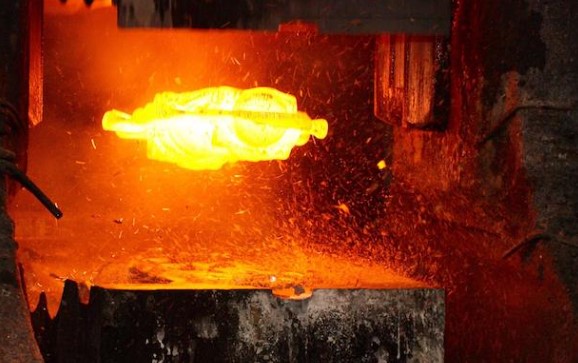
In the metal forging process, much attention is usually given to heating and forging deformation stages, while post-forging cooling is often overlooked. In fact, post-forging cooling is just as critical as pre-forging heating and shaping deformation in determining the final quality of forged parts.
Post-forging cooling refers to the entire process in which a forged piece cools from its high-temperature state after final forging to ambient temperature. Although it appears to be a simple temperature reduction process, it has a decisive influence on forging quality. Even if optimal process parameters are used during heating and forging to obtain high-quality forged parts, improper cooling methods can still lead to serious defects.
Improper cooling may cause several problems. First, coarse forging structures may be inherited into subsequent heat treatment microstructures, affecting the final mechanical performance of the product. Second, improper cooling may directly induce various defects that can lead to forging rejection and economic losses. Therefore, post-forging cooling is an essential process that cannot be ignored in warm and hot forging production.
For small carbon steel forgings, natural cooling by placing the forged piece on the ground after forging is generally acceptable. However, for alloy steel forgings and large forgings, such simple treatment can lead to serious defects, including cracks, white spots, brittle fracture surfaces resembling stone texture, and network carbides. These defects not only prolong production cycles but may also result in complete scrapping of forgings in severe cases.
To understand the influence of cooling on forging quality, it is necessary to first analyze the stresses generated during cooling. Three main types of internal stresses act on the forging during the cooling process: thermal stress, transformation stress, and residual stress. The superposition of these stresses determines whether cracking will occur.
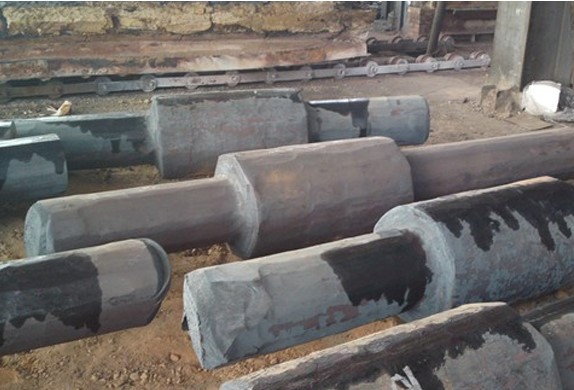
At the initial stage of cooling, there is a significant temperature gradient between the surface and the core of the forging. The surface temperature decreases rapidly, resulting in larger volume contraction, while the core remains at a higher temperature and contracts less. Consequently, the contraction tendency of the surface layer is restrained by the hotter core, generating tensile stress on the surface and compressive stress inside the core.
For steels with good plasticity and low deformation resistance, this situation usually does not cause serious problems because the core temperature is still high, the deformation resistance is low, and plasticity remains good. Microplastic deformation may occur locally to relax thermal stress and prevent cracking.
In the later stage of cooling, the situation reverses. When the forging surface temperature approaches room temperature, thermal contraction almost ceases. However, the core continues to cool and contract, but this contraction is constrained by the hardened surface layer. As a result, the stress direction is reversed: tensile stress develops in the core while compressive stress forms on the surface.
When phase transformation occurs during cooling, transformation stress is generated because the specific volume before and after transformation differs, and phase transformation occurs within a temperature interval. Moreover, the surface and core do not transform simultaneously.
Taking martensitic transformation as an example, when the surface cools to the martensitic transformation temperature, transformation first occurs at the surface, accompanied by volume expansion. However, this expansion is constrained by the core, generating transformation stress characterized by compressive stress on the surface and tensile stress in the core. Since the core temperature remains relatively high and plasticity is good, local plastic deformation may occur to alleviate the stress.
As cooling continues, the core also reaches the martensitic transformation temperature and begins transformation with volume expansion. At this stage, the surface has already completed transformation and no longer changes volume. The core expansion is constrained by the surface layer, resulting in stress reversal: compressive stress appears in the core and tensile stress develops on the surface.
As martensite content in the core gradually increases, transformation stresses between the surface and core tend to offset each other but then increase again until martensitic transformation is completed. This transformation stress exists in a three-dimensional stress state, with tangential stress being the largest component, which explains why longitudinal surface cracks may sometimes form.
Besides thermal stress and transformation stress, residual stress also exists in forgings. This stress originates from the forging deformation process. During forging of heated billets, deformation is often uneven, and work hardening generates internal stress. If such stress is not eliminated through timely recrystallization softening, it will remain inside the forging as residual stress.
The distribution of residual stress within the forging depends on the degree of deformation non-uniformity. Tensile stress may appear either in the surface layer or in the core.
The total internal stress experienced during cooling is the superposition of the above three stresses. When the total internal stress exceeds the local strength limit of the material, cracks will form. Even if cracking does not occur, the presence of residual stress may adversely affect subsequent heat treatment processes.
Generally, during the early stage of cooling when the internal temperature of the forging is still high but the surface temperature is lower, cracking may occur due to thermal stress. However, in most cases, cooling cracks are caused by transformation stress.
High-speed steel, Cr12MoV steel, and martensitic stainless steel are typical materials prone to such defects. In particular, high-speed steel forgings may still undergo transformation from retained austenite to martensite at room temperature, continuously increasing surface tensile stress and potentially causing cracking. Therefore, high-speed steel forgings are required to undergo annealing within 24 hours after forging.
The larger the forging size, the lower the thermal conductivity, and the faster the cooling rate, the greater the thermal and transformation stresses, making cracking more likely.
After understanding the basic mechanisms of stress formation during cooling, it is important to examine the practical defects caused by improper cooling processes. Alloy steel forgings and large forgings are particularly sensitive to cooling rates due to their high alloy content and large cross-sectional dimensions.
For hypereutectoid steel and bearing steel, if the final forging temperature is too high and slow cooling occurs within the Acm–Ar1 temperature range, secondary cementite will precipitate intensively from austenite. Due to the high mobility of carbon atoms and sufficient diffusion time toward grain boundaries, network carbides may form along prior austenite grain boundaries.
Severe network carbide formation is difficult to eliminate through conventional heat treatment and will significantly reduce impact toughness and may cause cracking during quenching.
For austenitic stainless steels such as 1Cr18Ni9 and 1Cr18Ni9Ti, slow cooling within the temperature range of 800°C to 550°C may lead to chromium carbide precipitation along grain boundaries, forming network carbides. The precipitation of carbides causes chromium depletion near grain boundaries, reducing intergranular corrosion resistance.
Prevention measures include controlling final forging temperature, avoiding slow cooling within sensitive temperature zones, and selecting appropriate cooling rates to suppress grain boundary carbide precipitation.
Stone-like fracture surfaces are mainly caused by billet overheating, but cooling rate also plays an important role. Interestingly, for overheated alloy structural steel forgings, both extremely fast and extremely slow cooling may avoid stone-like fracture, whereas a medium cooling rate is often the most dangerous.
Mechanism analysis shows that when billets are overheated, large blocky second-phase particles such as MnS, AlN, and TiN dissolve into the matrix, and austenite grains grow rapidly. During cooling, these dissolved phases may reprecipitate as fine particles or flakes along coarse austenite grain boundaries. Under stress, these particles become initiation sites of microcracks, leading to intergranular weakening. When fractured under brittle conditions, the fracture surface appears stone-like, and impact toughness decreases sharply.
The higher the precipitation density of secondary phases along grain boundaries, the stronger the grain boundary weakening effect and the higher the probability of stone-like fracture. At very high cooling rates, atomic diffusion is limited and precipitation may not occur in time. Conversely, at very low cooling rates, precipitated phases may aggregate into larger particles, reducing grain boundary weakening. Therefore, medium cooling rates are the most dangerous.
Prevention measures include strictly controlling heating temperature to avoid billet overheating and selecting cooling rates according to material characteristics to avoid dangerous intermediate cooling zones.
White spots are internal defects formed during cooling and are essentially internal microcracks. On longitudinal fracture surfaces, white spots appear as round or oval silvery-white marks (bright in alloy steels and relatively darker in carbon steels). On transverse fracture surfaces, they appear as tiny cracks. White spot sizes may range from several millimeters to several tens of millimeters.
Microscopic observation shows no plastic deformation around white spots, indicating a purely brittle nature.
White spots are extremely harmful to forging performance. They can significantly reduce mechanical properties, cause cracking during quenching heat treatment, and may lead to sudden fracture under cyclic or alternating loads. White spots are stress concentration sites and often become crack initiation sources under fatigue loading.
White spots are more common in pearlitic and martensitic alloy steels, while they are rarely observed in austenitic, ferritic, or ledeburitic steels. They are generally considered to result from the combined effect of hydrogen and transformation stress. Faster cooling rates intensify this effect, and large forgings are more susceptible.
Prevention measures include reducing hydrogen content in steel, controlling cooling rate, and applying isothermal annealing when necessary. For white spot–sensitive steels, dehydrogenation annealing should be performed promptly after forging.
If forgings are cooled improperly after final forging, non-equilibrium microstructures may form. These non-equilibrium structures, such as martensite, bainite, and Widmanstätten structures, exhibit metallurgical heredity and may influence subsequent heat treatment microstructures.
For example, if 20CrMnTi carburizing steel forgings are air-cooled improperly after final forging, a mixed microstructure consisting of ferrite, pearlite, Widmanstätten structure, and bainite may form. After carburizing heat treatment, coarse austenite grains may appear, demonstrating structural heredity.
In contrast, controlled cooling in a cooling box after forging can produce a balanced microstructure consisting of ferrite and pearlite, resulting in significantly refined microstructure after carburizing.
Prevention measures include adopting controlled cooling after final forging to obtain near-equilibrium microstructures, which is an effective method for preventing metallurgical heredity.
Based on the above analysis, controlled cooling technology must be adopted for alloy steel forgings and large forgings instead of simple natural cooling.
The core concept of controlled cooling is to regulate cooling rate according to material properties and forging dimensions, allowing the process to avoid dangerous temperature zones where defects may form and achieve an ideal microstructure.
Practical measures include:
- Using dedicated cooling equipment such as cooling boxes and thermal insulation pits to control cooling rate and avoid excessively fast or slow cooling.
- Applying stepwise cooling by using different cooling rates in different temperature ranges to avoid sensitive zones.
- Employing isothermal cooling by holding the forging at specific temperatures to ensure sufficient phase transformation and prevent non-equilibrium microstructures.
- Performing timely heat treatment. For white spot–sensitive steels, dehydrogenation annealing should be conducted promptly after forging. For high-speed steel, annealing must be completed within 24 hours after forging.
- Controlling final forging temperature to avoid excessively high finishing temperatures and reduce defects such as network carbides.
Post-forging cooling is a complex process involving heat transfer, metallurgy, and mechanics. Improper cooling may cause cracks, white spots, stone-like fractures, network carbides, and metallurgical heredity, severely affecting forging quality and operational safety.
For alloy steel and large forgings, post-forging cooling must be carefully controlled based on material characteristics. Appropriate cooling methods and rates should be selected, and controlled cooling technology should be applied when necessary to ensure product quality and avoid economic losses and safety accidents.
In practical production, scientific cooling process specifications should be formulated according to specific steel grades, forging dimensions, and geometries, and strict quality control should be implemented to ensure stable and reliable forging quality.