Steel Forging Quenching Media: Water vs. Oil
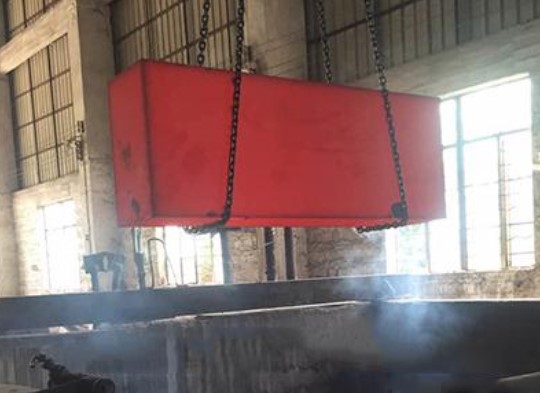
In the metal heat treatment process, quenching is the key step that determines the final performance of a steel forging. The choice of quenching medium not only directly affects the mechanical properties and metallographic structure of the forging, but also relates to whether the workpiece will experience deformation, cracking, and other quality issues. Therefore, selecting a suitable quenching medium and carrying out proper daily maintenance are core skills that every heat treatment engineer must master.
An ideal quenching cooling process should follow a specific temperature curve: above 650 °C, the austenite phase is relatively stable, and a slower cooling rate is required to reduce thermal stresses caused by temperature differences between the interior and exterior; between 650 °C and 450 °C, in the "nose region," a sufficiently fast cooling rate (exceeding the critical cooling rate) must be achieved to ensure the formation of martensite or bainite; below 400 °C, especially below the martensite start point (Ms point), cooling should be slow to reduce structural stress and prevent excessive deformation and cracking.
Water, as a quenching medium, is the most widely used in industrial production. It is low-cost, easily available, safe, and non-toxic, seemingly making it an ideal choice. However, the cooling characteristics of water have obvious duality: it can achieve rapid cooling to obtain high hardness, but uneven cooling may also lead to workpiece defects. Understanding the advantages and disadvantages of water quenching is the foundation of mastering quenching processes.
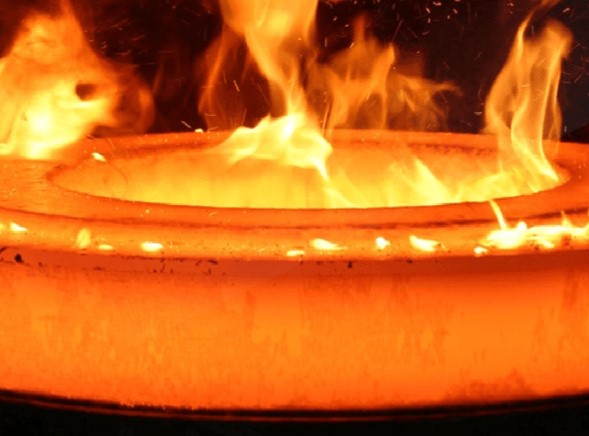
Water is the most common and economical quenching medium, with significant advantages such as being non-toxic, safe, and low-cost. However, in terms of cooling characteristics, water is not an ideal quenching medium.
In the high-temperature range of 700 °C to 800 °C, water quenching has a serious problem—the vapor blanket phenomenon. When a red-hot forging is immersed in water, a layer of vapor quickly forms on the surface, enveloping the workpiece and slowing down the cooling rate. In the critical nose region (650 °C–450 °C), where rapid cooling is required, water’s cooling rate does not exceed 200 °C/s.
Worse still, in the martensite transformation zone below 400 °C, the vapor blanket suddenly collapses, causing the cooling rate to surge to 700 °C/s. This “slow first, then fast” cooling characteristic is completely opposite to the ideal curve, producing tremendous internal structural stress that can directly lead to cracking.
The vapor blanket also causes local cooling unevenness, leading to certain areas of the forging cooling too slowly and failing to form martensite, resulting in “soft spots” with insufficient hardness. As water temperature rises, its cooling capacity drops sharply—when water reaches 40 °C, the cooling rate in the nose region decreases to only 100 °C/s, seriously affecting quenching quality.
To ensure uniform quenching quality, industrial practice strictly controls water temperature between 15 °C and 25 °C, requiring continuous replenishment of fresh water to maintain low temperature. Additionally, to reduce the formation of soft spots, water circulation must be maintained to constantly refresh the water on the workpiece surface, breaking the stability of the vapor blanket.
Water quality cleanliness is equally critical. When water contains dirt, oil, soap, or other substances, the vapor blanket forms more quickly, significantly reducing cooling ability and uniformity. It is worth noting that using compressed air to stir water is unreasonable, as this introduces large amounts of dissolved gas, adversely affecting cooling performance.
To address the deficiencies of pure water quenching, two improved media—saltwater and alkaline water—have been developed in industry.
Saltwater quenching: Adding 5–10% sodium chloride (NaCl) to water can significantly improve cooling characteristics. During quenching, salt crystallizes and bursts on the hot workpiece surface, breaking the vapor blanket and causing the scale to fall off, producing a clean surface. In the nose region, the cooling rate of saltwater can reach 1000 °C/s (measured with a φ20 mm silver probe), while at low temperatures it is close to that of plain water. This allows the forging to more easily achieve uniform high hardness and a deeper hardened layer. Therefore, in industry, pure water quenching is rarely used; the vast majority of quenching employs NaCl aqueous solutions.
Alkaline water quenching: Adding 10–15% sodium hydroxide (NaOH) to water can achieve even higher cooling rates than saltwater in the nose region between 650 °C and 550 °C, while at low temperatures, the cooling rate is lower than that of saltwater. Workpieces can achieve high hardness without soft spots, while reducing deformation and cracking, making it an ideal quenching medium for carbon steel. In addition, the reaction between alkali and metal releases hydrogen, removing scale and producing a silver-white surface.
However, the use of alkaline water has obvious drawbacks: NaOH is highly corrosive and irritating to the skin, making it inconvenient to use; it absorbs carbon dioxide from the air and turns into sodium carbonate, reducing cooling ability; and the solution is prone to deterioration. For these reasons, alkaline water is less commonly used than saltwater.
The effect of temperature on the cooling ability of saltwater and alkaline water is relatively small: saltwater can be used up to 50 °C, and alkaline water up to 60 °C. After cooling in saltwater or alkaline water, workpieces must be thoroughly cleaned to prevent corrosion.
Unlike the aggressive cooling of water quenching, oil quenching represents a gentler and more controllable quenching approach. Mineral oil, due to its unique cooling characteristics, achieves slow cooling in the low-temperature stage, effectively balancing the conflict between hardness requirements and deformation control. For complex-shaped or sensitive material forgings, oil quenching is often a more reliable choice.
Both vegetable oils and mineral oils have been used as cooling media, but vegetable oils decompose and age easily and are expensive, so they have been completely replaced by mineral oils.
The cooling rate of mineral oil is relatively slow. In the nose region, the cooling rate is approximately 100 °C/s, but in the low-temperature stage below 300 °C, cooling is extremely slow. This “fast first, then slow” cooling characteristic exactly meets the requirements of the ideal quenching curve in the martensite transformation region, effectively reducing the risk of deformation and cracking.
Due to its lower cooling capacity, oil is suitable only for steels with C-curves toward the right (i.e., high-hardenability steels) or carbon steel parts that do not require extremely high hardness. For workpieces requiring very high hardness, oil quenching alone may not meet requirements.
As oil temperature rises, viscosity decreases, flow improves, and cooling capacity increases. However, excessive oil temperature poses serious safety hazards, potentially causing fires. Therefore, industrial practice generally requires that oil temperature be kept below 80 °C during use.
Most mineral oil media used in production are 10#–30# engine oils, with 90% using N22 or N32 mechanical lubricating oils or corresponding spindle oils. The higher the oil grade, the higher the viscosity, and the lower the cooling capacity. Enterprises can select the appropriate oil viscosity based on workpiece material and hardness requirements.
When oil contacts hot workpieces, it decomposes and generates residue; at the same time, it continuously oxidizes. These factors gradually reduce the cooling capacity of the oil, causing oil aging. Therefore, quenching oil must be regularly tested for cooling characteristics and replaced or regenerated in time to ensure stable quenching quality.
To compensate for the insufficient cooling rate of ordinary mineral oil, modern industry has developed rapid quenching oils—by adding highly effective cooling agents, these oils can increase cooling speed at high temperatures while maintaining the slow-cooling benefits at low temperatures.
After understanding the working principles of water and oil quenching, it is necessary to compare them systematically on the same dimension. Cooling rate, applicable materials, deformation control, cost and environmental impact, and operational safety are the five core indicators that determine the choice of quenching method in practical production. The following analysis comprehensively explains the differences and trade-offs of the two quenching methods based on specific data and application scenarios.
Cooling rate is the core indicator for evaluating quenching effectiveness. The cooling rate of water quenching (including saltwater and alkaline water) is much faster than that of oil quenching, typically 3–5 times higher than oil quenching at high temperatures above 500 °C.
This rapid cooling allows materials to quickly reach high hardness, but also increases the risk of workpiece cracking. In contrast, oil quenching has a slower cooling rate, especially in the low-temperature stage below 300 °C, which effectively reduces stress concentration and decreases the likelihood of cracks.
Oil quenching: Alloy steel, tool steel, high-carbon steel, and other materials sensitive to deformation and cracking. These materials have rightward C-curves with lower critical cooling rates, allowing martensite formation even at slower cooling rates; fast cooling tends to produce excessive internal stress, causing workpiece failure.
Water quenching: Low- and medium-carbon steels and other materials requiring high cooling rates. These materials have leftward C-curves, requiring rapid cooling to surpass the nose region and obtain martensite; they are relatively insensitive to stresses caused by rapid cooling and are less prone to cracking.
It is worth noting that some special materials may require specific quenching media or composite processes (such as water quenching followed by oil quenching, or polymer quenching) to achieve optimal performance.
Oil quenching, due to its slower cooling rate, can effectively control workpiece deformation, making it particularly suitable for precision parts such as gears, bearings, and molds. Water quenching is prone to workpiece deformation, especially in complex shapes or components with varying cross-sections—thin-walled areas cool faster while thick sections cool slower, generating uneven stress distribution.
To reduce water quenching deformation, some enterprises perform tempering or other post-treatment processes after water quenching to improve workpiece stability and accuracy, or use interrupted quenching and dual-medium quenching techniques.
Cost: Oil quenching is relatively expensive, mainly due to three factors: the higher price of quenching oil compared to water, the need for regular maintenance and replacement, and the requirement for fire prevention and oil fume treatment equipment. Water quenching is low-cost, the most economical method.
Environmental impact: Water quenching is more environmentally friendly, but water-quenched workpieces require anti-rust treatment afterward. Oil quenching may produce oil mist or waste oil, affecting the environment, and requires proper collection and treatment facilities. Long-term selection must consider both process cost and environmental compliance.
Oil quenching operations are relatively safe, as mineral oil has a high flash and fire point, making it unlikely to catch fire (though oil temperature must still be strictly controlled). Water quenching requires attention to high-temperature steam burns and water splashing, with operators needing strict protective measures, including protective clothing and face shields.
Theoretical comparisons must ultimately be applied to practical production. Different industries and workpieces have differentiated quenching requirements, and water and oil quenching have thus developed mature application systems in their respective fields. Case analysis provides a more intuitive understanding of the actual logic behind selecting quenching methods.
Automotive components: Engine gears, transmission gears, bearing races, and other parts requiring high precision and wear resistance typically use oil quenching or rapid quenching oil to ensure dimensional accuracy and surface quality.
Mold manufacturing: Cold and hot-work molds requiring high hardness, wear resistance, and crack prevention commonly use oil quenching or staged quenching.
Aerospace: Aerospace engine parts, landing gear components, and other critical parts requiring extreme reliability and precision often use oil quenching or isothermal quenching to strictly control deformation.
Construction steel: Rebars, structural steel, and other construction steels with high hardness requirements but relatively relaxed deformation tolerance often use water or saltwater quenching to achieve high strength.
Agricultural machinery: Plowshares, harvester blades, and other wear-resistant parts requiring high hardness and low cost are suitable for water quenching.
General tools: Files, saw blades, and simple knives with relatively simple shapes and low sensitivity to deformation typically use water quenching for high hardness.
Choosing between water and oil quenching requires comprehensive consideration of the following factors:
Material characteristics: Analyze the steel's C-curve position, critical cooling rate, and hardenability to determine the theoretical cooling rate range required.
Workpiece shape: Simple-shaped workpieces can tolerate larger cooling rate differences, suitable for water quenching; complex or uneven-thickness workpieces should use oil quenching to reduce deformation.
Hardness requirements: Workpieces requiring extremely high hardness may need water or saltwater quenching; for moderate hardness with low deformation requirements, oil quenching is more suitable.
Precision requirements: Precision parts must control deformation, so oil quenching is preferred; general parts may allow for higher deformation, making water quenching a cost-effective choice.
Production volume: For large-scale production, water quenching offers a cost advantage; for small-batch, multi-variety production, oil quenching offers better adaptability.
Safety and environmental compliance: Evaluate enterprise safety facilities and environmental requirements to select a compliant quenching method.
Water and oil quenching each have advantages and disadvantages. There is no absolute “best,” only the “most suitable.” Water quenching provides fast cooling and low cost, suitable for simple-shaped, low- and medium-carbon steel mass production; oil quenching offers gentle cooling and minimal deformation, suitable for complex shapes, alloy steels, and precision components.
With the development of materials science, new technologies such as polymer quenching, gas quenching, and spray quenching continue to emerge. However, water and oil quenching, with their mature reliability and controllable cost, will continue to play a significant role in industry. Mastering the principles and characteristics of both methods and flexibly choosing based on specific conditions is a core capability of heat treatment engineers.
When selecting a quenching process, enterprises should not blindly pursue low cost or high performance, but should base their choice on product requirements, production conditions, and quality stability to achieve the optimal balance between quality and efficiency.