Solutions for Low Quenching Hardness in Forgings

In the field of mechanical manufacturing, the quenching process of forgings is of crucial importance, as it directly determines the hardness, strength, and service life of the forging. However, in actual production, situations where the hardness of a forging after quenching is lower than the technical requirements occur frequently. This not only affects the tensile strength and bending fatigue strength of the forging but also makes it prone to fatigue cracks during use, greatly reducing its performance. This article will provide an in-depth discussion of the factors that lead to low quenching hardness in forgings and propose corresponding solutions to ensure that the forging quality meets the required standards.
The quenching process of forgings is critical, as it directly determines the hardness, strength, and service life of the forging. However, in actual production, situations where the hardness of a forging after quenching is lower than the technical requirements occur frequently. This not only affects the tensile strength and bending fatigue strength of the forging but also makes it prone to fatigue cracks during use, greatly reducing its performance. Below, we will explore in detail the various factors that cause low quenching hardness in forgings, providing a basis for subsequent improvement measures.
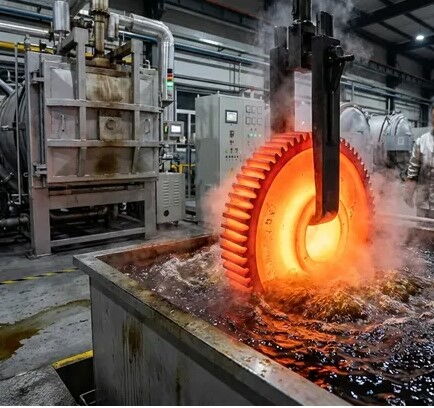
- Insufficient Heating Temperature: The quenching heating temperature is one of the key factors affecting the hardness of the forging. If the heating temperature is too low, the austenite in the forging cannot form fully, resulting in a martensitic structure after quenching that does not reach high hardness. For example, in hypoeutectoid and eutectoid steels, ferrite may not dissolve completely, and in hypereutectoid steels, carbides may dissolve insufficiently. Both conditions lead to austenite with low carbon content, which in turn affects the hardness after quenching.
- Insufficient Soaking Time: Even if the heating temperature meets the requirements, if the soaking time is too short, the internal structure of the forging cannot fully homogenize, also resulting in incomplete austenitization. In actual production, incorrect procedures, excessive or densely packed furnace loads, or poor convection and circulation of the heating medium can all cause uneven heating and insufficient soaking.
- Heating Equipment Malfunction: Aging or malfunctioning heating furnaces can severely affect quenching outcomes. In air-heated furnaces, heating elements often fail, and poor sealing can reduce uniformity. In salt bath furnaces, short or thin electrodes can lead to low furnace temperatures and slow heating rates. Additionally, malfunctioning temperature control instruments may not accurately reflect the actual heating temperature inside the furnace, causing insufficient austenitization, incomplete ferrite dissolution, and ultimately low hardness after quenching.
- Improper Selection of Cooling Medium: During quenching, the cooling rate of austenite must exceed the critical cooling rate in order to produce martensite and ensure that the forging achieves the required hardness. In production, improper selection of the quenching medium, insufficient circulation speed or spray pressure, or excessively high medium temperature can all result in low quenching hardness. For example, in salt (alkaline) water solutions, if the salt or alkali content is too low, the vapor film formed on the forging surface cannot break due to “salt explosion,” reducing quenching efficiency and causing localized or overall low hardness.
- Improper Cooling Process Control: The handling of the forging from the furnace to the quenching medium is critical. Excessive transfer time in air, insufficient cooling time in the medium, incomplete penetration, or self-tempering can result in low hardness. In dual-medium quenching, such as water followed by oil, if the cooling time in water is insufficient or the forging remains in air too long before immersion in oil, bainite or troostite may form in the structure, leading to low hardness.
- Fixture and Loading Issues: If the fixture is overloaded during installation, the internal heating may be insufficient, resulting in low hardness. When batch forgings are immersed in the quenching medium, internal pieces may fail to quench properly. In step quenching or isothermal quenching, excessively high temperatures or overly long holding times can also reduce quenching hardness.
- Steel Mixing: Mixing steels of different grades, such as low-carbon and medium-carbon steels, can lead to insufficient austenitization in low-carbon pieces or overheating in medium-carbon pieces at the same austenitizing temperature, resulting in post-quench hardness discrepancies.
- Surface Decarburization: Heating in strongly oxidizing atmospheres or media can cause surface decarburization, reducing the carbon content in the surface austenite and lowering surface hardness after quenching.
- Original Microstructure: If the forging is not normalized or annealed after forging, the initial microstructure may contain a large amount of ferrite. With short-time heating and soaking during quenching, the ferrite may not be removed and remains, resulting in retained ferrite after quenching and lower hardness.
- Quenchability: Forgings with poor quenchability, large dimensions (size effect), severe banded structures in raw material, carbide segregation, or excessive non-metallic inclusions may all affect post-quench hardness.
- Hardness Measurement: Inaccurate hardness tester readings, rough surfaces with burrs or oxide scale, or uneven hardness test platforms can all affect the accuracy of hardness measurements.
- Tempering: High tempering temperatures or prolonged soaking during tempering can also result in reduced hardness.
After a thorough analysis of the many causes of low quenching hardness in forgings, it is necessary to explore targeted solutions. Addressing this issue not only improves the mechanical performance of forgings but also extends their service life, ensuring better performance in practical applications. The following strategies are proposed to ensure that the hardness of quenched forgings meets technical requirements.
- Define Process Parameters Clearly: The quenching process must be correct, accurate, and in line with actual production conditions. Process parameters should specify heating temperature, soaking time, furnace loading method, furnace load amount, quenching method, type, composition, and temperature of the quenching medium. Detailed process operation regulations should be established and strictly followed.
- Strictly Control Transfer Time: For dual-medium quenching, air pre-cooling, step quenching, and isothermal quenching, transfer operations must have strict time control to prevent formation of non-martensitic structures.
- Regular Equipment Inspection: Heating equipment must meet process requirements. Regular checks should be conducted on furnace temperature uniformity, door sealing in air-heated furnaces, and temperature uniformity at furnace corners in salt baths. Heating elements should be checked frequently and replaced promptly if damaged.
- Calibrate Temperature Instruments: Temperature control instruments should be regularly calibrated, with errors marked, to ensure accurate readings.
- Select Suitable Medium: The quenching medium should be chosen based on steel grade, size, shape, and required hardness. Cooling capacity of the medium, such as saltwater specific gravity, should be regularly tested to meet process requirements.
- Maintain Medium Quality: Cooling medium should meet process standards. For salt or alkaline water, the salt/alkali content must meet required standards. High temperatures, impurities in water or oil, water in oil, or oil in water can affect cooling efficiency and should be addressed promptly.
- Control Transfer and Cooling Time: Transfer time in air before immersion in quenching medium should be minimized, and cooling time in the medium should be sufficient to ensure full penetration. In dual-medium water-oil quenching, sufficient cooling in water and minimal air exposure before oil immersion are critical.
- Use Appropriate Cooling Methods: For large workpieces with size effects, surface hardness may be low. Strong jet quenching can increase cooling rate and improve surface hardness.
- Avoid Steel Mixing: Different steel grades should be strictly separated to prevent mixing. Consistency of steel material in each batch should be ensured for uniform quenching results.
- Prevent Surface Decarburization: During heating, forgings should avoid strongly oxidizing atmospheres or media. Protective atmospheres or anti-oxidation coatings may be used.
- Optimize Initial Microstructure: Forgings should undergo normalization or annealing after forging to reduce ferrite content. Appropriate heating and soaking during quenching can remove ferrite and prevent retained ferrite formation.
- Handle Poorly Quenchable Forgings: For forgings with poor quenchability, transfer time should be minimized and cooling rate increased. For workpieces with excessive retained austenite, cold treatment can be applied.
- Ensure Hardness Tester Accuracy: Hardness testers must be calibrated regularly. Forging surfaces should be smooth, free of burrs or oxide scale, and test platforms should be flat to ensure accurate measurements.
- Use Appropriate Hardness Test Methods: Hardness test methods include indentation, scratch, and rebound methods. For heat treatment quality inspection, indentation methods are mainly used, sometimes supplemented by rebound methods. Indentation hardness reflects the forging surface's resistance to plastic deformation under applied load and correlates approximately with material strength.
After addressing low quenching hardness, accurate hardness testing is essential for scientifically evaluating improvements. Hardness testing is a critical quality control step, providing key data to ensure forged components meet design requirements. Understanding and mastering correct testing methods is essential.
Instruments include Shore and Leeb hardness testers, producing Shore hardness (HS) and Leeb hardness (HL). The principle involves dropping a diamond indenter of a specified shape from a fixed height h0 onto the sample surface. The harder the forging, the higher the rebound h. The hardness is calculated using a coefficient K as HS = K * (h / h0). Shore testers are lightweight (standard 4 kg) and can be used directly on large forgings. Curved surfaces should have a radius of at least 32 mm.
Indentation hardness reflects the surface's resistance to plastic deformation. Indentation hardness values correlate approximately with material strength, making it widely used. Instruments consist of a specimen table, indenter, loading device, and display for hardness or indentation size. Based on indenter type and calculation, instruments include Brinell, Rockwell, Vickers, microhardness, and Knoop testers.
- Brinell Hardness Tester: Uses a large indenter for low-hardness forgings or multi-phase metals with large hardness differences.
- Rockwell Hardness Tester: Uses two types of indenters, suitable for both soft and hard metals, making it versatile and essential in heat treatment workshops.
- Vickers, Microhardness, and Knoop Testers: Use similar indenters and principles. They employ low loads and small indentations, ideal for small parts or thin hardened layers, and can map hardness distribution. Microhardness can measure hardness of individual microstructural phases.
Low quenching hardness in forgings is a complex issue, involving the quenching process, heating equipment, quenching medium, cooling control, steel grade, initial microstructure, quenchability, and hardness measurement. By optimizing the quenching process, ensuring proper operation of heating equipment, selecting and maintaining appropriate quenching media, controlling the cooling process, strengthening quality control during production, and employing suitable hardness testing methods, low quenching hardness can be effectively addressed. This ensures forging quality meets technical requirements and enhances performance and service life. In production, strict adherence to process regulations, regular equipment maintenance, and control of all process stages are essential to guarantee quenching quality.