Forging Fold Defects: Causes, Impacts & Solutions
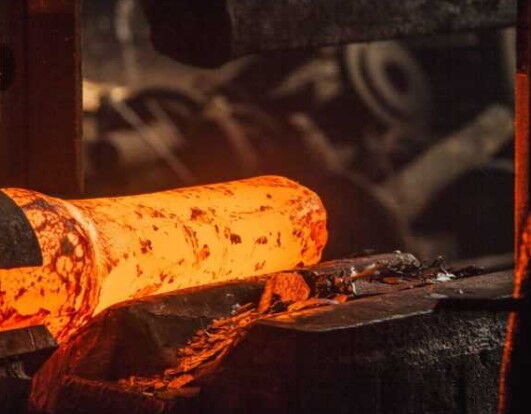
In the field of metal forging, fold defects remain a persistent and challenging problem for manufacturers. These defects not only compromise the surface quality of forged components but also have profound effects on their internal integrity, structural performance, and overall service life. Fold defects can lead to stress concentration points, reduced fatigue resistance, and ultimately premature failure of critical components. This makes their prevention and resolution a top priority in modern steel forging operations.
This article aims to provide a comprehensive analysis of fold defects, covering their definition, common types, causes, detection methods, potential impacts, and practical solutions. The objective is to offer forging engineers and production managers a detailed and actionable reference guide to improve both product quality and production efficiency.
A fold defect, in its simplest form, occurs when layers of metal overlap during the forging deformation process, typically due to surface oxidation or improper material flow. The defect may manifest visibly on the forged component, or it may remain hidden internally, detectable only through specialized non-destructive testing (NDT) methods such as magnetic particle inspection or penetrant testing.
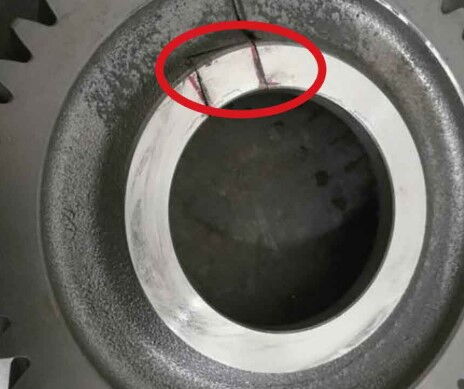
Depending on the location and mechanism of formation, fold defects can be classified into several distinct types:
Crankshafts equipped with oil-seal flanges are particularly prone to oil-seal folds during the commissioning stage. These folds are often categorized as either fully closed or partially closed. They usually occur when a section of the component is partially formed, but subsequent axial movements during the forging or backfilling process cause misalignment of the pre-formed region. This misalignment forces the material to fold upon itself, resulting in a fold defect that can compromise both surface finish and structural integrity.
In direct final forging using a forging hammer, connecting rod neck folds are relatively common. These defects often appear along the upper inner section of the parting surface, exhibiting a variety of shapes. Horizontal folds may appear as straight “I” or double-line “8” patterns, while longitudinal folds may take the form of straight grooves or misaligned channels.
Forging presses with a pre-forging step significantly reduce the occurrence of these defects. However, if the pre-forging billet distribution is uneven or the die stock thickness is inconsistent, longitudinal folds or non-overlapping grooves may still appear during final forging.
During trimming operations, burrs or raised material at the edges can be pressed back into the forging body during subsequent correction processes, forming fold defects. This is especially common in twisted crankshafts. Here, burrs formed along the horizontal parting surface during trimming are transferred into the upper and lower slots of the correction die. When hot correction is applied, the burrs are pressed into the forging body, creating folds that may not be immediately visible but can significantly affect performance under stress.
Incomplete forging is another common source of folds. For instance, balance blocks may develop deep folds at the parting surface, which remain even after final forming. This often occurs due to undersized billets that fail to completely fill the die cavity. Even easily forgeable crankshafts may develop balance block folds if the billet is slightly undersized. Minor folds can be mitigated by enlarging adjacent die fillets, while more severe defects require directional stock distribution in the pre-forging design or the adoption of semi-closed forging techniques.
Fold defects can seriously compromise the mechanical performance of forged components. By breaking the continuity of the metal, they create localized weak points that serve as stress concentrators. During operation, these weak points are prone to fatigue crack initiation and propagation, leading to significant reductions in load-bearing capacity and component lifespan.
For die forgings, ribs often provide stiffness or serve as mounting and connection surfaces for other parts. Folds along these ribs can compromise the component’s ability to maintain structural integrity and precise alignment. In industrial applications, whether in heavy machinery or precision instruments, fold defects can lead to premature failure, equipment downtime, and even safety hazards. For enterprises, this translates to both direct financial loss and damage to reputation, highlighting the critical need for robust fold prevention strategies.
Fold defects result from the complex interaction of multiple factors, including billet design, forging processes, and die structure. Understanding these causes is essential for developing effective mitigation strategies.
A key contributor to fold defects is the mismatch between the initial billet geometry and the intended forging shape. For example, a forging process using a 180 mm × 420 mm round billet may lead to uneven metal distribution in symmetrical ribs, creating conditions for folds. Switching to a smaller billet, such as 170 mm × 280 mm, and elongating it appropriately in the die can improve metal flow uniformity and eliminate folds. Modern simulation software allows engineers to model metal flow and predict potential fold-prone areas before production, enabling proactive design optimization.
Different forging methods influence fold formation differently:
- Forging Hammer Process: Without pre-forging, crankshaft sections such as connecting rod necks may develop folds due to initial protrusion formation, lateral pit shifts, and uneven metal backflow. Mitigation strategies include controlling strike intensity across forging stages or adding larger fillets and thicker stock in critical areas to improve metal flow.
- Forging Press Process: The presence of a pre-forging step typically prevents connecting rod neck folds. However, uneven pre-forging stock thickness or misaligned billet placement can still produce grooves or folds during final forging. These issues are generally resolved by adjusting die structure or pre-forging parameters.
- Drop Die Process: Stepped shafts may develop folds at step regions due to cavity steps and insufficient fillets. Improved tooling design, including tangent lines and arc adjustments, can create additional cavity space to accommodate excess metal, preventing folds and flash formation.
Die structure and dimensioning play a critical role in fold formation.
- Insufficient Die Fillets: Small fillets restrict metal flow, creating voids and fold defects. Enlarging fillets on ribs, webs, and protrusions allows the metal to fill the die cavity uniformly while directing excess material into flash grooves, reducing the risk of folds.
- Improper Parting Surface and Cavity Design: Bent parts, including connecting rods, crankshafts, and pipe joints, are particularly susceptible. Bending angles below 110° or overly small inner radii increase material flow disparities, leading to folds. Optimizing bend angles, radii, and die groove slopes ensures smooth metal flow and minimizes fold occurrence.
Timely and accurate detection of fold defects is essential for quality control and loss reduction. The most common detection methods include:
- Visual Inspection: Simple and quick, suitable for obvious folds but limited for subtle or internal defects.
- Magnetic Particle Inspection: Exploits the magnetic properties of ferromagnetic materials to reveal surface and near-surface defects. It offers high sensitivity, low cost, and straightforward operation.
- Penetrant Testing: Uses capillary action to allow liquid penetrants to infiltrate surface defects. A developer then makes the defect visible. While highly effective for surface folds or cracks, it requires skilled operators for accurate interpretation.
Effective prevention of fold defects requires a multi-pronged approach, including optimizing billet design, refining forging processes, and improving die structures.
Careful consideration of billet size and shape ensures uniform metal flow during forging. For crankshafts prone to balance block folds, increasing billet size or using a semi-closed process can reduce the likelihood of folds. Simulation and modeling software allows engineers to predict metal flow, identify potential defect areas, and make preemptive design adjustments.
- Pre-Forging Steps: Introducing pre-forging helps reduce folds by improving metal flow, mitigating step effects, and enhancing material utilization. Pre-forging is particularly effective in reducing connecting rod neck folds in press forging.
- Process Parameter Control: Precise control of forging parameters, including strike intensity, speed, and temperature, is crucial. For hammer forging, controlling strike intensity at each stage prevents uneven metal flow and displacement, minimizing fold formation. Correct temperature ensures the metal remains in an optimal plastic state, further reducing the risk of folds.
- Trimming and Correction Optimization: Replacing worn trimming dies and controlling burr height prevents burr-induced folds. During crankshaft correction, careful management of parameters ensures that burrs do not press into the forging body.
- Fillet Design: Enlarging die fillets reduces resistance to metal flow and ensures complete cavity filling. For die forgings, fillets on ribs, webs, and protrusions should be optimized to direct excess metal into flash grooves, ensuring smooth, fold-free surfaces.
- Cavity and Parting Surface Adjustments: For bent components, bend angles, inner radii, and die groove slopes should be optimized to prevent material folding. Adjusting bend groove slopes based on production feedback ensures smooth metal flow and minimal fold formation.
- Die Maintenance and Upgrades: Regular inspection and maintenance of dies, including replacement of worn components, are essential. Worn dies alter metal flow patterns, increasing the likelihood of folds. Dies should also be upgraded as needed to accommodate different component designs and production requirements.
Fold defects are a common but complex quality issue in forging production. Their causes span billet design, forging process parameters, and die structure. By optimizing billet design, incorporating pre-forging steps, adjusting process parameters, and improving die geometry and maintenance, manufacturers can effectively prevent and minimize fold defects, thereby improving component quality, reliability, and production efficiency.
Although fold defects cannot be completely eliminated in forging practice, systematic and scientifically guided prevention and remediation measures can reduce their incidence to a minimum. By adopting these strategies, forging enterprises can maintain high-quality production standards, reduce operational risks, enhance equipment performance, and strengthen market competitiveness.
Through a combination of careful design, precise process control, and rigorous quality inspection, the negative impacts of fold defects can be effectively controlled, ensuring the long-term reliability and safety of forged components. This comprehensive understanding and proactive management of fold defects provide an invaluable reference for forging professionals seeking to optimize production processes and achieve sustainable industrial growth.