Defects in Isothermal Normalizing of Forgings
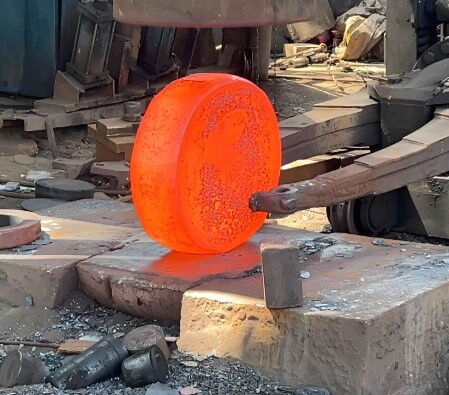
In the field of mechanical manufacturing, the quality of forgings directly affects the performance and reliability of the final products. As a critical heat treatment process in forging production, isothermal normalizing plays an undeniably important role. However, in actual operations, the isothermal normalizing process often encounters a variety of defect-related problems. These issues not only impair the quality of forgings but may also cause numerous difficulties in subsequent machining and heat treatment. This article provides an in-depth discussion of the common defects that occur during the isothermal normalizing of forgings and presents corresponding solutions, with the aim of offering useful references for practitioners in the field.
Isothermal normalizing is a special type of normalizing process. Its principle involves heating the workpiece to 30–50 °C above the Ac₃ or Accm temperature, holding it for an appropriate period, and then cooling it in a suitable manner to a selected temperature within the pearlite transformation region. The workpiece is held at this temperature so that the temperatures of different parts of different components, as well as different regions of the same component, become uniform. At this constant temperature, the transformation to ferrite + pearlite is completed uniformly, followed by air cooling.
Compared with conventional normalizing, the greatest advantage of isothermal normalizing lies in its ability to overcome the difficulties associated with controlling cooling rates and uneven cooling during conventional normalizing. As a result, it achieves uniformity in transformation products as well as in stress and hardness distribution.
Conventional normalizing is a heat treatment process in which steel is heated to an appropriate temperature above Ac₃ (or Accm), generally 30–50 °C higher, held for a certain time, and then air-cooled to obtain a pearlitic microstructure. Its purpose is to eliminate or improve various structural defects formed during billet preparation, obtain a microstructure and hardness most favorable for machining, improve the morphology and distribution of various phases in the structure, refine grains, and prepare the microstructure for final heat treatment. However, because conventional normalizing relies on continuous air cooling, the temperature range over which pearlite forms is wide, resulting in poor microstructural uniformity, large hardness dispersion, inferior machinability, and a tendency to cause deformation during final heat treatment. Therefore, in recent years, automotive gear steels have widely adopted isothermal normalizing as a pre-heat treatment process.
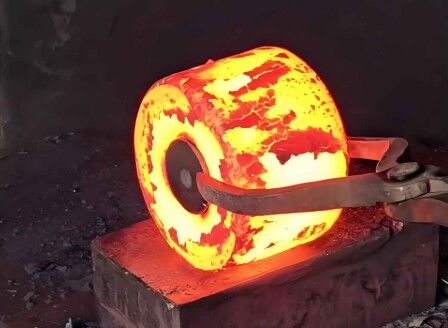
The isothermal normalizing process includes three main stages: the heating and austenite homogenization stage; the intermediate cooling stage (cooling from the austenitizing temperature to the isothermal treatment temperature); the isothermal holding stage, followed by air cooling.
During the heating and austenite homogenization stage, the temperature selection is the same as that for conventional normalizing, generally in the range of 920–950 °C. This stage is critical both in equipment design and in overall process planning. Key process parameters include furnace loading methods, rapid cooling methods (including cooling air volume and direction), rapid cooling time, slow cooling methods (including air volume and direction), and slow cooling time.
From an equipment design perspective, it is necessary to consider the uniformity of cooling rates at various positions within the cooling chamber during air cooling, as well as the capability to combine rapid cooling and slow cooling. This combination enables temperature uniformity between different components or between the inner and outer regions of the same component, thereby ensuring uniform microstructural transformation. From a process standpoint, it is essential to properly coordinate the relationships among loading methods, loading quantity, cooling rate, and cooling uniformity.
This stage is the key phase for controlling banded structures and avoiding non-equilibrium microstructural transformations. Therefore, a controlled cooling strategy is adopted: rapid cooling is used to cool the workpiece to near the ferrite transformation completion line, followed by slow cooling to allow the temperatures of different components or different regions of the same component to uniformly decrease to the isothermal temperature. The isothermal temperature and holding time should be determined based on the material’s isothermal transformation curves, furnace loading quantity, and effective thickness of the components, ensuring sufficient time for the transformation of austenite to ferrite and pearlite.
Although isothermal normalizing can theoretically and effectively resolve the problem of uneven cooling encountered in conventional normalizing, various defects may still arise in actual production due to the complexity of process parameters and uncertainties in operation. These defects not only affect the microstructural properties of forgings but may also cause numerous issues in subsequent machining and heat treatment. Therefore, gaining a thorough understanding of the common defects in isothermal normalizing and mastering the corresponding solutions is of vital importance for improving forging quality and production efficiency. The following sections provide a detailed discussion of common defects and their solutions.
Fine and non-uniform grain defects often occur in 20CrMnTi materials. This is because these materials contain titanium (Ti), a grain-refining element that inhibits grain growth. If the temperature is insufficient or the holding time is too short, grains do not have enough time to grow; alternatively, some grains may grow while others remain undeveloped. The main causes include low heating temperature, short holding time, and the presence of bainite or martensite in the initial microstructure formed during rapid cooling of the forging, which is difficult to transform during normalizing. This defect can be improved by increasing the heating temperature and extending the holding time.
Coarse grain defects commonly occur in 20CrMo and 20CrNiMo (8620R) materials. Such structures deteriorate machinability and make components prone to deformation during final heat treatment. The causes of coarse pearlite grains include alloy composition segregation, severe overheating during forging, slow heating in the two-phase region during normalizing, and excessively long furnace holding times after equipment failure without extinguishing the furnace. Solutions include lowering the forging temperature; accelerating heating through the two-phase region; shortening holding time when the normalizing temperature is too high; shutting down the furnace and reducing temperature promptly in case of equipment failure to avoid prolonged high-temperature exposure; and using multiple normalizing cycles to eliminate already formed coarse grains.
Widmanstätten structures commonly appear in 20CrMo, 20CrNiMo (SAE 8620R), and SAE 8627RH materials. This structure reduces machinability, shortens tool life, and leads to unstable deformation during final heat treatment. The main causes include excessively high heating temperatures for forgings; slow heating of forgings containing Widmanstätten or bainitic structures; excessively high air velocity during normalizing; overly high normalizing temperatures; and excessively fast cooling rates. Widmanstätten structures are more likely to occur in steels with severe alloy element segregation. Countermeasures include lowering the forging heating temperature, reducing the cooling rate during normalizing, shortening air-cooling time, and increasing the temperature at which the workpiece enters the isothermal furnace.
A banded structure refers to the alternating band-like distribution of ferrite and pearlite in hypoeutectoid steels. Although the hardness of a banded structure is not particularly high, its non-uniformity causes directional mechanical properties, especially significantly reduced transverse plasticity and toughness. It also worsens machinability, leading to rough machined surfaces, reduced cutting tool life, and increased heat treatment deformation. The main causes are raw material composition segregation or slow cooling rates during normalizing. Banded structures can be alleviated by increasing the normalizing cooling rate, extending the isothermal holding time, and reducing furnace loading quantities.
Intragranular segregation, also known as dendritic segregation, refers to the non-uniform distribution of chemical elements within grains. The presence of dendritic segregation seriously affects mechanical properties and corrosion resistance and is detrimental to processing performance. This structure is common in materials with high alloy content and severe composition segregation, such as 20CrNi3. It is caused by insufficient isothermal holding time, which prevents adequate atomic diffusion. This defect can be addressed by extending the holding time and increasing the cooling rate.
Network pearlite structures commonly occur in the cores of relatively large components. Due to the slow cooling rate in the core, atoms do not have sufficient time to diffuse, resulting in compositional non-uniformity. This issue can be improved by extending the holding time.
In acicular ferrite structures, ferrite appears in a needle-like form instead of forming an equiaxed and uniformly distributed ferrite and pearlite structure. The grains appear to exhibit a flowing tendency, as if atoms are still diffusing. This structure is commonly found in 20CrMnTi materials and may also occur in other materials when heating is insufficient or holding time is inadequate. The main cause is insufficient normalizing, namely low heating temperature and short holding time. This defect can be resolved by increasing the heating temperature and extending the holding time.
Excessively low hardness is mainly caused by overly slow cooling during isothermal normalizing, excessively high temperatures when entering the isothermal furnace, and overly high isothermal furnace temperature settings. Low hardness leads to increased surface roughness during machining and a tendency for built-up edge formation on cutting tools. Hardness can be increased by increasing air velocity during isothermal normalizing; lowering the temperature at which the workpiece enters the isothermal furnace and reducing the furnace set temperature; and reducing the number of parts per load or changing the stacking method.
Non-uniform hardness mainly results from large differences in cross-sectional dimensions of components, leading to different cooling rates at different steps on the same shaft and consequently different hardness levels. Excessive loading or improper stacking methods can also cause uneven cooling rates among different components, resulting in significant hardness variations. This defect reduces machinability, shortens tool life, and causes deformation during final heat treatment. It can be improved by modifying the stacking method.
As an advanced heat treatment process, isothermal normalizing plays an important role in improving the microstructural properties of forgings. However, in practical applications, the process still faces numerous defect-related challenges due to various influencing factors. Through in-depth analysis and study of these defects, a series of effective solutions has been summarized. These solutions not only improve forging quality but also provide strong support for subsequent machining and heat treatment processes. In conclusion, isothermal normalizing has broad application prospects in forging production. With continuous exploration and innovation, existing problems can be overcome, its advantages can be fully realized, and greater contributions can be made to the high-quality development of the mechanical manufacturing industry.