Open Die Forging in Modern Industry
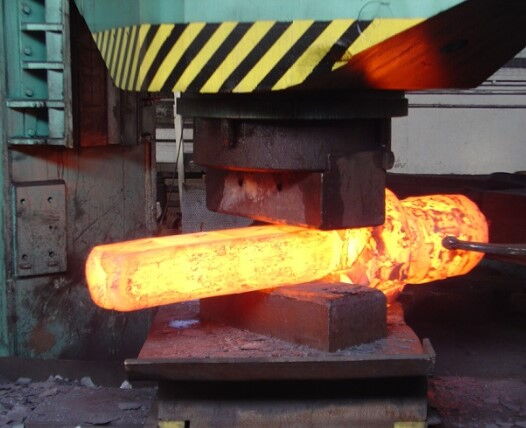
Among the numerous processing technologies in modern industry, open die forging maintains a prominent position due to its unique advantages and broad range of applications. Although it is a relatively traditional processing method, open die forging continues to play an irreplaceable role in key areas such as heavy machinery, aerospace, and energy equipment. This article will explore in depth the characteristics, main processes, application fields, and the importance of open die forging in modern industry.
Open die forging is a processing method in which a heated metal billet undergoes plastic deformation between an upper and lower anvil through the application of impact or pressure, thereby obtaining a forging with the desired shape and dimensions. This method features simple tools, strong versatility, and low cost, making it particularly suitable for single-piece, small-batch, and heavy forgings. Compared with cast billets, open die forging can effectively eliminate defects such as shrinkage cavities, shrinkage porosity, and gas holes, resulting in forgings with superior mechanical properties.
Open die forging is mainly divided into two forms: manual open die forging and machine-assisted open die forging. Manual open die forging, due to low production efficiency and high labor intensity, is usually only used for repair work or the production of simple, small, or limited-quantity forgings. In modern industrial production, machine-assisted open die forging has become the primary method, playing a crucial role, especially in heavy machinery manufacturing.
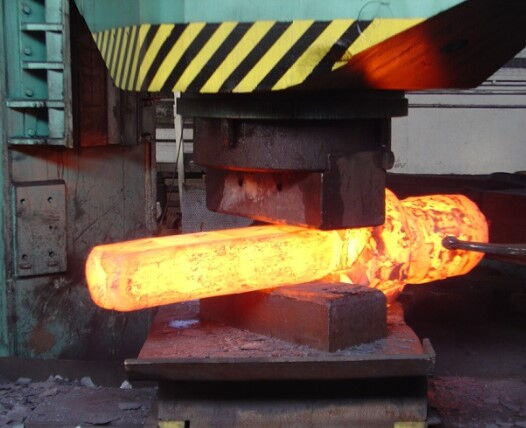
The basic processes of open die forging include upsetting, drawing out, punching, bending, cutting, twisting, shifting, and forging welds. These processes can be used independently or combined as needed to achieve complex forging shapes and dimensional requirements.
- Upsetting: Upsetting is a forging process that reduces the billet height while increasing the cross-sectional area, suitable for disc-shaped and plate-type forgings. During upsetting, to prevent axial bending of the billet, the height of the upset portion should not exceed 2.5–3 times the billet diameter. If only a portion of the billet requires upsetting, localized heating may be applied to that section.
- Drawing Out: Drawing out is a forging process that reduces the cross-sectional area of the billet while increasing its length, mainly used for shaft-type and rod-type forgings. During drawing out, the billet is typically clamped firmly and then hammered to deform. To ensure forging quality, the billet should be continuously rotated along its axis during hammering. Common rotation methods include repeated 90° rotations and spiral rotations. Additionally, mandrel drawing is a special drawing process in which a mandrel is inserted into a hollow billet to deform it, reducing the outer diameter (wall thickness) of the hollow billet while increasing its length.
- Punching: Punching is the process of creating through-holes or blind holes in a billet. Common methods include double-sided punching and single-sided punching. For double-sided punching, a preliminary indentation is made on the billet to check the hole position. Once verified, a small amount of coal powder is sprinkled into the indentation to facilitate punch removal, and the punch is driven to a depth of 2/3–3/4 of the billet thickness before flipping the billet to complete the hole. Single-sided punching is performed directly after confirming the hole position, mainly used for thinner billets.
- Bending: Bending is a forging method in which the billet is bent into a specified shape using certain tools or molds. Depending on the bending method, it can be free bending or die bending. Free bending relies primarily on the operator’s experience and skill, while die bending requires specific molds to achieve precise bending shapes.
- Cutting: Cutting is the process of dividing the billet or removing excess material. Common cutting methods include single-sided cutting, double-sided cutting, four-sided cutting, and round billet cutting. The purpose of cutting is to obtain the required shape and size of the billet and to prepare for subsequent forging processes.
- Twisting: Twisting is the process of rotating one part of the billet relative to another by a certain angle. This process is particularly useful when manufacturing forgings with special shapes, such as crankshafts.
- Shifting: Shifting is the process of displacing one part of the billet relative to another. This process can be used to manufacture complex shapes, for example, in certain mechanical components with special structures, shifting helps achieve the required shape and dimensions.
- Forging Welds: Forging welds join two or more billets through heating and forging. This process is very useful in the production of large forgings. For instance, when manufacturing large crankshafts, multiple billets can be joined by forging welds and then forged as a whole.
Open die forging has the following process characteristics:
- High Flexibility: Open die forging operations are flexible and can be adjusted according to different forging requirements. It is suitable for producing simple-shaped forgings with low dimensional precision, and particularly suitable for single-piece, small-batch, and heavy forgings. Because open die forging does not require complex molds, the production cycle is short, allowing quick responses to market demands.
- Low Equipment Requirements: The tools and equipment used in open die forging are relatively simple, versatile, and low-cost. Unlike die forging, it does not require high-precision equipment or complex molds, so the equipment precision requirements are lower. This allows open die forging to be widely used in small and medium-sized enterprises.
- High Forging Quality: Compared with cast billets, open die forging can effectively eliminate defects such as shrinkage cavities, shrinkage porosity, and gas holes, resulting in forgings with higher mechanical performance. By gradually deforming the billet to the desired shape and dimensions, superior internal quality is achieved. Additionally, heat treatment can be applied as needed to further improve performance.
- High Labor Intensity: Open die forging mainly relies on manual operation to control the shape and dimensions of the forging, resulting in high labor intensity. Operators need technical skills and experience to ensure the quality of the forgings. Moreover, open die forging has relatively low production efficiency and larger machining allowances, further increasing labor intensity.
Open die forging has wide applications in modern industry, particularly in areas with high requirements for forging quality, where it plays an irreplaceable role.
- Heavy Machinery Manufacturing: In heavy machinery manufacturing, open die forging is the main method for producing large forgings. For example, large crankshafts, rolls, and pressure vessel components are typically produced using open die forging, meeting dimensional and mechanical performance requirements and ensuring reliability and safety during use.
- Aerospace: Aerospace components demand near-perfect reliability. Open die forging is widely used in aerospace, such as turbine discs and landing gear in aircraft. Through open die forging, fiber flow lines are preserved, improving fatigue life. For example, the Boeing 787 landing gear uses 300M ultra-high-strength steel forgings, achieving a tensile strength of 1960 MPa and 8% elongation after open die forging.
- Energy Equipment Industry: Open die forging is crucial in the energy equipment industry. For example, supercritical turbine rotors must withstand high temperatures and high-speed operation. The continuous flow structure produced by open die forging effectively prevents stress corrosion cracking. Similarly, pressure vessel steels in nuclear power equipment achieve uniform grain structures through open die forging, increasing resistance to neutron irradiation embrittlement by more than three times.
- Military Equipment Manufacturing: Open die forging is an important process in manufacturing armored steel plates and other critical military components. It produces dense microstructures, improving ballistic resistance. Experiments show that homogenized armored steel plates forged using open die forging can achieve V-notch impact toughness 2.5 times higher than cast equivalents.
- Medical Devices: In the medical field, open die forging is used to produce key materials such as titanium alloys for surgical implants. Open die forging ensures defect-free materials, extending the service life of artificial joints to 15–20 years.
- Ultra-Large Component Processing: Open die forging has irreplaceable advantages in processing ultra-large components. For instance, the Three Gorges hydropower turbine main shaft weighs 150 tons and is forged in multiple heats using a 10,000-ton hydraulic press to achieve a 2.5-meter diameter and 10-meter length as a single piece. Though the production cycle takes 6–8 months, the internal quality fully meets the requirement for a 100-year service life.
As a traditional processing method, open die forging still holds an important position in modern industry. Its unique process characteristics and wide range of applications provide strong support for industrial development. Despite some challenges, with continuous technological advancement, open die forging is moving toward higher efficiency and intelligent processes. In the future, open die forging will continue to play a crucial role in heavy machinery, aerospace, and energy equipment, contributing significantly to technological progress and economic development.