How to Select Between Forging and Extrusion for Manufacturing
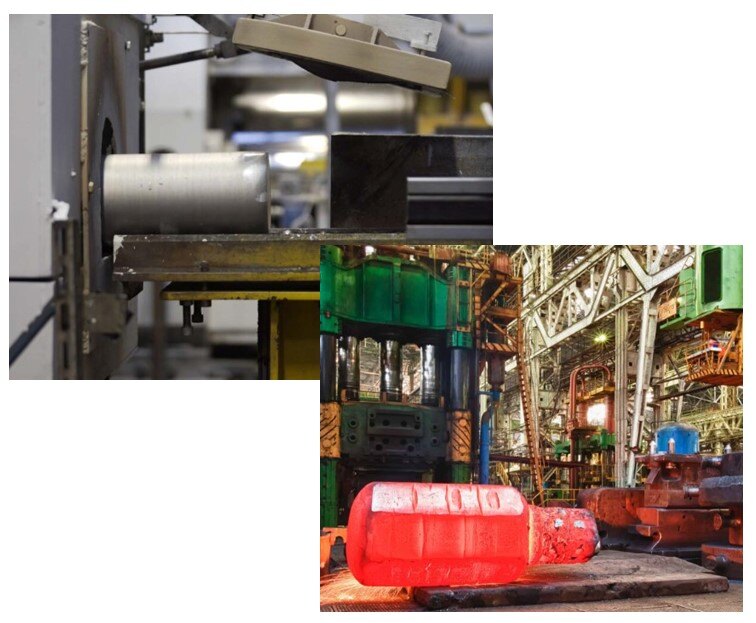
In manufacturing, metal forming is a critical step that directly influences the quality and performance of components. Metal forging and extrusion are two of the most commonly employed metal forming processes. While both aim to shape raw materials into desired forms, they differ significantly in their methods, suitable applications, and final outcomes. Forging relies on compressive forces to deform metal, making it ideal for producing complex parts with high strength and toughness. Extrusion, on the other hand, pushes material through a die to create consistent cross-sectional shapes, making it suitable for long, uniform profiles requiring high precision.
Many manufacturers face a dilemma when choosing between these processes: which is best suited for their production needs? This article systematically compares metal forging and extrusion from multiple perspectives, including definitions, workflows, differences, advantages and limitations, applications, and selection guidelines, to help readers make informed decisions in practical manufacturing scenarios.
Before comparing the two processes, it is important to understand forging, a time-honored metal forming technology. Familiarity with its definition, main types, and workflow is key to understanding why it produces parts with superior strength.
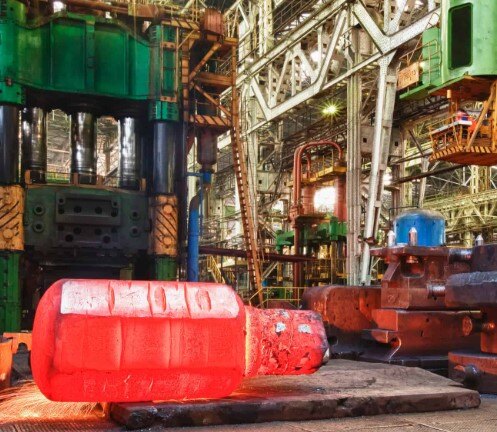
Forging is a manufacturing process in which compressive forces are applied to a metal to induce plastic deformation and form a specific shape. The process typically employs hammers, presses, or dies to shape the material. Metals can be forged hot, after heating to a plastic state, or cold, at room temperature. Through repeated impacts or sustained pressure, the metal is plastically deformed into the desired shape.
The essence of forging lies in shaping the metal without altering its molten state. Mechanical force improves the internal structure of the metal, enhancing both strength and durability.
Forging can be categorized based on the method of operation and die usage:
Open-die forging (or free forging) involves shaping metal between two flat dies, suitable for large or simple parts.
Closed-die forging uses precision dies with a specific shape, enabling the production of complex three-dimensional parts in high volumes.
Hammer forging utilizes steam, electric, or pneumatic hammers to repeatedly strike the workpiece, rapidly reshaping large or heavy components, typically in open-die applications.
Press forging applies continuous pressure through upper and lower dies, capable of forming various shapes; closed-die press forging is almost always used for three-dimensional parts.
Roll forging passes heated material through steel rolls to reduce cross-sections and extend length, producing round, square, or rectangular blanks. Roll surfaces can also transfer patterns onto the workpiece.
The basic forging workflow involves several steps:
Heating the metal to a suitable temperature for plastic deformation.
Placing the heated metal on a die or anvil.
Applying compressive force through hammers or presses to shape the metal.
Cooling and post-processing the forged part.
In hot forging, temperature control is crucial to maintain plasticity while preventing grain coarsening. Cold forging occurs at room temperature, increasing material strength through work hardening.
Unlike forging, extrusion follows a fundamentally different forming logic. Understanding extrusion involves examining its definition, types, and workflow.
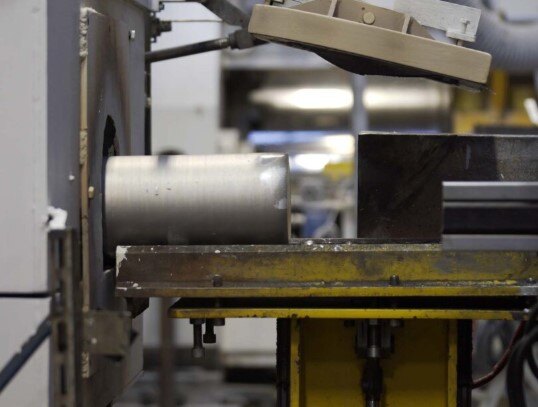
Extrusion is a process in which metal is forced through a die to create objects with a uniform cross-sectional shape. The metal is pressed through a die opening, forming a continuous, consistent profile. This process is commonly used to produce rods, tubes, and complex profiles.
Extrusion begins with a fixed-shape die and a raw material, usually a cylindrical billet. The billet is larger than the die opening, and under high pressure, it is compressed and forced through the die, forming the intended cross-section.
Extrusion can be classified based on temperature and method:
Hot extrusion heats the material above its recrystallization temperature, allowing large deformations, accommodating complex shapes, and reducing deformation resistance.
Cold extrusion shapes metal at room temperature or below, offering higher dimensional accuracy, superior surface finish, and minimal oxidation while enhancing tensile and yield strength through work hardening.
Direct extrusion is the most common method, pushing the billet through the die in a single step.
Indirect extrusion uses a hollow punch to push the material, reducing friction and improving precision, suitable for high-accuracy parts.
Drawing is a pull-based process similar to extrusion, often used for simple shapes like wires and tubes.
The basic extrusion workflow includes:
Preparing a fixed-shape die and billet (usually cylindrical).
Heating the billet to a plastic state (for hot extrusion) or keeping it at room temperature (for cold extrusion).
Using a punch or screw to push the billet through a steel die, forming the die’s shape.
Cooling and cutting the extruded material to the required length.
Extrusion produces smooth-surfaced billets, and brittle materials can be extruded easily with die support and simple force. The process accommodates metals, plastics, and composites.
With a basic understanding of both processes, the next step is a multidimensional comparison. Recognizing differences in forming method, precision, surface quality, and mechanical properties is crucial for making informed process decisions.
The fundamental difference lies in forming methods and material flow:
Forging uses compressive forces to shape metal, with material flowing within the die to fill cavities, forming complex, irregular 3D shapes. Grain flow aligns with part geometry, enhancing directional strength.
Extrusion pushes material through a die to form a continuous profile with a consistent cross-section. Material primarily flows axially, and the final product matches the die opening. Extrusion is ideal for long parts but struggles with complex 3D shapes.
Cold extrusion excels in dimensional precision. Without thermal expansion or contraction, extruded parts are stable and smooth, achieving tolerances as tight as ±0.02 mm. Forged parts, though strong, may show minor deviations due to temperature fluctuations and die wear. Hot forging can cause surface roughness from oxidation and scale, often necessitating additional machining.
Forging enhances impact toughness and fatigue strength by aligning grains with part geometry, crucial for components like crankshafts, connecting rods, and gears. Cold extrusion increases tensile and yield strength through work hardening, offering a balance of strength and precision for medium-stress parts. In terms of material efficiency, cold extrusion can exceed 95%, whereas forging consumes more material but remains competitive for large, heavy parts.
Through the comparison above, we have clarified the core differences between forging and extrusion in terms of principles and performance. To more comprehensively evaluate which process is more suitable for specific production tasks, it is necessary to systematically summarize their respective advantages and limitations.
The main advantages of forging include improved mechanical properties, high fatigue resistance, good material utilization, and suitability for large-scale production. Forging can refine the grain structure, enhancing the strength and toughness of the metal. Forged parts are suitable for withstanding impact loads and cyclic stresses, resulting in long service life.
The limitations of forging include lower precision, rough surface finish, and difficulty in forming complex or hollow shapes. Forging dies are expensive, especially for closed-die forging, which requires precision molds. Large forgings require heavy equipment, leading to significant initial investment.
The main advantages of extrusion include uniform cross-section, smooth surface, high precision, and suitability for large-scale production. Extrusion can process metals, plastics, and composite materials, making it widely applicable. The extrusion process can produce complex cross-sectional shapes, such as profiles and tubes, with good consistency.
The limitations of extrusion are that the mechanical properties are lower than those of forged parts, because the grain structure is not as directional as in forging. Material waste may occur during trimming in the extrusion process. The complexity of extruded products is limited, making it difficult to manufacture three-dimensional parts with variable cross-sections.
Forging is widely used in the manufacturing of parts that require high strength and toughness. In the automotive industry, forging is used to produce crankshafts, gears, and connecting rods. These parts are subjected to large cyclic loads and require excellent fatigue performance.
In the aerospace sector, forging is used to manufacture landing gear and turbine components. These parts require lightweight durability, and forging can precisely control the grain structure to enhance strength and longevity.
In the industrial tools field, forging is used to produce hand tools such as hammers and wrenches.
In the defense and military industry, forging is used to manufacture high-strength parts to meet stringent operational requirements.
Extrusion is widely applied in construction, automotive, electrical, and consumer product sectors.
In construction, extrusion is used to produce aluminum profiles, tubes, and structural sections, which are used for door and window frames, curtain walls, and supporting structures.
In the automotive industry, extrusion is used to manufacture radiators and decorative components.
In the electrical industry, extrusion is used to produce copper and aluminum wires and tubes, which are applied in cables and conductive equipment.
In the consumer products sector, extrusion is used to manufacture bicycle frames, furniture components, and appliance parts.
Extrusion is also used to produce plastic tubing, medical catheters, and food products.
Selecting between forging and extrusion requires a systematic approach, considering part characteristics, production requirements, and avoiding common selection errors.
Forging: Complex 3D shapes, high-stress, impact, or cyclic load parts.
Extrusion: Constant cross-section shapes, high dimensional accuracy, smooth surface.
Part size: Forging for large, heavily deformed parts; extrusion for small- to medium-sized precision parts.
Batch size: Forging suits large-volume heavy parts; extrusion excels in long, continuous profiles.
Precision requirements: Cold extrusion provides tight tolerances and superior surface finish; forging suits parts prioritizing strength.
Cost considerations: Equipment and die investment, material utilization, and post-processing must be balanced.
Assuming forging and extrusion are identical.
Choosing inappropriate processes for part geometry or performance.
Ignoring material properties and manufacturability.
Avoid mistakes by understanding process differences, aligning with part requirements, and consulting experts when necessary.
As demands for precision and sustainability grow, forging and extrusion are evolving. Trends like cold extrusion and hybrid processes provide additional options for achieving both strength and accuracy.
High-precision applications in automotive, aerospace, hydraulic, and energy systems increasingly demand both strength and tight tolerances. Cold extrusion, performed near room temperature, offers superior dimensional accuracy, smooth surfaces, and reduced oxidation. Forging enhances impact toughness and fatigue resistance through directional grain flow. Both provide unique advantages depending on stress and precision requirements.
Hybrid processes, combining forging and cold extrusion, leverage the strength of forging and the precision of extrusion. For example, parts may be hot-forged for initial shaping, then cold-extruded for fine tolerances. Cold extrusion also reduces energy consumption by 70–80%, minimizes waste, and lowers the carbon footprint. Advanced coatings and lubricants, like molybdenum disulfide or phosphate films, further extend tool life and maintain consistent quality.
Forging and extrusion are two cornerstone metal forming processes, each with distinct advantages and application scopes. Forging shapes high-strength, high-toughness components via compressive forces, while extrusion produces precise, consistent cross-section parts through die shaping. Manufacturers must consider part geometry, performance requirements, production volume, and cost when selecting the appropriate process. For specialized needs, cold extrusion or hybrid techniques can balance strength and precision. Understanding the characteristics and differences of these processes is fundamental to optimizing production efficiency and product quality.