Differences Between Drop Forging and Press Forging
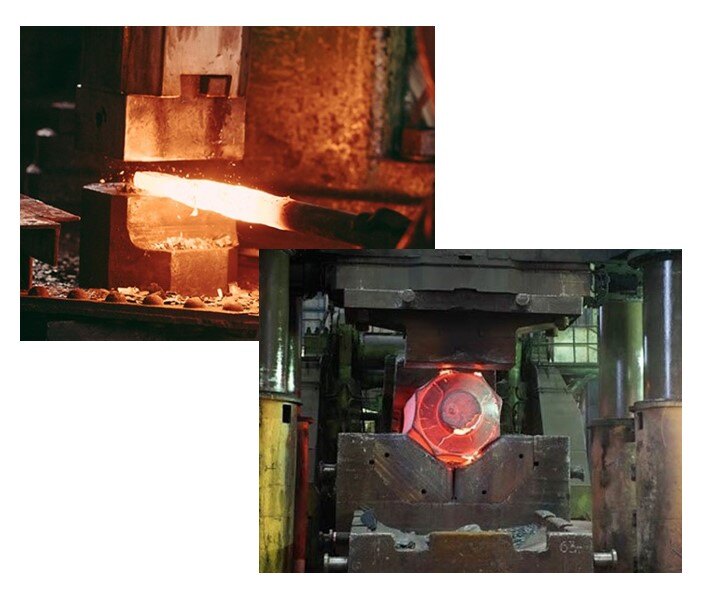
In industrial manufacturing, metal forging is one of the core methods used to transform raw materials into high-strength components. Whether it is the connecting rods inside automobile engines, structural load-bearing parts in aircraft, or transmission components in mechanical equipment, their production often relies on forging technology. Among the many metal forging methods available today, drop forging and press forging are the two most widely used process routes.
Although both processes share the same objective, using external force to plastically deform metal into a required shape, they differ significantly in working principles, equipment design, product quality, and application scenarios. For purchasing professionals, engineers, and manufacturing managers, understanding these differences directly affects production cost, product performance, and delivery efficiency.
This article systematically explains the major differences between drop forging and press forging from the perspectives of working principles, process characteristics, performance comparison, applications, and process selection recommendations, helping readers make more informed manufacturing decisions in practical projects.
Metal forging is a fundamental manufacturing process in modern industry. It uses impact force or compressive pressure to plastically deform metal materials and produce components with desired shapes and dimensions. Unlike casting, forging does not melt the metal. Instead, the material remains in a solid state while mechanical force changes both its external shape and internal structure.
This processing method improves the internal grain structure of the metal, enhances mechanical properties, and increases the service life of components. In actual manufacturing, forging processes are divided into several categories, among which drop forging and press forging are the most common.
Drop forging, also known as hammer forging, relies on repeated impact between dies to shape the material. Press forging, in contrast, uses continuous and stable pressure to deform the metal. These two methods differ considerably in equipment structure, processing principles, product quality, and suitable applications. Manufacturers must select the appropriate process according to specific production requirements.
After understanding the general principles of forging and the differences between the two major forging routes, we first focus on the older and more widely applied process: drop forging. As a typical impact-based forming method, drop forging demonstrates unique advantages in high-volume production environments. Its working mechanism and equipment configuration deserve detailed analysis.
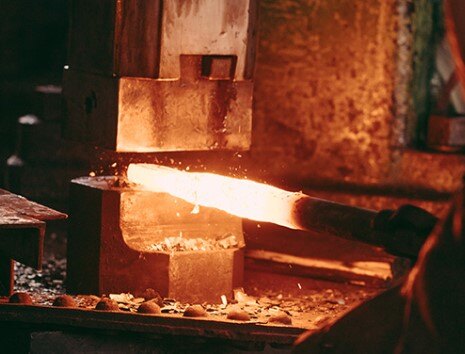
Drop forging is a process that plastically deforms metal through repeated impact between upper and lower dies. The lower die is fixed on an anvil block, while the upper die is repeatedly lifted and dropped by a mechanical lifting system. The heated metal billet placed in the lower die is continuously struck until the required shape is formed.
Common equipment includes power hammers and drop hammers. Some large forging systems use pneumatic or hydraulic systems to generate impact force.
The metal billet is usually heated to temperatures between 900°C and 1300°C. This temperature range ensures sufficient plasticity while maintaining structural stability, allowing the material to deform smoothly under impact without cracking.
Drop forging is mainly divided into open-die forging and closed-die forging.
Open-die forging uses relatively simple and open dies, allowing the metal to flow freely between flat or basic contour dies. During processing, most of the material remains visible, enabling operators to adjust the position and orientation of the billet at any time.
This method is suitable for producing large forgings or components with relatively simple shapes.
Closed-die forging uses specially designed dies that contain cavities corresponding to the shape of the final component. Under repeated impact, the metal gradually fills the die cavity and forms the finished forging.
Although the working principle resembles casting molds, the metal in forging only reaches a plastic deformation temperature and never melts.
One of the major characteristics of drop forging is its high production speed. The forming cycle for each component usually requires only 5 to 15 seconds, making it highly suitable for mass production.
Rapid impact allows the material to fill the die cavity quickly, providing good economic efficiency in manufacturing environments that prioritize high productivity.
In addition, drop forging can process a wide range of metallic materials and components with varying complexity. Whether manufacturing relatively simple parts or high-strength large components, the process can generally meet production requirements.
Modern drop forging equipment can also control the impact process more accurately, helping ensure consistent product quality.
Drop forging occupies an important position in mass production because of its rapid impact characteristics. However, this same impact-based nature also limits its application in extremely large or highly precise components. In contrast, press forging follows a completely different force application logic. The following sections explain how press forging compensates for some limitations of drop forging through continuous pressure.
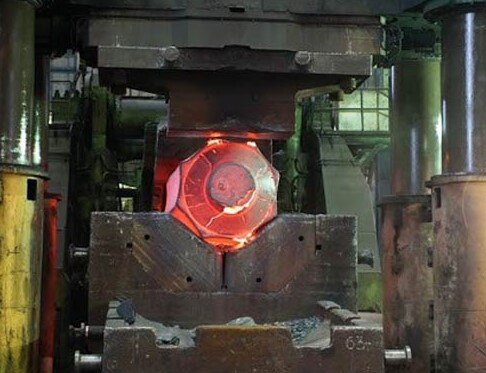
Press forging operates differently from drop forging. The heated metal billet is placed between upper and lower dies controlled by hydraulic or mechanical systems. Instead of repeated hammering, the material is plastically deformed through continuous and stable pressure.
Unlike drop forging, which requires multiple blows to complete shaping, press forging usually completes forming with a single pressing stroke.
Press forging equipment ranges from small hydraulic systems to extremely large presses capable of manufacturing aerospace structural components. Hydraulic presses and mechanical presses can apply force more uniformly, allowing more precise control of metal flow and dimensional accuracy.
The heating temperature is similar to that used in drop forging, typically between 900°C and 1300°C. However, because the forming time is longer, heat distribution becomes more uniform, which helps stabilize the deformation process.
Because pressure is applied more uniformly, the internal metal flow becomes more stable during press forging. This process usually achieves higher dimensional accuracy, better internal grain structure, and more uniform mechanical properties.
Stable pressure helps optimize grain flow and reduce residual internal stress.
Press forging is especially suitable for manufacturing complex components with high surface quality requirements and minimal material waste. Since the forming process is slower and more controllable, it can create continuous and uniform grain flow lines, improving component strength and durability.
Many problems associated with high-speed impact deformation can be effectively reduced or eliminated through press forging.
Although drop forging and press forging share the same overall manufacturing objective, they differ greatly in microscopic deformation mechanisms and process control methods. To guide practical process selection more clearly, the two methods should be compared under the same criteria, including forming method, material utilization, dimensional accuracy, and mechanical performance.
Drop forging gradually shapes metal through repeated impact. Each component usually requires multiple hammer blows before forming is complete.
Press forging, by contrast, completes forming through one continuous pressing operation, resulting in a smoother deformation process.
In terms of production efficiency, drop forging has a short cycle time of approximately 5 to 15 seconds per part, making it ideal for high-volume manufacturing.
Press forging generally requires a longer cycle time. Depending on component size and complexity, the process may take from 30 seconds to several minutes. However, because press forging often reduces subsequent machining requirements, the overall production efficiency may still remain competitive.
Material utilization is one of the most important differences between the two processes.
Drop forging typically requires flash formation, resulting in a material utilization rate of approximately 70% to 75%. High-speed impact forming needs extra overflow space for material flow, and the flash must later be trimmed.
Although scrap material can be recycled, it still increases material costs and waste processing workload.
Press forging, through more controlled metal flow, can achieve material utilization rates of 80% to 85%. Slow and stable pressure allows more accurate control of material direction, reducing flash and waste.
This advantage is especially important in industries such as aerospace and medical manufacturing, where high-value alloy materials are commonly used.
The dimensional tolerance of drop forging usually ranges from ±0.5 mm to ±1.5 mm. Therefore, high-precision components often require additional machining after forging.
Impact-based processing may also cause dimensional variation due to die wear.
Press forging can achieve higher precision, with dimensional tolerances typically ranging from ±0.2 mm to ±0.8 mm. Stable pressure helps maintain die alignment and reduces errors caused by die wear.
At the same time, press-forged parts generally have better surface quality, allowing many components to be used directly with minimal post-processing.
The forging method directly affects the mechanical properties and grain structure of components.
In drop forging, rapid deformation may trap impurities inside the material and create non-uniform grain flow, potentially affecting material strength. High-speed impact may also generate residual stress, reducing fatigue life.
Because press forging uses a slower and more controlled deformation process, it can create continuous and uniform grain flow lines, improving strength and durability.
Controlled plastic deformation also minimizes stress concentration areas that may lead to fatigue failure.
The two forging methods also differ in energy consumption patterns.
Drop forging equipment requires very high power during the moment of impact but relatively low continuous power overall. Due to fast cycle times, the process often demonstrates good energy efficiency in mass production.
Press forging equipment consumes more stable energy throughout the entire forming process. Although instantaneous power demand is lower, the longer working duration may increase total energy consumption per part.
However, because press forging reduces secondary machining operations, the overall energy difference is often balanced.
After clarifying the technical and performance differences between drop forging and press forging, a practical question naturally follows: what do these differences mean in real manufacturing environments? Different industries select forging methods according to their own product requirements, material characteristics, and performance standards.
The automotive industry commonly uses both forging processes depending on component requirements.
High-volume parts such as connecting rods and crankshafts are usually manufactured through drop forging because of its fast production rate and suitability for large-scale assembly operations.
Transmission gears and differential components, which require higher dimensional accuracy and surface quality, are more suitable for press forging to reduce machining operations and improve consistency.
The aerospace industry generally favors press forging.
Critical structural components require extremely high material integrity and dimensional precision. Any internal defect or stress concentration may lead to severe consequences.
The controlled deformation process of press forging ensures stable grain flow and minimizes fatigue-related stress concentration, making it more suitable for aircraft structural parts and engine components.
Material properties also strongly influence process selection.
High-strength aerospace alloys are generally more suitable for press forging because these materials are more likely to crack or develop internal stress under high-speed impact. Titanium alloys and special metal materials often achieve better quality through press forging.
Ordinary carbon steel and aluminum alloys can usually be processed using either method. In these cases, economic considerations and quality requirements become the primary deciding factors.
Manufacturers can select the process more flexibly according to production volume and precision requirements.
Drop forging and press forging are two important forming technologies in the metal manufacturing industry, each with distinct technical characteristics and application ranges.
Drop forging relies on repeated impact to achieve rapid forming. It is suitable for high-volume production of relatively simple components and offers advantages such as fast production rhythm and relatively lower equipment investment.
Press forging uses continuous and stable pressure for precision forming. It is more suitable for complex structures, high-precision products, and high-performance components, offering advantages such as higher material utilization, more uniform internal structure, and better dimensional accuracy.
When selecting a forging process, manufacturers should comprehensively evaluate factors including component size, shape complexity, dimensional tolerance requirements, material type, production volume, and total manufacturing cost.
For large-volume production of ordinary carbon steel or aluminum alloy components with relatively simple shapes, drop forging is usually the more economical choice.
For large, complex, high-precision, or high-strength alloy components, press forging often provides superior technical and economic advantages.
In actual production environments, process evaluation and optimization should typically be carried out by experienced forging manufacturers according to specific operating conditions and product requirements. A thorough understanding of both forging methods helps companies make more rational manufacturing decisions and achieve a better balance among product quality, production cost, and delivery schedule.