Forged Parts vs. Machined Parts: How to Choose
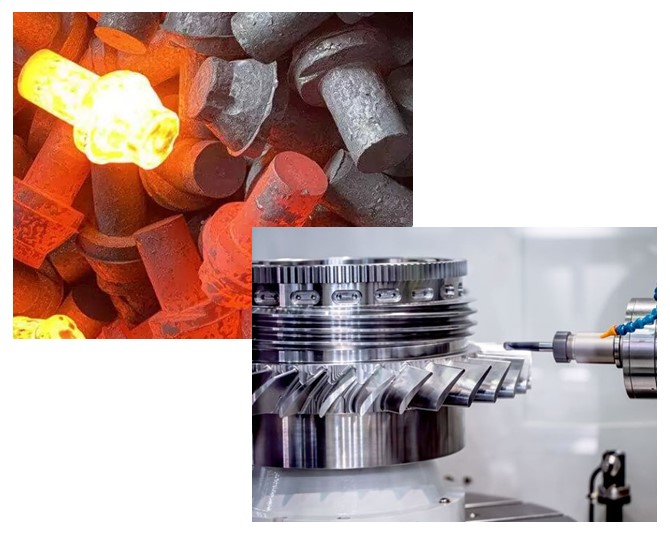
In manufacturing procurement and production management, a common question confronts engineers and buyers: should a part be forged or machined? This choice may seem simple, yet it directly affects product performance, cost, and delivery cycle. Selecting the wrong process can lead to increased material waste, substandard product performance, or even failures during actual use.
Forging and machining are the two main processes for manufacturing metal parts. Forging achieves high strength through plastic deformation of metals, while machining achieves complex shapes through precise cutting. Both processes have their advantages and limitations. Some parts must be forged to ensure safety, some parts can only achieve the required precision through machining, and a large number of parts require a combination of both processes.
This article will systematically compare forged parts and machined parts from the perspectives of basic principles, performance characteristics, cost structure, applicable materials, and application scenarios, helping you make a reasonable process selection based on actual needs. Whether you are an engineer responsible for product design or a procurement professional managing the supply chain, you can obtain practical decision-making references from this article.
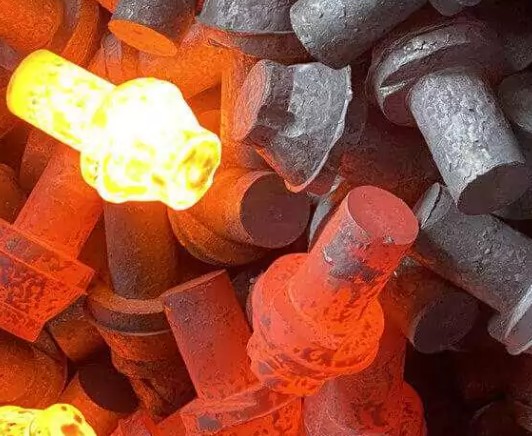
Forging is a processing method in which metal material undergoes plastic deformation through external force. The specific operation process is: first, heat the metal to a certain temperature, then hammer it or press it with a press to form the desired shape.
Forging is divided into three main types:
- Hot Forging: Steel is heated above 1000°C for processing. High temperatures make the metal soft and easy to shape, allowing the manufacture of complex-shaped parts, while refining the internal grain structure of the metal and improving mechanical properties.
- Cold Forging: Processed at room temperature or near room temperature, mainly used for softer metals such as aluminum. This method allows parts to achieve higher strength and better surface quality, but shape complexity is limited.
- Warm Forging: Processing temperature is controlled between 600°C and 800°C, combining the advantages of hot and cold forging, ensuring a certain material flow while achieving better dimensional accuracy.
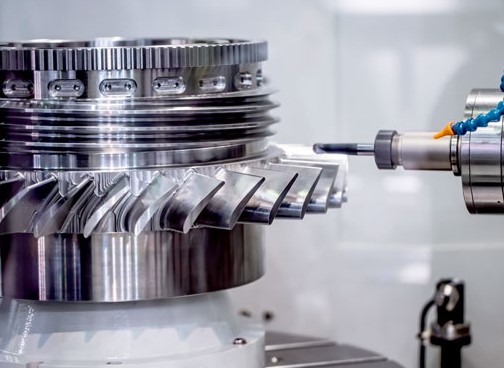
Machining is a material-removal processing method. A metal blank is mounted on a machine tool, and excess material is removed with cutting tools until the part meets the requirements. Modern machining is mainly performed using computer-controlled CNC machines.
Common machining methods include:
- CNC Milling: Rotating cutting tools remove material, suitable for manufacturing complex geometries.
- CNC Turning: The workpiece rotates while the cutting tool feeds, suitable for cylindrical parts.
- Drilling: Used to create holes in parts.
- Grinding: Used to achieve extremely high surface finish and dimensional accuracy.
After understanding the basic principles of the two processes, we further compare their differences in key performance indicators. These differences directly determine the part’s performance in actual use and are core considerations when selecting a process.
The greatest advantage of forged parts lies in their internal structure. During forging, the metal grains realign along the contours of the part, forming a continuous and dense structure. This structure gives forged parts excellent fatigue resistance and load-bearing capacity, allowing them to withstand repeated impacts and alternating loads.
For example, in automotive engine crankshafts, forged crankshafts can withstand higher cyclic loads than directly machined crankshafts, resulting in a longer service life.
In contrast, machined parts directly cut from metal blanks, breaking the original grain structure. The part’s strength mainly depends on the raw material itself. Although selecting high-strength materials can compensate for some differences, under the same material conditions, machined parts generally have lower fatigue resistance than forged parts.
Machining has a clear advantage in precision. CNC machines can achieve micron-level machining accuracy, meeting the strict dimensional tolerance requirements of aerospace, medical devices, and precision electronics industries.
Due to the characteristics of the forging process, forged parts have relatively wide dimensional tolerances, and surface roughness usually ranges between 3.2 and 25 microns. If parts require precise fits or strict dimensional control, forged blanks usually need secondary machining to meet requirements.
Machined parts can achieve surface finishes below 0.4 microns, with smooth and flat surfaces suitable for low-friction, precise-fitting, or high-aesthetic applications.
Forged parts are relatively rough on the surface but can improve surface quality through subsequent grinding or polishing.
Performance characteristics determine whether a part meets usage requirements, while cost and efficiency determine whether the solution is economically feasible. Next, we analyze the economic differences between the two processes from three dimensions: material utilization, production efficiency, and overall cost.
Forging is a near-net-shape process, with blanks close to the final part shape. The material that needs to be removed later is minimal, resulting in high material utilization and little waste.
Pure machining requires removing a large amount of material from solid blanks, producing a lot of chip waste. This waste can only be recycled as scrap, causing raw material loss. Especially for expensive materials such as titanium alloys or nickel-based alloys, material waste significantly increases costs.
Forging is suitable for large-batch production. Although initial investment in molds and equipment is high, unit cost drops rapidly as production volume increases. Forging can produce basic-shaped parts quickly.
Machining is a layer-by-layer removal process with longer processing times. Complex parts require multiple setups and operations, resulting in longer production cycles.
When selecting a process, one cannot only consider single-piece processing costs but must comprehensively consider:
- Raw material cost and scrap recovery value
- Investment in molds or fixtures
- Processing time and labor cost
- Subsequent operations (heat treatment, surface treatment, etc.)
- Quality inspection costs
For large-batch parts of simple to medium complexity, forging usually has a cost advantage. For small-batch, complex-shaped, or frequently redesigned parts, machining is more flexible and economical.
Cost analysis cannot ignore materials, and different processes also have obvious differences in material adaptability. Understanding the applicable materials for each process helps make reasonable planning at the material selection stage.
Forging mainly applies to metals with good plasticity at high temperatures:
- Steel and Alloy Steel: Medium-carbon steel can increase strength by approximately 30% after forging, widely used in automotive and engineering machinery.
- Aluminum Alloys: Suitable for lightweight components, mechanical properties improve significantly after forging, commonly used in automotive and aerospace parts.
- Titanium Alloys: High strength-to-weight ratio and excellent corrosion resistance; although forging is difficult, forged parts are irreplaceable in high-performance aerospace components.
Machining has a broader range of applicable materials:
- Aluminum Alloys: Good machinability, widely used in electronics and automotive.
- Stainless Steel: Corrosion-resistant and strong, suitable for precision parts in medical, food, and chemical industries.
- Engineering Plastics and Composites: Enable lightweight or insulating properties, used in medical devices and electronics.
- Copper Alloys: Good electrical and thermal conductivity, used in electrical connectors.
After clarifying material applicability, we examine the actual applications of the two processes in specific industries. Different industries focus on different priorities for part performance, precision, and cost, leading to process selection differences.
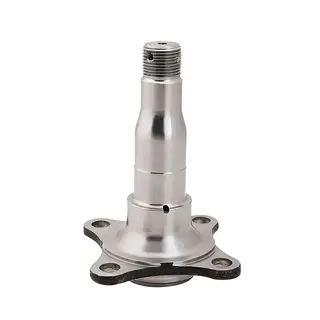
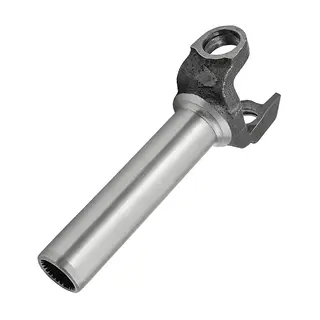
Forged parts: Drive shafts, connecting rods, differential gears, wheel hub flanges. These parts must maintain high reliability under continuous torque transmission, and forging ensures sufficient strength and fatigue resistance.
Machined parts: Engine blocks, transmission cases, complex pipe joints. These parts have complex shapes and strict dimensional requirements, suitable for casting blanks followed by machining.
In practice, many automotive parts use forged blanks with CNC finishing, combining structural strength with precise assembly requirements.
Large shafts, flanges, bearing housings, and other critical parts of wind turbines generally use forging. These parts bear enormous loads while rotating and operate under temperature variations, requiring extremely high structural integrity.
3. Heavy Machinery and Construction Equipment
Parts such as gear hubs, support wheels, couplings, and drive shafts work under high mechanical loads, requiring long life and high reliability. Forging is the preferred process.
Anchor chain links, propeller shafts, and high-strength bolts operate in corrosive or high-impact environments with extremely high safety requirements, fully demonstrating the performance advantages of forged parts.
Critical load-bearing structures, such as turbine disks and landing gear components, use precision or isothermal forging. At the same time, many complex housings and piping components rely on high-precision machining.
Parts with strict dimensional tolerance requirements, such as surgical instruments, precision instrument components, and optical device assemblies, mainly rely on machining.
From the comparison above, it is clear that each process has a defined application boundary. In practice, systematic evaluation based on specific requirements is needed. Below are selection suggestions for different scenarios.
Forging is recommended when:
- Parts bear high loads, impacts, or cyclic stress
- Extreme fatigue life and reliability are required
- Large production volume with relatively regular shapes
- Raw material cost is high, requiring improved material utilization
- Part material is forgeable metals such as steel, aluminum, or titanium
Machining is more suitable when:
- Parts have complex shapes, sharp internal corners, or intricate cavities
- Strict dimensional tolerance, at micron level
- High surface finish requirement
- Low production volume or frequent design changes
- Non-metallic materials such as plastics or composites are needed
- Prototype phase requires rapid design verification
In modern manufacturing, a single process often cannot meet all requirements. The combination of forging and machining is increasingly common:
Typical process: Forged blank → Heat treatment → CNC rough machining → CNC finish machining → Surface treatment → Final inspection
This combination retains the high strength of forged parts while achieving precision and surface quality through machining. It is standard practice in automotive and aerospace high-end manufacturing.
Forging and machining are two fundamental and important processes in manufacturing, each with clear advantages and application ranges.
Forging: Optimizes internal structure via plastic deformation, achieving high strength, toughness, and excellent fatigue resistance, suitable for high-volume production of critical load-bearing parts.
Machining: Offers high precision and flexibility, capable of producing complex geometries and tight tolerances, suitable for precision parts and low-volume production.
In practice, these processes are complementary rather than opposed. Forged blanks combined with CNC finishing achieve both structural strength and dimensional accuracy, becoming the mainstream model of modern precision manufacturing.
Final process selection should be based on specific application requirements, considering part function, performance, production volume, cost, and delivery schedule. For critical load-bearing components, prioritize strength and reliability; for precision-fitting parts, prioritize dimensional accuracy and surface quality; for large-batch production, optimize overall cost; for low-volume or R&D stages, prioritize flexibility and delivery speed.
By deeply understanding the technical characteristics and applicable boundaries of both processes, procurement professionals and engineers can make more reasonable manufacturing decisions, ensuring product quality, controlling production costs, and meeting delivery requirements.