Everything You Need to Know About Drop Forging
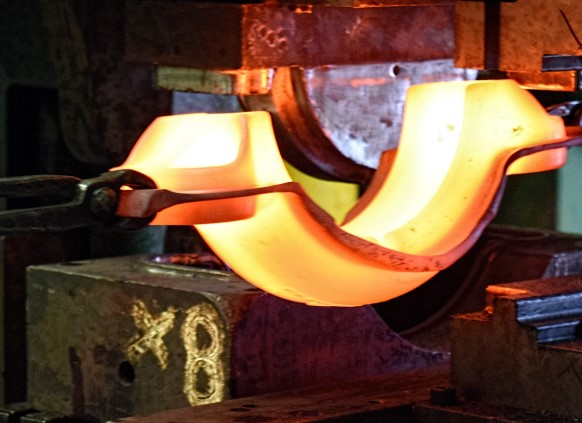
Drop forging is a metal forming process with a long history, having been used for hundreds of years. Simply put, this process involves placing a metal workpiece into a die and then hammering it to deform it, ultimately forming the shape of the die. During the entire process, the lower die remains fixed, while the upper moving hammer applies impact force to the workpiece by dropping, causing plastic deformation. Drop forging is also called hot forging, hammer forging, or die forging. The biggest difference from cold forging is that it is usually performed at high temperatures. High temperatures give the metal greater ductility, allowing complex shapes to be formed without cracking. This process is particularly suitable for producing metal parts with high requirements for strength, durability, and precision.
The production process of drop forging can be divided into four key steps, each of which has an important impact on the quality of the final product.
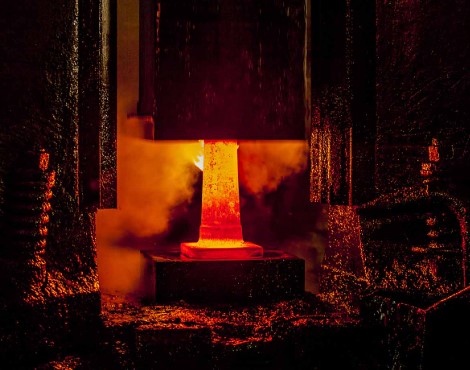
Material selection is the first step. Drop forging can be applied to a variety of metals, including steel, aluminum, titanium, brass, copper and their alloys, nickel-based alloys, and others. The choice of material depends on the specific requirements of the final product, such as the load it needs to bear, the working temperature environment, corrosion resistance requirements, and cost budget. Steel is the most commonly used material because of its high strength and good durability. Aluminum is often used in aerospace and automotive industries due to its lightweight advantage. Titanium alloys are suitable for fields that require a high strength-to-weight ratio.
The second step is to heat the selected metal to a temperature suitable for shaping, which is very critical. Proper heating temperature ensures that the material has good fluidity, is easy to form, and will not crack. Different metals require different heating temperatures, which need to be precisely controlled.
The third step is preparing the dies. Dies are carefully crafted templates based on the final part design, consisting of upper and lower dies. The quality of the dies directly determines the accuracy and surface quality of the forged parts. Dies are usually made of tool steel with high hardness, wear resistance, and toughness to withstand repeated impact forces.
The fourth step is the forging operation. The heated metal is placed between the dies, and continuous pressure is applied through a drop hammer or press, causing the metal to take the shape of the die. This process may require multiple hammer strikes, and after each strike, the operator may need to adjust the position of the workpiece until the final shape is achieved.
Drop forging can be divided into various types based on equipment structure and die form.
- Simple Hammer Configuration: The most basic type. The lower die is fixed on the anvil, and the upper die is fixed on the ram. The ram and upper die transmit high-speed kinetic energy to the workpiece. In this configuration, the anvil needs to be extremely strong, usually weighing 10 to 20 times the hammer, as it needs to absorb a large amount of impact energy.
- Double-Action Hammer: The structure is similar to a simple hammer, but the hammer fixed on the ram is accelerated during the fall by air or steam, i.e., hydraulic or pneumatic forging hammers. This type of hammer is more powerful and is gradually replacing the simple configuration.
- Dual Hammer Without Anvil: This structure does not have a traditional anvil. Instead, two hammers are fixed on two rams moving in opposite directions. This is the most complex structure, capable of precisely forging large workpieces and achieving extremely high forging energy.
- Open Die Drop Forging: The die does not completely cover the workpiece, allowing the workpiece to deform in open space. The operator places the metal blank on the die, and the hammer strikes it. Before each strike, the operator adjusts the workpiece until the final shape is achieved. This process has important advantages, including higher strength, improved grain size, and continuous grain flow.
- Closed Die Drop Forging (also called Impression Die Forging): The die is like a closed cavity, fixed on the anvil. The die on the hammer has a corresponding shape. When striking the workpiece, the material flows to fill the die cavity. The hammer drops quickly and continuously until the desired shape is reached. Sometimes, a series of different die cavities is required to complete complex shapes. Although closed-die equipment requires a higher initial investment, as production increases, the per-piece cost advantage becomes significant, so it is commonly used in large-scale production in the automotive and die industries.
As an important process in metal processing, drop forging has several significant advantages.
- Excellent Mechanical Properties: This is the most prominent feature of drop forging. During forging, the metal grain structure is optimized, forming a continuous grain flow. This allows stress to be more evenly distributed under load, and the overall strength and toughness are significantly better than cast parts. For example, automotive crankshafts formed by die forging can have a fatigue life 3 to 5 times longer than cast parts.
- High Dimensional Accuracy: Precision dies ensure accurate part shapes, strict tolerance control, and high consistency. Tolerances for precision forging can approach ±0.2 mm, which in many applications can significantly reduce or even eliminate subsequent machining processes.
- High Material Utilization: Forging achieves dense structures through controlled plastic deformation, with few internal defects and stable yield. Compared to casting, a combination of forging + CNC machining can increase material utilization to 70%–90%, while traditional casting or direct CNC milling may only reach 30%–50%.
- Good Surface Quality: Drop forging can achieve a good surface finish, reducing subsequent finishing processes. Forged parts have denser surfaces and can be anodized or coated directly after CNC machining, without needing to fill porosity like castings.
- Cost Advantages in Mass Production: Although the initial investment in dies is high, in large-scale production, die costs can be quickly amortized. When production exceeds 50,000 pieces, the total cost of forging + CNC is usually 30%–50% lower than full CNC machining.
Both drop forging and press forging are used to shape metal parts, but the way force is applied is fundamentally different.
- Drop Forging: The hammer or powered ram falls onto the workpiece, using impact force to rapidly form the metal into the die shape. This method features high impact speed and short action time, suitable for rough forging with large deformation.
- Press Forging: Uses hydraulic or mechanical presses to gradually apply continuous pressure, shaping the workpiece more precisely. This method features slower deformation but more precise control, suitable for precision forming and finish forging.
The main difference is that hammer forging applies continuous impacts, while presses apply continuous pressure. Hammer forging is more suitable for large workpieces and open-die forging, while press forging is better for precise parts and closed-die forging.
Drop forging plays a key role in multiple industries, and its applications continue to expand with technological advancement.
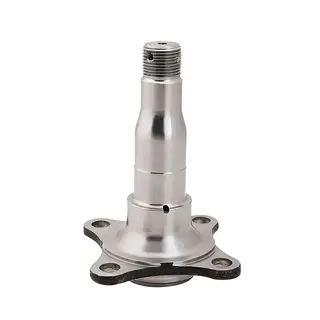
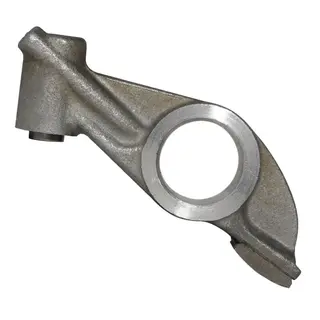
- Automotive: One of the largest markets for drop forging. Many critical components, such as crankshafts, connecting rods, gears, levers, and pedal cranks, are produced by forging to ensure strength and reliability. With the development of new energy vehicles, demand for lightweight forged parts continues to grow.
- Aerospace: Demands extremely high material and process standards. Drop forging is used to produce landing gear parts, structural frame components, turbine blades, and other critical components. Titanium and nickel-based forged parts provide strength, corrosion resistance, and excellent heat resistance for extreme conditions. The expansion of the aerospace industry in the Asia-Pacific region drives the growth of the forging market in this region.
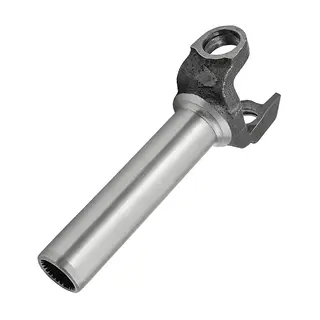
- Agricultural Machinery: Many heavily loaded parts, such as drive shafts, gears, and connectors, are forged to withstand harsh field conditions.
- Mining and Drilling Equipment: Requires extremely high strength and wear resistance. Drop forging is widely used to produce drill bits, rods, and mining machinery parts, ensuring reliability under extreme conditions.
- Industrial Equipment: Valves, couplings, and tooling components gain higher strength and durability through drop forging, extending equipment service life.
- Rail Transport: Forged rails can reach longitudinal tensile strengths above 880 MPa, significantly higher than rolled products. Railway components such as wheels, axles, and connectors also commonly use forging.
- Defense and Military: Forged parts play a critical role in weapons systems, armored vehicles, and ship components, where material performance requirements are strict.
- Emerging Applications: Renewable energy (wind turbines, solar supports) requires high-strength forgings; medical implants and surgical instruments demand excellent mechanical properties and biocompatibility; key components in humanoid robots, such as harmonic drive flex wheels, are starting to use precision forging technology.
Drop forging can be applied to a variety of metals, each with specific application scenarios.
- Steel: The most commonly used forging material, including carbon steel, alloy steel, and stainless steel. Steel has high strength, good durability, and moderate cost, suitable for most industrial applications. Depending on specific use, different carbon content and alloying elements can be selected.
- Aluminum and Alloys: Lightweight, with a density roughly one-third that of steel, widely used in aerospace and automotive industries. Forged aluminum alloys have an excellent strength-to-weight ratio, suitable for aircraft structures, engine parts, and wheel hubs.
- Titanium Alloys: Extremely high strength-to-weight ratio and excellent corrosion resistance. Although costly, they are indispensable in aerospace, medical implants, and chemical equipment. Forged titanium parts provide a combination of strength, corrosion resistance, and excellent heat resistance.
- Brass and Copper Alloys: Good corrosion resistance and thermal conductivity, often used in electrical components, decorative parts, and heat exchangers. Brass is suitable for decorative or functional parts that require corrosion resistance and special appearance.
- Nickel-Based Alloys: Such as Inconel and Monel, suitable for high-temperature, corrosion-resistant, and wear-resistant applications. Widely used in aerospace engine components, chemical equipment, and nuclear industry in extreme environments.
- Tool Steel: Used for manufacturing forging dies, requiring high hardness, wear resistance, and toughness to withstand repeated mechanical impacts and thermal cycles.
Material selection needs to comprehensively consider the required mechanical properties of the final product, cost, material availability, and specific application scenarios. The versatility of drop forging allows manufacturers to flexibly select materials based on performance and durability requirements.
When evaluating drop forging, cost factors must be fully considered.
- Initial Investment: Forging dies are generally expensive, especially precision dies that must withstand high compressive stress and impact loads, with strict design and material requirements. However, in mass production, die costs can be quickly amortized. A set of dies costing approximately 50,000 yuan, when producing 100,000 parts, results in a per-piece die cost of only 0.5 yuan.
- Production Cost: Forging generally has high material utilization, reaching 70–90%, reducing waste generation and handling costs. Forged parts have good dimensional consistency, shortening subsequent CNC machining time by more than 50%, significantly reducing machine wear and labor costs.
- Quality Cost: Forging is far more stable than casting, with defect rates usually below 2%, while castings may have scrap rates of 10–20% due to porosity or shrinkage. High yields reduce waste losses and quality control costs.
- Total Cost of Ownership (TCO): Although forging tooling and per-piece costs may be higher than casting, forged parts reduce failure probability and extend service life, lowering warranty and maintenance expenses. In critical industries such as aerospace and energy, the long-term reliability value of forged parts far exceeds the initial cost difference.
Drop forging, as a classic process in metalworking, has maintained vigorous vitality after hundreds of years of development. From simple anvil hammering to modern CNC forging hammers, from manual operation to automated production lines, this process continuously incorporates new technology and adapts to new requirements. In today’s manufacturing industry, drop forging, with its excellent mechanical properties, high precision, and high reliability, plays an irreplaceable role in automotive, aerospace, energy, rail transport, and other critical fields. For manufacturers producing high-strength, precise, and durable parts, deeply understanding the technical features and cost structure of drop forging, and reasonably selecting process solutions, will help achieve the best balance between product quality and production efficiency, gaining a competitive advantage in a fiercely competitive market.