Connecting Rod Manufacturing: Forging vs. Casting Process
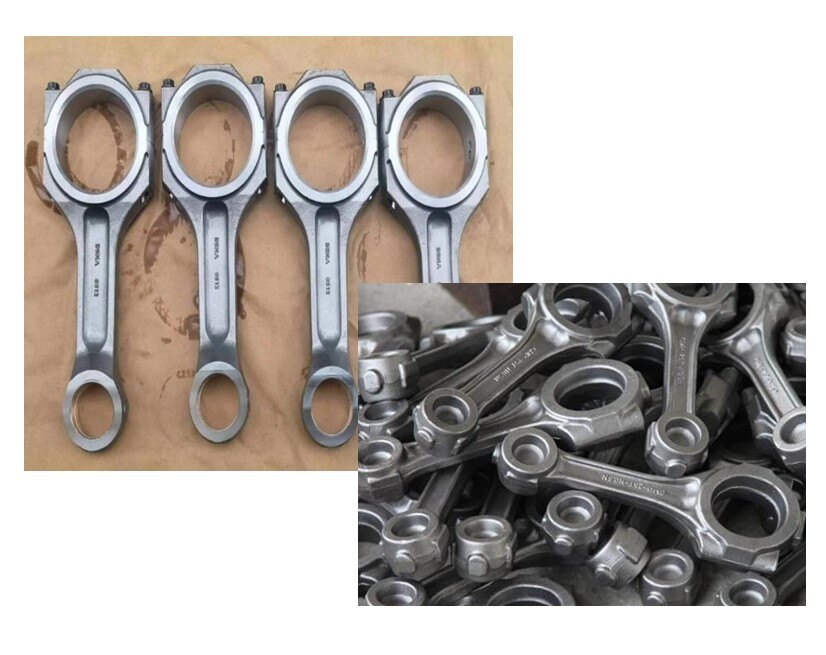
In an automobile engine, there is a component that is not as frequently mentioned as the piston or spark plug, but it plays a decisive role in engine performance and service life. This component is the connecting rod. The main function of the connecting rod is to connect the piston and the crankshaft, converting the reciprocating motion of the piston into the rotational motion of the crankshaft, thereby driving the vehicle forward.
During engine operation, the connecting rod must withstand extremely high pressure, high-speed tensile forces, and continuous high temperatures. If the strength of the connecting rod is insufficient, once it breaks, the entire engine may be destroyed. Therefore, the choice of connecting rod directly determines whether the engine can operate reliably under high load conditions.
There are two main manufacturing processes for connecting rods: forging and casting. These two methods produce connecting rods with significant differences in performance, cost, and application scenarios. Forged connecting rods are generally stronger and more fatigue-resistant and are commonly used in racing and high-performance engines. Cast connecting rods, on the other hand, are cheaper and suitable for mass production, widely used in standard passenger vehicles.
This article provides a clear and easy-to-understand explanation of the manufacturing processes, performance characteristics, advantages, and disadvantages of both forged connecting rods and cast connecting rods. After reading, you will have a clear understanding of which type of connecting rod is suitable for different engines and how to balance performance, durability, and cost.
The connecting rod is one of the core components inside an automobile engine. It connects the piston and the crankshaft and is responsible for converting the reciprocating linear motion of the piston into the rotational motion of the crankshaft. Through this conversion, the energy generated by fuel combustion is ultimately transformed into the power that drives the wheels.
During operation, the connecting rod is subjected to extremely high mechanical loads. When fuel combustion occurs inside the cylinder, the resulting high pressure pushes the piston downward, and this force is transmitted entirely through the connecting rod to the crankshaft. At the same time, the connecting rod must also endure inertial forces caused by high-speed rotation and a continuously high-temperature environment. Therefore, the strength, durability, and fatigue resistance of the connecting rod directly determine the reliability and overall performance of the engine.
In high-performance and racing engines, the selection of connecting rods becomes even more critical. These engines often operate under high RPM and high load conditions, placing far greater demands on components than standard passenger vehicles. If the quality of the connecting rod is insufficient, failure may occur under extreme conditions, leading to complete engine breakdown.
After understanding the basic function of connecting rods and the general differences between the two manufacturing methods, we now analyze forged connecting rods in detail. The reason forged connecting rods are widely used in high-performance engines is closely related to their production process and material characteristics. The following sections explain material selection, manufacturing steps, and the effect of forging on metal structure.
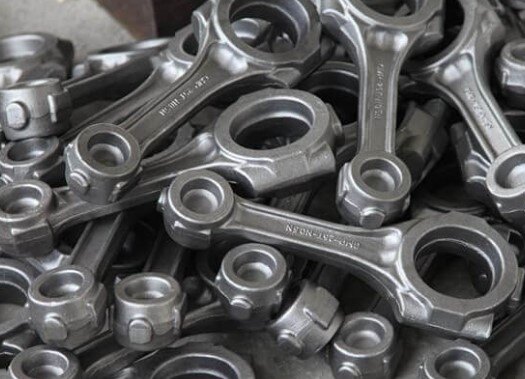
Forged connecting rods are typically made from forged steel alloys. Common alloying elements include chromium, nickel, and molybdenum. These elements improve strength, toughness, and fatigue resistance. High-performance forged connecting rods may also use specially formulated alloy steels to meet more demanding operating conditions.
The forging process involves heating metal to a high temperature and applying high pressure to shape it. The main steps include:
- Cutting (Blank Preparation): Raw material is cut into small billets of predetermined size for forging.
- Heating: The billet is heated above its recrystallization temperature, typically using induction heating equipment. The purpose is to improve plasticity and make the metal easier to deform.
- Roll Forging: The heated billet is pre-shaped using rolling equipment to achieve better material distribution.
- Closed-Die Forging: The pre-formed billet is placed into a closed die, and high pressure is applied using a forging press to form the final shape. The metal is forced to fill the die cavity completely.
- Trimming and Piercing: Excess material is removed, and necessary holes are punched.
- Heat Treatment: Processes such as quenching and tempering are applied to improve strength and toughness.
- Shot Peening: Steel shots are blasted at high speed onto the surface to remove scale and impurities while also creating a compressive stress layer that improves fatigue resistance.
- Precision Calibration: Final dimensional correction ensures the part meets design specifications.
During forging, the metal undergoes plastic deformation under high pressure, breaking and rearranging the internal grain structure. The grains align along the contour of the part, forming a directional flow line structure. This optimized grain flow results in a dense and uniform internal structure with no typical casting defects such as porosity or voids.
Forged connecting rods offer significantly higher strength, toughness, and fatigue resistance compared to cast ones. Due to the optimized grain flow, they can withstand higher loads and higher engine speeds. They are therefore ideal for racing engines and high-performance passenger vehicles.
In addition, forging allows for high dimensional accuracy, improving assembly precision and operational stability. With sufficient strength, forged connecting rods can also be designed to be thinner and lighter, reducing reciprocating mass and improving engine responsiveness.
Unlike forging, cast connecting rods are produced by pouring molten metal into a mold and allowing it to solidify naturally. This method relies on the fluidity of liquid metal to fill the mold cavity rather than applying external force to solid metal. Casting is especially suitable for mass production and allows complex shapes to be manufactured at lower cost.
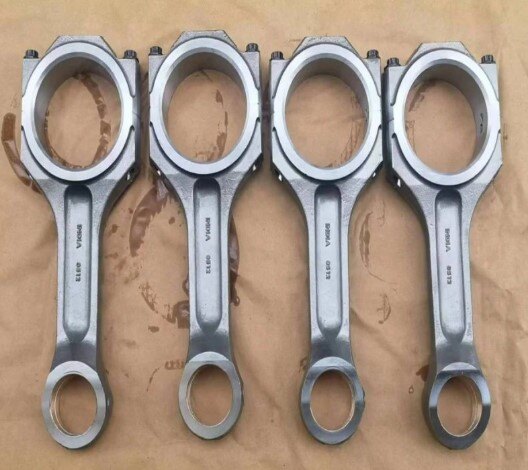
Casting is a manufacturing method in which molten metal is poured into a mold cavity and solidifies into a final shape after cooling. Unlike forging, casting does not require deformation of solid metal under pressure; instead, it relies on the flowability of liquid metal.
Sand casting is the most common method for producing connecting rods:
- Pattern Making: A high-precision model of the connecting rod is created, usually from metal.
- Mold Making: The model is placed in a sand box, filled with molding sand, and compacted. After removing the model, a cavity in the shape of the connecting rod remains.
- Metal Melting: Metal materials such as cast iron or aluminum alloy are melted in a furnace.
- Pouring: Molten metal is poured into the sand mold cavity.
- Cooling and Solidification: The metal is allowed to cool and solidify naturally.
- Shakeout: The sand mold is broken to remove the casting.
- Post-Processing: Cleaning, machining, and heat treatment are performed to meet dimensional and performance requirements.
Casting is suitable for producing complex shapes with intricate geometries. Internal channels or complex structures that are difficult to forge can be easily produced by casting. It also has significant cost advantages in mass production due to low per-unit cost.
A major limitation of casting is the possibility of internal defects. During solidification, defects such as porosity, shrinkage cavities, or inclusions may form. These act as stress concentration points and may lead to cracking or failure under high load conditions. Therefore, cast connecting rods generally have lower strength and fatigue resistance compared to forged ones.
From the above descriptions, the fundamental differences can be summarized as follows:
- Manufacturing Method: Forging applies high pressure to solid metal to induce plastic deformation, while casting involves pouring molten metal into a mold and allowing it to solidify.
- Material Properties: Forging improves grain structure and produces a dense internal structure with higher strength and toughness. Casting may contain internal defects, resulting in lower strength under high stress.
- Application Scenarios: Casting is suitable for complex shapes and large-scale production. Forging is better for simpler structures requiring high strength.
- Cost Comparison: Casting has lower per-unit cost in mass production. Forging requires more processing steps and higher equipment investment, making it more expensive.
- Material Utilization: Forging has higher material efficiency with less waste. Casting requires additional material for gating and risers.
High-performance engines operate under more extreme conditions than standard engines, including higher RPM, higher combustion pressure, and greater thermal load.
- Higher Strength and Durability: Forged connecting rods have superior strength and fatigue resistance due to optimized grain flow.
- Ability to Withstand Higher Compression Ratios: Higher strength allows forged rods to handle higher compression ratios and more aggressive ignition timing, improving engine efficiency and power output.
- High Customizability: Forging allows engineers to adjust shape, weight distribution, and length to optimize engine balance and performance.
- Better Heat Resistance: Reduced internal defects improve stability under high-temperature conditions.
- Lighter Weight: Forged rods can be made thinner and lighter while maintaining strength, improving engine responsiveness.
Despite lower performance compared to forged rods, cast connecting rods remain widely used.
- Cost Efficiency in Mass Production: For passenger vehicles produced in large quantities, casting significantly reduces manufacturing cost.
- Sufficient Reliability: Modern casting technology provides adequate strength and durability for normal driving conditions.
- Agricultural and Industrial Machinery: These applications require long-term stable operation rather than high power output, making cast rods suitable.
Selection depends on application requirements:
- Performance Needs: High RPM or racing applications require forged rods.
- Durability Requirements: Long-life, high-reliability engines benefit from forged rods.
- Cost Constraints: Budget-focused applications favor cast rods.
- Production Volume: Mass production favors casting; small batches favor forging.
The connecting rod is a key engine component linking the piston and crankshaft, and its manufacturing method directly affects engine performance and reliability.
Forged connecting rods, through heating and high-pressure forming, achieve optimized grain structure and superior strength, toughness, and fatigue resistance. Although more expensive, they are essential for high-performance and racing engines.
Cast connecting rods, formed by pouring molten metal into molds, offer significant cost advantages for mass production. While they may contain internal defects and have lower strength, they are sufficiently reliable for standard passenger vehicles and industrial applications.
Understanding the differences between forging and casting helps in selecting the appropriate connecting rod type based on performance, durability, and cost requirements, ensuring stable and reliable engine operation under various working conditions.