Coarse Grain Formation in Aluminum Alloy Forgings
In the field of metal processing, aluminum alloy forgings are widely used in aerospace, automotive manufacturing, and mechanical equipment due to their high strength-to-weight ratio and excellent overall performance. However, in actual production, coarse grain formation remains a persistent and common quality issue that troubles many manufacturers. Once abnormally large grains develop within a forging, not only does the material’s mechanical strength decline, but surface defects may also occur, directly affecting the service life and operational safety of the product. Therefore, a thorough understanding of the formation mechanisms of coarse grains and the influencing factors is of great importance for improving the quality of aluminum alloy forgings.
Coarse grains refer to a microstructural condition in which the grain size of a metallic material becomes abnormally large. In properly manufactured aluminum alloy forgings, the grains should be fine and uniformly distributed to ensure balanced mechanical properties. Once coarse grains form, the mechanical performance of the forging deteriorates significantly, typically manifesting as reduced fatigue strength, lower toughness, and diminished plasticity.
In extreme cases, coarse grains may lead to surface defects resembling an orange peel texture. Such surface irregularities not only impair appearance but also act as stress concentration sites, increasing the likelihood of crack initiation and propagation.
From a microstructural perspective, plastic deformation stores energy within the metal and leaves the microstructure in an unstable state. When the material is reheated to an appropriate temperature, new grains nucleate and grow, a process known as recrystallization. Under proper control, recrystallization produces fine, uniform, equiaxed grains. However, improper control can result in abnormal grain growth, which generally occurs in two forms: one in which all grains grow uniformly, and another in which a small number of grains grow abnormally large and consume surrounding smaller grains. The latter is more common in aluminum alloy forgings and is the primary cause of coarse grain defects.
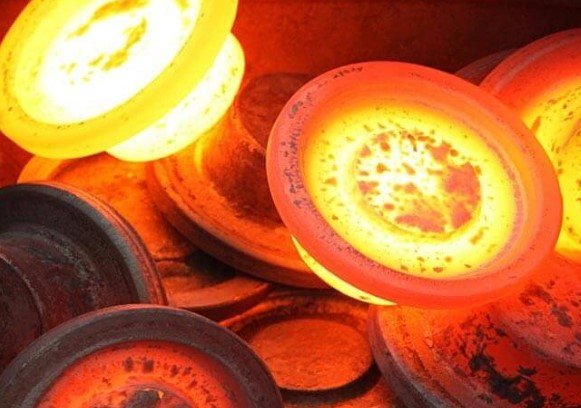
Forging parameters are the most direct factors affecting grain size. Temperature, degree of deformation, and deformation rate interact with one another and jointly determine the final microstructure.
Forging temperature must be strictly controlled, avoiding both excessively high and excessively low values. If the initial forging temperature is too high and approaches the melting point of the alloy, sufficient energy and driving force are provided for recrystallization and grain growth. Under such conditions, atomic mobility increases, grain boundary migration accelerates, and coarse grains are easily formed.
Conversely, if the final forging temperature is too low, strain hardening becomes significant, deformation resistance increases, and subsequent recrystallization may be incomplete, resulting in a non-uniform microstructure.
Different alloy systems have specific requirements for final forging temperature. In general, the final forging temperature of aluminum alloy forgings should not be lower than 370 °C. For Al–Cu–Mg alloys such as 2A11 (formerly LY11), stricter control is required, and the final forging temperature must exceed 390 °C to prevent coarse grain formation. Al–Mg–Si alloys also demand strict temperature control and are more prone to coarse grain defects than Al–Zn–Mg–Cu alloys.
The degree of deformation is a key factor governing recrystallization behavior. When deformation falls within the critical deformation range—typically between 5% and 15%—only a limited number of recrystallization nuclei form. These nuclei then have sufficient space and time to grow, ultimately resulting in abnormally large grains. This occurs because stored energy is unevenly distributed at critical deformation levels, giving a few grains a distinct growth advantage.
In practical production, the deformation applied during the final forging pass is particularly critical. If the deformation is too small, the number of recrystallization nuclei is limited and the incubation period is prolonged, making the forging susceptible to coarse grain formation during subsequent heating or heat treatment. When deformation falls within the critical range of approximately 3% to 15%, recrystallized grains may grow rapidly. Therefore, forging passes and reduction per pass must be carefully controlled to prevent excessive passes with insufficient deformation.
The deformation rate refers to the speed at which the metal is deformed. Excessively high deformation rates can lead to localized thermal effects. When deformation occurs too rapidly, the heat generated by plastic deformation cannot dissipate in time, causing localized temperature increases. These local temperature rises promote grain growth in specific regions, resulting in coarse grain structures. Consequently, deformation rates must be selected based on material characteristics and forging geometry.
The quality of forgings originates from the raw material. If the ingot or billet initially contains coarse grains or severe dendritic segregation, these defects are likely to be inherited by subsequent forged products. Even with optimized forging processes, the adverse effects of poor initial microstructure are difficult to eliminate completely.
Alloying elements play a vital role in suppressing coarse grain formation. Elements such as zirconium (Zr), manganese (Mn), and chromium (Cr) in aluminum alloys form finely dispersed compounds that pin grain boundaries and hinder grain boundary migration, thereby suppressing recrystallization and grain growth. If the content of these elements is insufficient or their distribution is uneven, the pinning effect weakens, making grain coarsening more likely during hot working. Therefore, selecting high-quality raw materials with uniform composition and fine microstructure is the first line of defense against coarse grain defects.
Heat treatment is a critical post-forging operation, but improperly designed parameters can become a major cause of coarse grain formation. For heat-treatable aluminum alloys, the temperature and holding time during solution treatment are particularly important.
If the solution treatment temperature is too high or the holding time is too long, recrystallization proceeds extensively, accompanied by pronounced grain coalescence and growth. In forgings with uneven deformation, differences in stored energy between regions can easily lead to secondary recrystallization at high temperatures. Secondary recrystallization involves the abnormal growth of a small number of grains at the expense of many surrounding smaller grains, producing extremely coarse and uneven microstructures.
Heat treatment schedules must be matched to the forging process. Because deformation varies across different regions of a forging, applying uniform heat treatment parameters may cause lightly deformed areas to undergo static recrystallization and grain growth, while heavily deformed areas retain fine grains. This mixed-grain structure can be even more detrimental to mechanical performance than uniformly coarse grains.
Although open-die forging offers greater flexibility than closed-die forging, die design (including anvils) and tooling conditions still significantly affect microstructural uniformity. Equipment precision and operator skill are also critical factors.
Poorly designed dies or inadequate lubrication can lead to non-uniform metal flow, resulting in large variations in deformation across the forging. Regions with large deformation may undergo dynamic recrystallization and form fine grains, while regions with little or no deformation may retain coarse original grains or experience grain growth during subsequent heat treatment. Such mixed-grain structures are often more harmful than uniformly coarse grains.
In closed-die forging, excessively low die temperatures accelerate heat loss from the metal, reducing deformation temperature. This not only hinders cavity filling but may also promote coarse grain formation on the forging surface. Die preheating temperatures are typically controlled between 300 °C and 400 °C, depending on forging geometry and alloy grade.
Forgings with special structures, such as high ribs, require particular attention. After the cavity is filled, continued die closure may force excess metal at the web to flow directly into the flash gutter along the rib root, leading to excessive local deformation and localized coarse grains. Therefore, while ensuring complete cavity filling and proper fiber flow, unnecessary forging passes should be minimized to avoid excessive deformation accumulation.
If the impact energy and speed of forging equipment such as hammers or presses are not accurately controlled, the actual deformation may deviate from design values and unintentionally fall within the critical deformation range. Operators must strictly follow process specifications and control dwell times between operations. Excessive dwell times allow forging temperatures to drop into the low-temperature forging range, increasing deformation resistance and promoting incomplete recrystallization.
Temperature uniformity in heating equipment is equally important. Non-uniform furnace temperatures can cause localized overheating of billets, creating preferred sites for coarse grain formation. Regular calibration and maintenance of heating equipment are essential preventive measures.
Addressing coarse grain issues in aluminum alloy forgings requires a systematic approach encompassing materials, processes, equipment, and operations.
In raw material control, suppliers should be strictly qualified to ensure uniform composition, fine microstructure, and minimal dendritic segregation. Key alloying elements should be carefully analyzed to confirm sufficient grain boundary pinning capability.
Process optimization involves precisely defining forging temperature windows and avoiding critical deformation ranges. Process plans should specify deformation requirements for each pass, particularly ensuring adequate deformation in the final pass. Deformation rates should be properly controlled to prevent localized thermal effects.
Die design should promote uniform metal flow and improved lubrication. For complex forgings, numerical simulation can be used to optimize die structures and predict metal flow behavior, minimizing deformation non-uniformity caused by flow dead zones.
During heat treatment, differentiated process parameters based on local deformation levels may be adopted, or staged heating and controlled heating rates can be used to prevent secondary recrystallization. Solution treatment temperature and time must be precisely controlled to avoid excessive holding.
From an equipment perspective, forging and heating equipment should be regularly calibrated to ensure accurate energy delivery and temperature control. Operator training should be strengthened, and standardized operating procedures should be enforced to minimize human-induced process deviations.
Coarse grain formation in aluminum alloy forgings is not caused by a single factor, but rather by the complex interaction of material properties, process parameters, equipment conditions, and operational practices. Different aluminum alloy systems exhibit varying sensitivity to processing conditions, with Al–Cu–Mg and Al–Mg–Si alloys requiring stricter control than Al–Zn–Mg–Cu alloys.
The key to preventing coarse grains lies in comprehensive process control: starting with high-quality raw materials, optimizing forging parameters to avoid critical deformation ranges, designing dies to ensure uniform deformation, strictly controlling heat treatment parameters to prevent abnormal grain growth, and supporting these measures with precise equipment control and standardized operations. Only by establishing a complete and integrated quality control system can coarse grain defects be effectively minimized, ensuring that aluminum alloy forgings achieve excellent mechanical properties and reliable performance to meet the stringent demands of advanced manufacturing industries.