A Comprehensive Guide to Hollow Shaft Forging Technology
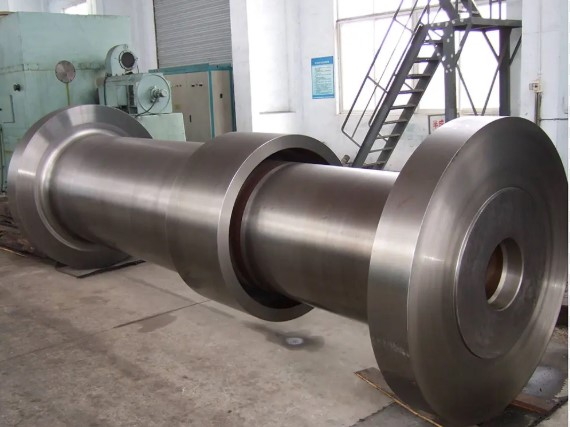
Hollow shaft forging is a specialized metal forming process used to manufacture hollow shafts. Simply put, it relies on the combined effects of pressure and heat to plastically deform metal materials, ultimately producing tubular components with specific shapes and performance characteristics.
This process plays an increasingly important role in modern manufacturing. From automotive drive shafts and aircraft landing gear to wind turbine main shafts, forged hollow shafts are highly valued for their unique advantages. Compared with solid shafts, hollow shafts can significantly reduce weight and save material costs while maintaining the same load-bearing capacity, an essential requirement in today's push toward industrial lightweighting.
- Raw Material Selection: The first step in manufacturing a hollow shaft is choosing the right material. Common raw materials include steel ingots, aluminum ingots, and other metals. The selection depends on the operating environment and performance requirements of the shaft. For example, aerospace applications demand extremely high strength and corrosion resistance, so high-strength alloy steels are typically used. Automotive drive shafts prioritize lightweight design and cost efficiency, making aluminum alloys an excellent option. Wind turbine main shafts must withstand enormous torque and axial forces, and therefore are generally made from high-quality carbon steel or alloy steel.
- Heating Treatment: After selecting the material, it must be heated to the appropriate forging temperature. This stage is critical because proper temperature reduces internal stress, improves plasticity, and facilitates subsequent deformation. Heating temperatures vary by material: ordinary carbon steel is typically forged at 1100°C–1200°C, while aluminum alloys require lower temperatures of approximately 400°C–500°C. Precise temperature control is essential, excessive heat can cause grain coarsening, whereas insufficient heat reduces plasticity and may lead to cracking.
- Preforming: The heated metal is then transferred to forging equipment such as forging hammers, presses, or rolling mills. Under applied pressure, the metal undergoes plastic deformation and begins to take on the general shape of the hollow shaft. Techniques such as hammering, pressing, or rolling increase the diameter until it approaches the target dimensions. The purpose of preforming is not to achieve the final shape immediately, but to establish a solid foundation for later finishing operations.
- Dimensional Adjustment and Elongation: Following initial forming, the shaft's dimensions must be further refined. Hammering, rolling, or pressing methods are used to elongate the shaft to the required length. Precise control of equipment parameters, including pressure, speed, and stroke, is necessary to ensure dimensional accuracy.
- Forge Welding and Forming: Next comes the critical forge welding process, where both ends of the hollow shaft are joined to create a complete structure. Temperature and pressure must be carefully controlled to guarantee joint strength and overall integrity. For shafts with complex geometries, welding or other joining technologies may also be required for final assembly.
- Cooling and Heat Treatment: Cooling is equally important in the forging process. By controlling the cooling rate, manufacturers can obtain the desired microstructure and ensure the required mechanical properties. Rapid cooling increases hardness, while slow cooling helps relieve internal stress. Additional heat treatments, such as normalizing, quenching, and tempering, are often performed to further enhance strength, toughness, and wear resistance so the shaft can withstand demanding operating conditions.
- Finishing and Surface Treatment: Once heat treatment is complete, the shaft enters the finishing stage. Machining removes surface defects and achieves precise dimensions and geometry. Surface treatments such as polishing, plating, or coating are then applied to improve wear resistance, corrosion resistance, and overall appearance.
- Quality Inspection: The final step is comprehensive quality inspection. Dimensional accuracy, surface condition, and mechanical performance are rigorously tested to ensure compliance with design requirements. Common inspection methods include ultrasonic testing and X-ray non-destructive testing, as well as destructive tests such as tensile and impact testing.
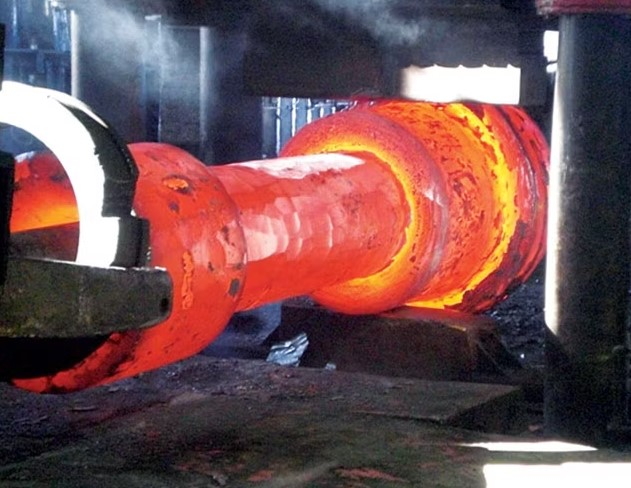
According to the latest industry research, hollow shafts can be produced through various forming methods, each offering distinct advantages and application ranges.
- Forging Combined with Machining: This is the most traditional method. Forging provides the rough shape, followed by machining for precision finishing. Its main advantage is high dimensional accuracy, though production efficiency and material utilization are relatively low.
- Radial Forging: Radial forging employs multiple evenly distributed tools that apply radial force to the billet within the same plane. This method can produce complex hollow shaft shapes with uniform microstructures and excellent mechanical properties, making it particularly suitable for components subjected to complex loads.
- Rotary Forging (Swaging): Rotary forging is one of the most advanced hollow shaft forming technologies available today. Multiple hammers are evenly arranged around the billet circumference and rotate around the axis while delivering high-frequency radial blows. This reduces the cross-sectional size and elongates the shaft. Its greatest advantage is flexibility, it is ideal for directly forming multi-step shafts with variable wall thickness and can even forge internal and external splines. Continuous material grain flow and significant work hardening greatly improve fatigue life as well as compressive, bending, and torsional strength. This process is increasingly used in the production of motor shafts for new energy vehicles.
- Extrusion Forming: Extrusion forces heated metal through a die under high temperature and pressure to create the preliminary hollow shaft shape. It can produce components with complex cross-sections, but requires specialized equipment and precision dies, resulting in higher initial investment.
- Cross-Wedge Rolling: This process uses wedge-shaped dies to roll the metal billet. It is well suited for mass production, offering high efficiency and excellent material utilization. However, it demands advanced die design and manufacturing capabilities.
- Internal High-Pressure Forming: A relatively new technique, this method applies high-pressure fluid inside a tubular billet, causing it to expand and conform to the mold cavity. It enables the production of complex cross-sectional shapes with high dimensional accuracy, though equipment costs and process control requirements are substantial.
- Substantial Weight Reduction and Material Savings: This is the most intuitive advantage. Engineering mechanics shows that when transmitting torque, shear stress across a shaft's cross-section is linearly distributed along the radius, with minimal stress near the center, meaning that material is underutilized. Redistributing this material toward the outer edge to form a hollow structure increases the radius and enhances torque capacity. Data indicates that when the ratio of inner to outer diameter is 0.5, the outer diameter of a hollow shaft needs to be only about 2% larger than that of a solid shaft to achieve the same load-bearing performance, while reducing weight by more than 20%.
- Lower Moment of Inertia and Faster Dynamic Response: Lighter weight results in smaller rotational inertia. For high-speed rotating components, this allows quicker acceleration and deceleration, faster transmission response, and lower energy consumption, particularly important for new energy vehicles and high-speed rail systems.
- Reduced Vibration and Smoother Operation: The lightweight design also helps minimize vibration. Lower mass improves dynamic balance, raises critical speed, and reduces operating noise. Studies show that hollow shafts outperform solid shafts in dynamic response, noise, vibration, and control characteristics.
- Improved Heat Dissipation: The hollow structure provides a channel for cooling media, promoting heat dissipation. In electric motor shafts for new energy vehicles, hollow designs facilitate more effective cooling layouts, reduce operating temperatures, and extend service life.
- Usable Internal Space: The central bore can accommodate cables, sensors, or other components, enabling functional integration and simplifying mechanical design, particularly valuable in space-constrained applications.
- Automotive Manufacturing: Hollow shafts are widely used in drive shafts, steering shafts, and transmission shafts. With the rapid growth of new energy vehicles, hollow motor shafts have become a natural choice for lightweight design.
- Aerospace: Weight sensitivity is critical in aerospace engineering. Hollow forgings are extensively used in wing structures, tail assemblies, propeller shafts, and helicopter rotor shafts. Their superior strength-to-weight ratio makes them ideal for aircraft manufacturing.
- Wind Power Generation: The wind power sector is one of the fastest-growing markets for hollow shafts. Main shafts must withstand tremendous axial forces and torque while minimizing weight to reduce tower loads. Since 2017, hollow forging technology has gradually gained adoption in main shaft production, and by 2024, large numbers of orders have emerged for hollow main shafts used in turbines exceeding 8 MW, with inner diameters reaching up to 1200 mm.
- Oil and Gas: In oil drilling and natural gas transportation, hollow forgings are used to manufacture pipelines, valves, and high-pressure equipment. These components must endure high pressures and corrosive environments, and forging provides exceptional strength and reliability.
- Rail Transportation: Key components such as high-speed train axles and bogies are increasingly adopting hollow shaft designs. Their high strength and lightweight characteristics help improve operational efficiency and safety.
Hollow shaft forging is an advanced technology that integrates materials science, plastic forming, and precision manufacturing. Every stage, from raw material selection to final production, requires strict control. Compared with solid shafts, hollow shafts maintain similar load-bearing capacity while significantly reducing weight, saving materials, and lowering energy consumption, precisely the goals of modern industry.
With ongoing advancements in computer technology, automation, and innovative processes, hollow shaft forging continues to evolve rapidly. Driven by demand in sectors such as new energy vehicles, wind power, and aerospace, the application scope of hollow shafts will keep expanding. For manufacturers, mastering hollow shaft forging technology is not only essential for enhancing product competitiveness but also a strategic step toward the lightweight and sustainable future of manufacturing.