Material Selection and Optimization in Forging Design

Forging is one of the most widely used and technically mature manufacturing processes in the field of metal forming. By applying compressive or impact forces to shape metal, forging not only changes the external geometry of a material but also optimizes its internal microstructure. This transformation significantly enhances the strength, toughness, and service life of components. In industries such as construction machinery, heavy-duty trucks, agricultural equipment, and mining machinery, forged parts play a critical role, and their quality directly determines the safety and reliability of entire systems.
However, forging design is not a single-step task. It is a systematic engineering discipline involving material selection, geometric design, process parameters, heat treatment, and quality verification. Any negligence in one of these stages may lead to underperforming parts or even equipment failure. Therefore, a deep understanding of forging design principles is essential for engineers, procurement specialists, and equipment manufacturers.
Before discussing geometric design and heat treatment processes, it is necessary to clarify the foundational elements of forging design. Material selection is the most fundamental and critical stage, as it defines both the performance ceiling and manufacturing cost of a component. The key evaluation criteria include mechanical, thermal, and chemical properties, as well as forgeability.
Material selection is the foundation of forging design. During forging, metal is shaped under pressure or impact, and its internal grain structure is altered, improving strength and structural integrity. Different steels are suitable for different applications.
Carbon steel is widely used in industrial applications due to its high strength and good toughness. Stainless steel is preferred in corrosive environments such as chemical processing and marine engineering because of its excellent corrosion resistance. Alloy steel provides a balanced combination of hardness, toughness, wear resistance, and fatigue resistance, making it suitable for high-load components.
In addition to performance requirements, material availability and cost must also be considered. Some special steel grades may be limited in supply or expensive, increasing procurement difficulty. Furthermore, downstream processing and heat treatment costs must also be included in the evaluation to ensure a reasonable balance between technical performance and economic feasibility.
Material properties can be divided into three main categories: mechanical, thermal, and chemical properties.
Mechanical properties include tensile strength, yield strength, ductility, hardness, and impact toughness. These parameters determine how the material behaves during forging deformation and how the final product performs in service.
Thermal properties include thermal conductivity and thermal expansion coefficient. High thermal conductivity helps achieve uniform temperature distribution during hot forging, while thermal expansion directly affects dimensional accuracy after cooling.
Chemical properties refer to the composition of the steel and its sensitivity to corrosion, oxidation, and high-temperature reactions. These factors influence both process stability and component service life.
Forgeability refers to the ability of a material to be plastically deformed without cracking or forming defects. It is influenced by ductility, work-hardening rate, and thermal behavior.
Materials with good forgeability can more easily fill die cavities, resulting in more uniform internal structures. When selecting materials, engineers must consider part geometry complexity and forming processes to evaluate forgeability comprehensively. Poor evaluation may lead to defects such as cracking or folding during forging.

Once material selection is determined, geometric design becomes the key factor influencing forging quality and cost. Geometric design involves structural shape, draft angle, fillet and transition radius, tolerances and machining allowances, and handling of internal concave features.
The geometry of a part directly determines die type, required forging pressure, and overall manufacturing complexity. Simple geometries are easier to forge, require fewer operations, and reduce cost. Complex structures often require multiple forming steps and more sophisticated die designs, increasing both cost and production time.
Part size also affects equipment selection. Larger components require higher-tonnage presses and more heating energy. Symmetrical structures are easier to form and reduce deformation caused by uneven cooling. Uniform wall thickness promotes consistent cooling and minimizes warping and internal defects. Sudden thickness changes may lead to folding or delamination during forging.
Draft angles ensure that forged parts can be smoothly removed from the die. A properly designed draft angle not only prevents damage during demolding but also reduces die wear and extends tool life. Insufficient draft may cause sticking, tearing, or deformation.
In steel forging, typical draft angles range from 3° to 7°. The exact value depends on part complexity, die structure, and material type. More complex or deeper parts generally require larger draft angles to ensure smooth removal.
Fillets and transition radii play an important role in forging design. Proper fillet design improves metal flow, allowing material to fill the die cavity more completely. Sharp corners tend to create stress concentrations, reducing fatigue life.
Fillet design also distributes stress more evenly, improving overall strength and durability. In addition, proper radii reduce localized stress on the die, extending tool life and reducing cracking risk. Engineers must balance functional requirements with manufacturability when designing geometric transitions.
Tolerances define allowable dimensional variation, ensuring interchangeability and assembly precision. Tighter tolerances require higher machining accuracy and increase manufacturing cost.
Machining allowances compensate for dimensional changes during processing, including machining removal, cooling shrinkage, die wear, and draft-related variations. Proper allowance design ensures final parts meet specifications without excessive machining difficulty or increased scrap rates.
Internal concave features are particularly challenging in forging design. Their complexity increases die manufacturing difficulty and may disrupt metal flow, leading to incomplete filling or defects. They also increase die wear and complicate part removal.
In many cases, engineers must balance functional requirements with manufacturability. A common approach is to achieve concave features through post-forging machining, which reduces die complexity and improves reliability. Although this adds an additional process step, it significantly improves yield and extends die life.
While geometric design defines external shape, forging itself determines internal microstructure, which directly affects strength, toughness, and service life.
Strength is generally defined as the maximum stress a component can withstand before failure. In heavy machinery such as excavators, loaders, tractors, combine harvesters, conveyors, and trucks, critical components must withstand harsh operating conditions.
Low-cost parts do not always result in lower total cost. Unstable performance or premature failure can lead to greater long-term losses. Integrated forging processes significantly improve strength and durability, optimizing lifecycle cost.
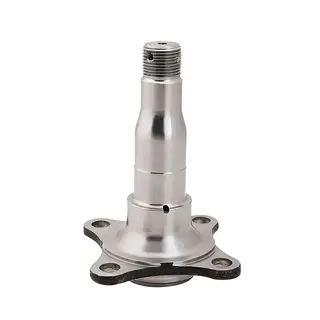
Integrated forging reduces manufacturing steps and material waste while minimizing machining requirements. For components such as axle flanges and drive gears used in off-road trucks or excavators, performance depends heavily on internal structure.
Through optimized process design, engineers can control grain flow, microstructure, and mechanical properties to produce more reliable components. Integrated forging improves the strength-to-weight ratio and enhances durability while reducing defects commonly found in casting or bar machining processes.
Metal flow lines play a decisive role in performance. Proper grain alignment along stress directions enhances load-bearing capacity and fatigue resistance.
Near-net-shape forging reduces machining allowances and shortens machining time while improving consistency. Key metallurgical factors include grain size, phase distribution, and inclusion content. Fine grains generally indicate higher strength and toughness, while uniform structure ensures consistent batch performance.
Forged parts typically undergo heat treatment to achieve final mechanical properties. Common processes include annealing, normalizing, quenching and tempering, and controlled cooling.
Subcritical annealing heats components to approximately 1100°F–1300°F, followed by slow cooling or air cooling to reduce hardness and relieve residual stress.
Full or isothermal annealing is performed at 1500°F–1750°F, followed by controlled cooling to produce a uniform and machinable structure, improving processing performance.
Normalizing involves heating and air cooling to refine grain structure. It improves machinability, dimensional stability, and response consistency in subsequent heat treatments. It also provides a stable base structure for further strengthening processes.
Quenching and tempering are essential for achieving high-strength components. Steel is heated to approximately 1500°F–1650°F and rapidly cooled in oil, water, or polymer solutions to achieve high hardness.
Since quenched material is brittle, tempering is performed below 1300°F to improve toughness and ductility. Quenching media selection significantly affects cooling rate and final properties: oil provides balanced hardness for alloy steels, water offers rapid cooling for carbon steels but increases distortion risk, and polymer solutions provide intermediate performance.
In some cases, controlled cooling can replace part of the heat treatment process. For example, in conveyor systems, forged parts may be air-cooled to specific temperatures after forming.
This approach is particularly suitable for microalloyed steels, offering improved consistency and reduced energy consumption. It shortens production cycles and provides an economical alternative to conventional heat treatment.
A systematic quality assurance system is essential to ensure forged parts meet design requirements. This includes forging simulation, macro etching, mechanical testing, and metallographic analysis.
Simulation software can predict material flow and grain direction before die manufacturing, reducing trial-and-error costs.
Macro etching uses chemical processes to reveal grain flow patterns, helping verify whether the forging process meets design expectations and identifying defects such as folds or segregation.
Hardness testing provides a quick estimation of material strength. Tensile testing directly measures strength and ductility.
Charpy impact testing evaluates low-temperature toughness, which is critical for equipment operating in cold environments. These tests provide a comprehensive understanding of material behavior under different loading conditions.
Metallographic analysis examines grain size and microstructure under a microscope to confirm stability and consistency. Fine equiaxed grains indicate good mechanical performance, while abnormal structures may indicate process deviations.
Forging design is a comprehensive engineering discipline that integrates material selection, structural design, manufacturing processes, and quality control. Engineers must evaluate carbon steel, stainless steel, and alloy steel based on service conditions, loading requirements, and cost considerations, while carefully assessing mechanical, thermal, and forgeability properties.
At the design stage, geometry-related factors such as shape, draft angles, fillets, tolerances, and internal structures significantly influence manufacturability and product quality. Integrated forging processes enhance mechanical performance by optimizing metal flow and microstructure, while reducing waste and machining effort.
Heat treatment provides flexible control over material properties through annealing, normalizing, quenching, and tempering. Finally, simulation, macro inspection, mechanical testing, and metallographic analysis ensure consistent quality across production batches.
For heavy machinery and critical components, the value of forging extends far beyond initial cost. It lies in long-term durability, reliability, and lifecycle efficiency. Through scientific design and strict process control, forged components can maintain stable performance under severe operating conditions, reducing maintenance requirements and downtime while achieving overall cost optimization across the product lifecycle.