Forging Technology in Agricultural Machinery Manufacturing

Agricultural machinery is the core equipment of modern agricultural production, and its performance directly determines the efficiency and quality of field operations. From plowing and seeding to harvesting and threshing, from irrigation and fertilization to transportation and processing, agricultural machinery plays a critical role in every stage of agricultural production. However, the working environment of agricultural machinery is extremely harsh: stones and tree roots in the soil can cause unpredictable impacts, long-term continuous operation leads to constant wear, and high power output places strict requirements on component strength. Against this backdrop, how to manufacture components that are both high-strength and wear-resistant, reliable yet cost-effective, has become a core challenge in the agricultural machinery manufacturing industry.
Forging technology, as an important process in the field of metal processing, provides an effective solution to this challenge thanks to its unique material modification capability and forming advantages. Compared with casting and welding processes, forging applies pressure to solid metal to induce plastic deformation, fundamentally improving the internal structure of the material and giving components higher strength, toughness, and fatigue resistance. In large agricultural equipment such as tractors, combine harvesters, and excavators, forged components have become the foundation for ensuring machine performance and safe operation.
The working environment of agricultural machinery is typically characterized by high loads, severe wear, and unpredictable impacts, placing extremely high demands on equipment. In the context of modern agriculture pursuing higher efficiency and output, forged components, with their outstanding durability and reliability, have become a key foundation for long-term stable operation of agricultural machinery. They also play an important role in improving productivity and reducing maintenance costs.
Forging is a manufacturing process in which pressure, usually applied through hammering or dies, is used to shape metal. Before processing, the metal is typically heated to improve its plasticity and then pressed into the desired shape. Unlike casting, where molten metal is poured into molds, forging deforms metal in its solid state. This process significantly improves the grain structure, making the material denser and more uniform, thereby greatly enhancing mechanical properties.
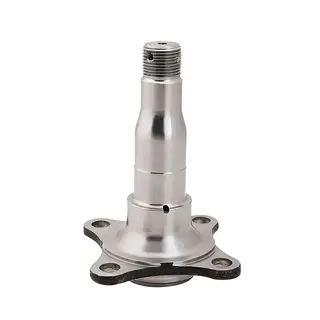
Common agricultural machinery components such as gears, crankshafts, blades, and axles are typically manufactured using forging processes to ensure reliability and service life under high-load conditions.

After understanding the core position of forging in agricultural machinery, it is important to explore how forging improves the overall mechanical properties of components by optimizing the internal material structure.
The importance of forging in agricultural applications is mainly reflected in its ability to optimize the internal structure of materials. Forging preserves the grain flow structure formed during rolling and further aligns grains along the direction of force through plastic deformation, significantly improving strength and toughness.
The grain structure inside metals directly affects mechanical performance. During forging, under high temperature and pressure, the metal undergoes plastic flow, and the original grains are elongated and rearranged along stress directions, forming a continuous fibrous structure. This structure effectively transfers stress, reduces stress concentration, and improves tensile strength and fatigue resistance.
Forging also reduces internal material defects, resulting in higher reliability and structural integrity compared to cast or machined parts. Common casting defects such as shrinkage cavities, porosity, and inclusions can be eliminated during forging. After repeated hammering, the internal structure becomes denser and grains become finer, directly improving macroscopic mechanical performance.
In particular, die forging can produce near-net-shape components, significantly reducing subsequent machining requirements. For high-strength alloy steels that are difficult to machine, this advantage is especially significant. Reduced machining not only lowers production costs but also avoids surface damage and stress concentration caused by cutting processes.
From a performance perspective, forged components offer several clear advantages:
Higher structural strength: Forged parts exhibit significantly better mechanical properties than cast or machined parts. For example, forged tractor axles or plowshares can maintain structural stability under repeated heavy impact without cracking or deformation.
Superior fatigue resistance: Forging aligns grain flow with the direction of stress, improving fatigue resistance and long-term stability under continuous load.
Stronger impact resistance: Agricultural machinery frequently encounters stones and tree roots; forged parts can withstand sudden impacts without brittle failure.
Higher hardness and wear resistance: Depending on alloy composition and heat treatment, forging can further enhance hardness and wear resistance, making parts suitable for harsh agricultural environments.
The advantages of forged components are fully reflected across various agricultural machinery systems, from soil preparation and tillage to power transmission and structural connections.

Tillage components continuously cut, turn, and break soil, bearing severe impact and wear. These parts require high strength and wear resistance, making forging the ideal manufacturing method.
Typical components include:
- Plowshares: The core working part of plows, directly contacting soil and bearing cutting resistance. Forged plowshares ensure stable penetration depth and balance, resisting bending and excessive wear.
- Disc blades: Used for cutting soil and crop residues, requiring high hardness and impact resistance. Forging provides excellent comprehensive mechanical properties.
- Tines: Subject to repeated impact and wear during operation; forged structures maintain shape stability under heavy-duty conditions.
- Furrow openers: Used for seedbed preparation, requiring precise control of depth and width; forging ensures dimensional accuracy and durability.
- Linkage and support components: These connect working parts to the main frame, transmitting force and ensuring structural reliability under load.
Power transmission components operate under high torque and stress, requiring exceptional strength and reliability. Their performance directly affects efficiency and safety.
Typical components include:
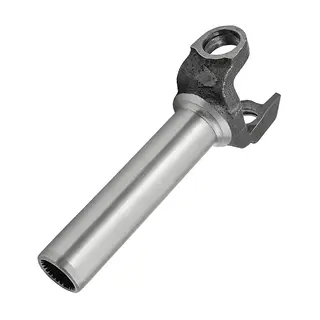
- Shafts: Transmission and drive shafts are critical for power delivery; forging ensures sufficient torsional strength and fatigue resistance.
- Sprockets: Work with chains to transmit power; forged sprockets maintain stable meshing under load.
- Chain links: Basic chain units subjected to tensile and bending loads; forging improves load capacity and service life.
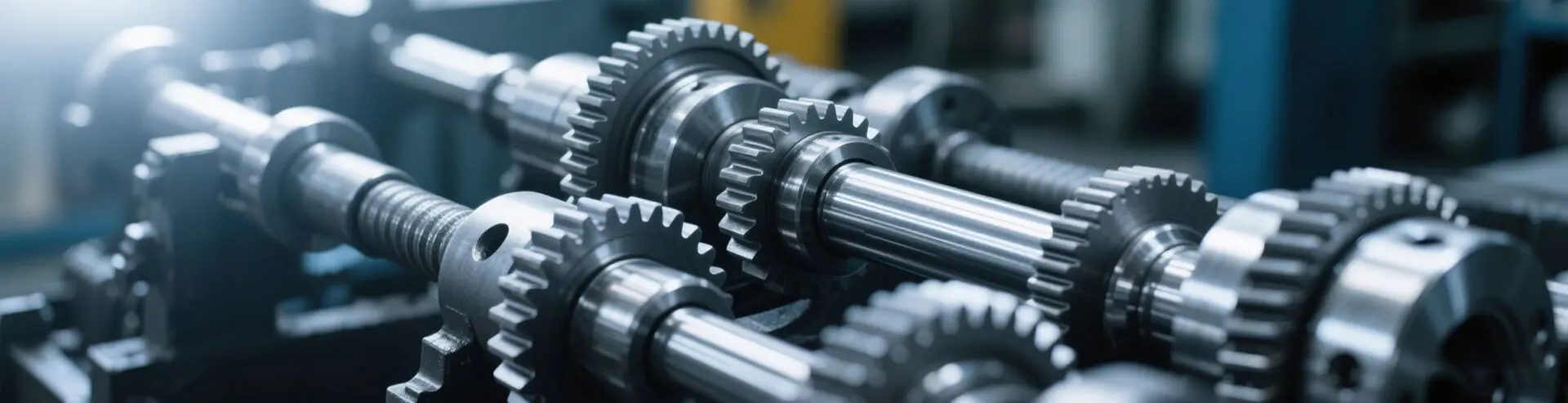
- Gearbox components: Gears and synchronizers operate under high-speed rotation and frequent shifting; forging ensures precision and mechanical performance.
These components must withstand high loads and impacts while maintaining stable motion performance. Their accuracy and strength directly affect operational quality.
Typical products include:
- Tie rods: Transmit tensile force between components; forging prevents deformation or fracture under high load.
- Flanges: Used for pipe or shaft connections, requiring sealing surfaces and structural strength.
- Main shafts: Core rotating supports; forging ensures rigidity and precision.
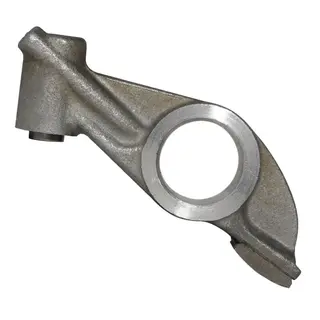
- Lever components: Used for force amplification and direction change, maintaining stability under load.
These components connect and tow agricultural equipment and trailers. Although structurally simple, they bear significant static and dynamic loads, making reliability critical for operational safety.
In tractors, key load-bearing components such as connecting rods, crankshafts, gears, steering knuckles, and axles are typically forged to improve engine efficiency and safety. Power output shafts and suspension components also widely use forging technology.
In plowing and tillage equipment, forged blades and tines effectively resist soil resistance and prevent deformation. Plowshares rely on forging to ensure stable penetration depth and balance.
In spraying equipment and high-speed rotating machinery, forged blades and rotors provide better dynamic balance and longer service life. Dynamic balance is crucial; imbalance can lead to vibration, premature bearing wear, and even equipment damage.
After understanding the applications of forged components in various systems, it is necessary to further explore the main types of forging processes commonly used in agricultural machinery manufacturing, as well as their respective characteristics.
Open-die forging is one of the oldest and simplest forging methods. Metal is placed between flat or shaped dies that do not fully enclose it, and pressure is applied to gradually deform it into shape.
It is suitable for large, simple components such as heavy shafts and brackets. Its advantages include flexibility and low tooling cost, but dimensional accuracy is relatively lower.
Die forging is widely used in agricultural machinery. Metal is placed in a closed die cavity and forced to fill the mold, forming complex shapes.
It is ideal for gears, crankshafts, and precision connectors. It offers high dimensional accuracy, good surface quality, and excellent mechanical properties, but requires higher mold cost.
Upset forging increases the cross-section of a metal part by local compression. It is commonly used for bolts, studs, and small shafts. It offers high efficiency and material savings, making it suitable for mass production of standard parts.
Precision forging is an advanced form of die forging that achieves extremely high dimensional accuracy and surface quality. It is suitable for high-performance gears and precision components. It reduces machining requirements and supports complex geometries, though it requires advanced equipment.
Although initial costs may be higher, forged components offer longer service life and lower maintenance needs, making them more economical over the full lifecycle. They reduce downtime and repair costs, improving equipment availability.
Modern forging also supports customization for different agricultural environments and reduces material waste. Compared with casting, forging produces less scrap and generally consumes less energy, supporting sustainable manufacturing.
Selection depends on part shape, production volume, and material properties. Simple large parts suit open-die forging, while complex precision parts require die or precision forging. High-volume production favors die forging, while material characteristics such as alloy strength and heat treatment response also influence process selection.
Forging technology plays an irreplaceable role in agricultural machinery manufacturing. From soil preparation tools to power transmission systems, forged components ensure strength, toughness, and durability under harsh working conditions. As agricultural machinery continues to develop toward larger scale, intelligence, and higher efficiency, forging, especially die and precision forging, will play an increasingly important role.
At the same time, its advantages in resource efficiency and environmental sustainability make forging a key supporting technology for modern agricultural development. For manufacturers and users, selecting high-quality forged components is an effective way to ensure long-term reliable operation and reduce lifecycle costs.