Near-Net Shape Forging: Benefits, Processes, and Applications

In modern manufacturing industries, the normal operation of critical equipment depends on a large number of precision moving components. From gear shafts inside automotive transmissions to turbine discs used in aircraft engines, these components play essential roles in power transmission, structural support, and load bearing. Although parts such as discs, sleeves, rings, cylinders, and various shaft components are usually small in size, their quality directly affects the performance, service life, and safety of the entire equipment system.
For many years, manufacturers have mainly relied on two methods to produce these components. The first method is casting, where molten metal is poured into molds and solidified into the required shape. The second method is machining, where the final part geometry is gradually cut from solid metal materials. Although casting provides high forming efficiency, cast components often have less dense internal structures and limited mechanical properties. Machining, while offering precise dimensional control, consumes large amounts of raw materials and requires significant processing time. The metal chips generated during machining also create additional waste and handling costs.
As industries continue to demand higher precision, stronger mechanical performance, and faster delivery cycles, the limitations of traditional manufacturing methods have become increasingly obvious. Manufacturers need a process that can maintain the material advantages of forging while reducing complicated secondary machining operations. Near-net shape forging was developed to address this challenge.
Near-net shape forging aims to produce metal components that are already close to their final dimensions and geometry during the forging stage. By achieving a near-final shape earlier in the production process, manufacturers can shorten production cycles, reduce manufacturing costs, improve material utilization, and maintain excellent mechanical performance.
This article explains the concept of near-net shape forging, its process characteristics, major advantages, typical applications, and practical value in modern manufacturing.
Near-net shape forging is a metal forming process designed with a simple objective: producing forged components that are as close as possible to their final finished shape.
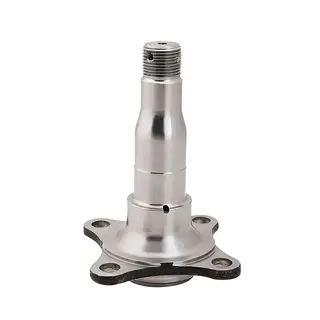
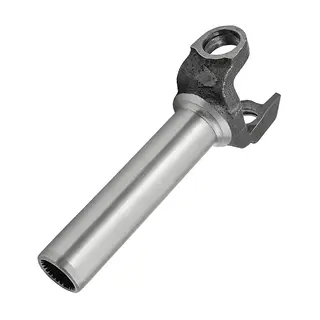
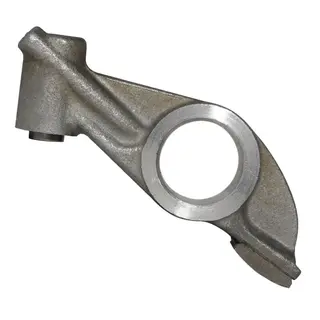
Whether it is a shaft component used in an automotive engine or a disc and sleeve component used in aircraft systems, near-net shape forging can be applied to manufacture these precision parts.
Traditionally, these components were mainly produced through casting or machining. Casting involves heating metal until it becomes molten, pouring it into a mold, and allowing it to cool and solidify. Machining removes excess material from a larger metal block step by step until the required shape is achieved.
However, both methods have limitations. Cast components often have internal defects, uneven structures, and lower mechanical strength compared with forged components. Machining provides excellent dimensional accuracy but wastes a considerable amount of raw material because large portions of the original material are removed during processing.
Near-net shape forging changes this approach. Through optimized forging processes and advanced computer-controlled manufacturing systems, components can achieve their basic final geometry during the forging stage. After production, manufacturers only need limited finishing operations before the components can be assembled or used.

Before near-net shape forging became widely adopted, manufacturers usually purchased components in a “forged condition.” These parts already had the basic shape and excellent material properties, but they were still far from the final finished product.
Forged-condition components typically have rough surfaces, possible oxide scale layers, and dimensional variations in different areas. Manufacturers must perform additional machining processes, including turning, milling, grinding, and other finishing operations, to achieve the required dimensions, tolerances, and surface quality.
These secondary machining processes create significant production burdens. Every additional machining operation increases raw material consumption, processing costs, and tool wear. Factories also need to allocate additional labor hours and equipment capacity for these operations.
As a result, production efficiency decreases, manufacturing cycles become longer, and the profit margin of the final product is reduced.
Near-net shape forging minimizes these disadvantages by allowing more of the final component geometry to be achieved during the initial forming process.
To understand the advantages of near-net shape forging, it is necessary to understand the differences between forging and casting.
Casting is a process where metal is heated until it reaches a molten state. The liquid metal is then poured into a mold and allowed to cool and solidify. During this process, the material changes from solid state to liquid state and then returns to solid state.
Forging is completely different. It does not involve melting metal. Instead, it applies mechanical force to solid metal materials. Through processes such as hammering, pressing, and high-pressure forming, the metal undergoes plastic deformation while remaining in a solid state.
The major advantage of forging comes from its ability to improve the internal structure of metals. During forging, metal grains are aligned along the direction of applied force, creating continuous grain flow. This structure improves tensile strength, fatigue resistance, and shear strength.
For industries such as automotive manufacturing, aerospace, and energy equipment, where safety and reliability are critical, these improved mechanical properties are extremely important. Therefore, engineers often select forged components instead of cast components for high-load applications.
The reason why near-net shape forging has been increasingly adopted in the manufacturing industry is that it provides significant improvements across multiple stages of the production process. These advantages cover various aspects, including production cycle time, manufacturing costs, material utilization, and component quality. The following sections explain each advantage in detail.
The most direct advantage of near-net shape forging is the reduction of secondary machining operations.
When components leave the forging equipment, they are already close to their final dimensions. Manufacturers do not need to perform extensive turning, milling, and grinding processes.
This allows components to move faster from raw materials to finished products, reducing production time and improving delivery efficiency.
Fewer machining operations directly reduce manufacturing costs. Shorter machine operating time lowers energy consumption, while reduced labor requirements decrease production expenses.
For large-scale manufacturing, the savings from eliminating multiple machining steps can create significant economic benefits and improve market competitiveness.
Machining is essentially a material removal process. Large metal blocks are cut and processed until only the required component shape remains. This process produces large quantities of metal chips.
Although these chips can be recycled, collection, transportation, and recycling require additional costs.
Near-net shape forging allows metal materials to be used more efficiently during forming. Although closed-die forging may still generate a small amount of flash, the amount of waste is much lower than machining waste.
The flash material can be collected and recycled as raw material for producing new forged components, improving overall material utilization.
Near-net shape forging maintains the mechanical advantages of traditional forging. The forging process improves grain structure and creates continuous grain flow inside the component.
As a result, forged parts have higher strength and better durability compared with cast parts. They can withstand high loads, high pressure, repeated stress, and complex operating environments.
Closed-die forging is one of the most representative near-net shape forging methods. It provides excellent dimensional accuracy, production efficiency, and material utilization.
Closed-die forging uses precision-machined upper and lower dies. The internal cavity of the dies matches the required component geometry.
The heated metal billet is placed between the dies and compressed under high pressure. The metal flows and fills the cavity, forming the required shape.
Because every component is produced using the same die set, dimensional consistency between individual parts and different production batches is very high.
This improves assembly accuracy and reduces adjustment requirements during later processing.
For automotive and transportation industries, consistent component weight directly affects equipment performance and safety.
Closed-die forging provides stable weight control. Components produced within the same batch typically have very small weight differences, helping manufacturers maintain consistent product performance.
Closed-die forging allows components to achieve near-final geometry during forming. Subsequent machining is mainly used for precise dimensions and surface finishing.
Compared with machining parts from solid materials, closed-die forging significantly reduces material removal, processing time, and tool consumption.
Closed-die forging offers high production speed. After the heated billet is placed into the dies, a near-final component can often be formed within seconds.
Compared with casting, forging eliminates melting, pouring, cooling, and solidification processes. Compared with machining, it reduces equipment transfers and waiting time between operations.
Therefore, closed-die forging provides higher overall production efficiency.
Although near-net shape forging greatly reduces machining requirements, completely eliminating machining is still unrealistic in most applications.
- The first reason is strict dimensional tolerance requirements. Many precision components require extremely high accuracy, and forging alone cannot always achieve micrometer-level tolerances.
- The second reason is surface finish requirements. Forged surfaces are strong and relatively smooth, but some applications require extremely low surface roughness, which requires additional grinding or polishing.
- The third reason is complex component geometry. Features such as small holes, threads, and grooves are difficult to form directly through forging and must be completed through machining.
Therefore, the purpose of near-net shape forging is not to replace machining completely but to reduce machining work and allow machining to focus only on critical dimensions and surface requirements.

Machining creates not only direct costs but also several hidden expenses.
- Metal Chip Handling Costs: Metal chips generated during machining require sorting, collection, transportation, and recycling. Each step increases operational costs. Manufacturers may also need advanced lubrication systems or process optimization technologies to reduce chip generation and improve machining efficiency.
- Equipment Maintenance Issues: If metal chips accumulate inside machine tools, they may reduce machining accuracy, damage sealing components, and increase equipment failure risks. Regular cleaning and maintenance require additional labor resources and may affect production efficiency. Near-net shape forging helps reduce these indirect costs by minimizing machining operations.
Near-net shape forging requires dedicated dies, and die manufacturing involves certain costs.
For low-volume production, machining directly from solid materials may sometimes be more economical because it avoids die investment.
However, the production volume required for forging to become cost-effective may be lower than expected. For complex parts with difficult machining requirements, near-net shape forging can provide economic advantages even in relatively small production quantities.
With the development of digital design, simulation technology, and advanced die manufacturing methods, die production costs are gradually decreasing.
Near-net shape forging is an advanced manufacturing process that produces components close to their final dimensions and geometry during the forming stage. By reducing secondary machining requirements, it helps manufacturers shorten production cycles, lower costs, improve material utilization, and produce components with excellent mechanical properties.
Closed-die forging, as a typical near-net shape process, offers clear advantages in dimensional consistency, production efficiency, and material savings.
Although die costs remain an important consideration for small-batch production, modern digital technologies are continuously reducing the barriers and costs associated with die manufacturing.
For industries such as automotive, aerospace, energy equipment, and heavy machinery, near-net shape forging provides an effective balance between quality, cost, and manufacturing efficiency. With continued technological development, this process will remain an important solution for advanced manufacturing in the future.